
Now Reading: Billionaire Issa brother snaps up Prax forecourts as Britain’s petrol station market consolidates
-
01
Billionaire Issa brother snaps up Prax forecourts as Britain’s petrol station market consolidates
Billionaire Issa brother snaps up Prax forecourts as Britain’s petrol station market consolidates
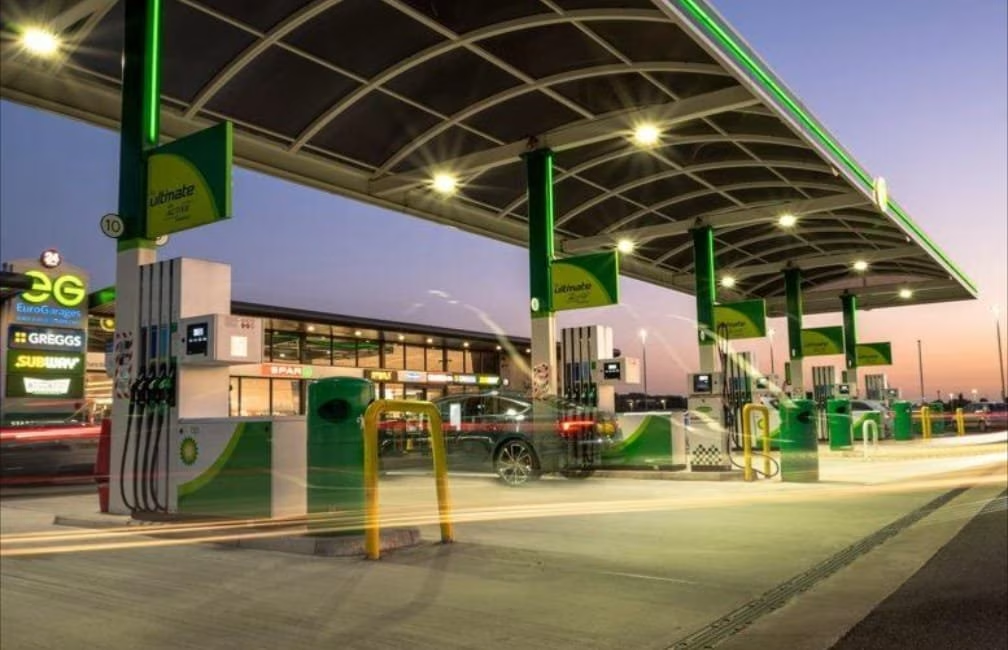
Zuber Issa has agreed to buy 85 petrol stations from the collapsed Prax Group, a deal that underlines two stubborn truths about modern Britain: fuel retail remains a cash-generating business even as ministers talk up the end of the internal combustion engine, and distress elsewhere in the supply chain can still produce bargain opportunities for the best-capitalised operators.
The acquisition will take Issa’s EG On The Move to 285 forecourts, a striking expansion for a business launched only three years ago. It also extends a familiar arc in the Issa story. The brothers, Zuber and Mohsin, built EG Group from a single garage in Bury in 2001 into one of Europe’s largest petrol station operators, then diversified into supermarkets with their £6.8bn takeover of Asda in 2020. Since then, the partnership has been unwinding in public view, with Zuber selling his stake in Asda in 2024 and pursuing a fresh build-up in forecourts through EG On The Move.
That renewed push has been fast and deliberate. EG On The Move, established as a separate business in 2023, has already acquired EG Group’s UK business and 98 forecourts from Applegreen. Adding 85 more sites in one move both lifts the company’s scale and shows where Issa believes value still sits: not in the wholesale production of fuel, which has become a politically sensitive and capital-hungry arena, but in the consumer-facing forecourt, where margins are increasingly shaped by coffee, food-to-go and convenience retail rather than petrol alone.
Prax’s failure is the dark mirror of that thesis. Founded by Sanjeev Kumar Soosaipillai and his wife Arani, Prax unravelled last year under mounting financial pressure. Several key companies were pushed into administration, triggering one of the biggest failures in the UK fuel supply chain in recent years. Administrators have alleged widespread financial irregularities, which Soosaipillai disputes. Whatever the outcome of those arguments, the collapse exposed how quickly leverage and operational complexity can turn a sprawling energy group into a threat to itself, particularly when funding conditions tighten and creditors lose patience.
At its height, Prax owned the Lindsey oil refinery and supplied roughly a tenth of Britain’s fuel, while running forecourts under the TotalEnergies and Harvest Energy brands. That combination of upstream assets and downstream outlets can look like vertical integration, the holy grail of energy security and margin control. In practice, it can also mean that problems in one part of the system infect the rest. Refining is brutally cyclical, subject to international crack spreads, regulatory costs and unplanned outages. Retail, by contrast, is more local, more stable and increasingly less dependent on the fuel molecule. When the group structure begins to wobble, it is the forecourts, with their visible cashflow and saleable real estate, that can become the pieces creditors most readily monetise.
For EG On The Move, the attraction is clear. The acquired sites will continue to be operated by independent commission managers, with the company pledging investment in food-to-go, electric vehicle charging, convenience retail and customer facilities. The commission model reduces the day-to-day operating burden for the owner while creating a network effect around procurement, branding and capex programmes. It can also keep local managers incentivised to drive footfall and basket size, an increasingly important metric as fuel volumes face long-term pressure from cleaner vehicles and changing driving habits.
Issa framed the deal in familiar terms, promising to work “alongside each operator” to help make every site “more effective, more competitive and even more attractive to customers”. The language is corporate, but it points to the real battle taking place on Britain’s main roads: forecourts have become mini retail parks, vying for time-poor customers who might refuel, charge a car, grab a sandwich, pick up groceries and wash the vehicle in a single stop. The winners are those able to invest across multiple categories and execute consistently at scale.
It is not just a story about one entrepreneur’s ambition. The UK forecourt sector is consolidating, and the forces behind that trend are structural. Smaller independent operators face higher financing costs, rising wage bills, volatile energy prices and the capital demands of a transition that is arriving unevenly across the country. Installing rapid EV chargers is expensive, grid connections can take time, and utilisation rates vary widely by location. Meanwhile, customers now expect decent coffee, clean loos and a shopping offer that rivals the local convenience store. Those upgrades require investment that is easier for large groups to fund and standardise.
That is why distressed assets can be particularly valuable to consolidators. Buying sites out of administration can allow a well-funded acquirer to obtain a network foothold at a lower entry price, then apply a refit playbook to lift performance. The forecourts themselves are often in prime roadside locations with established traffic patterns. The transformation is in the offer around the pumps, and in the ability to negotiate better terms with suppliers and foodservice partners.
Yet there is a tension at the heart of every forecourt acquisition in 2026: electric cars are rising, and the government’s broader direction of travel is clear, even if the policy path has been revised more than once. For investors, the question is not whether petrol demand will fall, but how quickly, and what replaces it in the economics of a site. Forecourts that fail to add alternative revenue streams risk being stranded with declining volumes and underused land. Those that invest smartly can become hubs for a different kind of mobility, where charging time becomes shopping time, and where the key metric is dwell time rather than pump throughput.
EG On The Move is explicitly betting on that adaptation. The company has talked of investing in rapid EV charging across the expanded network, as well as grocery ranges, foodservice brands and car washes. The point is not to pretend fuel is irrelevant. Petrol and diesel still pay the bills. It is to build an operation that can absorb the gradual shift in propulsion without collapsing its cash generation. A forecourt with a strong shop and food offer is, in effect, a convenience store with a forecourt attached, and convenience retail is an industry that has proved resilient even in a cost-of-living squeeze.
The Prax deal also lands at a moment when the Issa brothers’ earlier creation, EG Group, is taking on a new chapter. The former EG Group forecourt business, now operating under the Cumberland Farms name, has confidentially filed for a New York stock market listing that could value it at about $9bn. The figure is striking, not least because it suggests that global capital markets still attach a premium to scale in fuel retail, despite the EV transition. A listing is expected to crystallise shareholdings worth around $2.3bn each for the Issa brothers, further entrenching them among Britain’s wealthiest entrepreneurs.
That prospective flotation provides useful context for Zuber Issa’s current strategy. Public markets have a habit of rewarding predictable cashflows, clear capex narratives and the sense of a business positioned for a definable future. A well-run forecourt chain can tell that story: stable sites, measurable refurbishments, growing non-fuel margins, and an EV charging rollout tied to consumer demand. A messy, over-levered energy conglomerate that owns a refinery and a web of trading entities tells a different story, and one that lenders can quickly tire of. The contrast between EG’s evolution and Prax’s collapse is a lesson in where financial risk now sits in the energy economy.
Still, the ambitions of any expanding forecourt operator must be judged against practical realities. Building a network is one thing; integrating it is another. Sites acquired from a collapsed group may come with varied standards, legacy contracts and disparate customer propositions. Some will need significant refurbishment to meet modern expectations, and each upgrade brings disruption alongside cost. The pledge to invest in food-to-go and customer facilities is sensible, but execution requires not just capital, but operational discipline. In a sector where reputation can be shaped by the cleanliness of a single toilet block, brand consistency matters.
There is also the question of how the commission model plays out at scale. Keeping independent managers in place can preserve local knowledge and continuity, particularly important at sites where customer loyalty can be oddly sticky. But it also means the owner is reliant on a diverse set of operators to deliver a uniform customer experience. The challenge for EG On The Move will be to provide incentives and support while enforcing standards. The promise to work “alongside” operators is, in effect, a recognition that the value of a network is partly cultural, and that retail success is not achieved by spreadsheets alone.
Politically, the deal is a reminder that Britain’s fuel infrastructure remains essential, even as the country argues about how quickly it can decarbonise transport. The collapse of Prax was not merely a corporate failure; it shook confidence in parts of the supply chain and raised questions about oversight, resilience and the consequences of heavy debt in strategically sensitive industries. The sale of forecourts does not solve those upstream concerns, but it does ensure that consumer-facing sites continue to operate, and that investment in modernisation is more likely than if they languished under administrative uncertainty.
For Issa, the purchase looks like another step in the construction of a second act: an attempt to assemble a sizeable, modern forecourt network while the market is still fragmented and while the transition to electric mobility is creating both anxiety and opportunity. If he can upgrade sites, grow non-fuel earnings and place chargers where they will be used, the business can be positioned as a consumer services network rather than a relic of the petrol age. If he misjudges the pace of change, or overpays for assets that require more capital than anticipated, the expansion could become a test of endurance.
The transaction was advised by Cleary Gottlieb, PwC and the company’s banking partners, a reminder that even the retail end of fuel is now deeply financialised, shaped by dealmaking and the availability of capital as much as by the price on the pump. Britain’s roadside economy is being rebuilt by those with the balance sheets to take risk at moments when others cannot. Prax’s collapse has left scars across the sector. It has also handed the next set of pieces to an entrepreneur who has made a career out of assembling them.
Post Disclaimer
The following content has been published by Stockmark.IT. All information utilised in the creation of this communication has been gathered from publicly available sources that we consider reliable. Nevertheless, we cannot guarantee the accuracy or completeness of this communication.
This communication is intended solely for informational purposes and should not be construed as an offer, recommendation, solicitation, inducement, or invitation by or on behalf of the Company or any affiliates to engage in any investment activities. The opinions and views expressed by the authors are their own and do not necessarily reflect those of the Company, its affiliates, or any other third party.
The services and products mentioned in this communication may not be suitable for all recipients, by continuing to read this website and its content you agree to the terms of this disclaimer.
Related Posts


Previous Post
Next Post

