Now Reading: Google Confronts Nvidia in Escalating AI Chip Competition
-
01
Google Confronts Nvidia in Escalating AI Chip Competition
Google Confronts Nvidia in Escalating AI Chip Competition
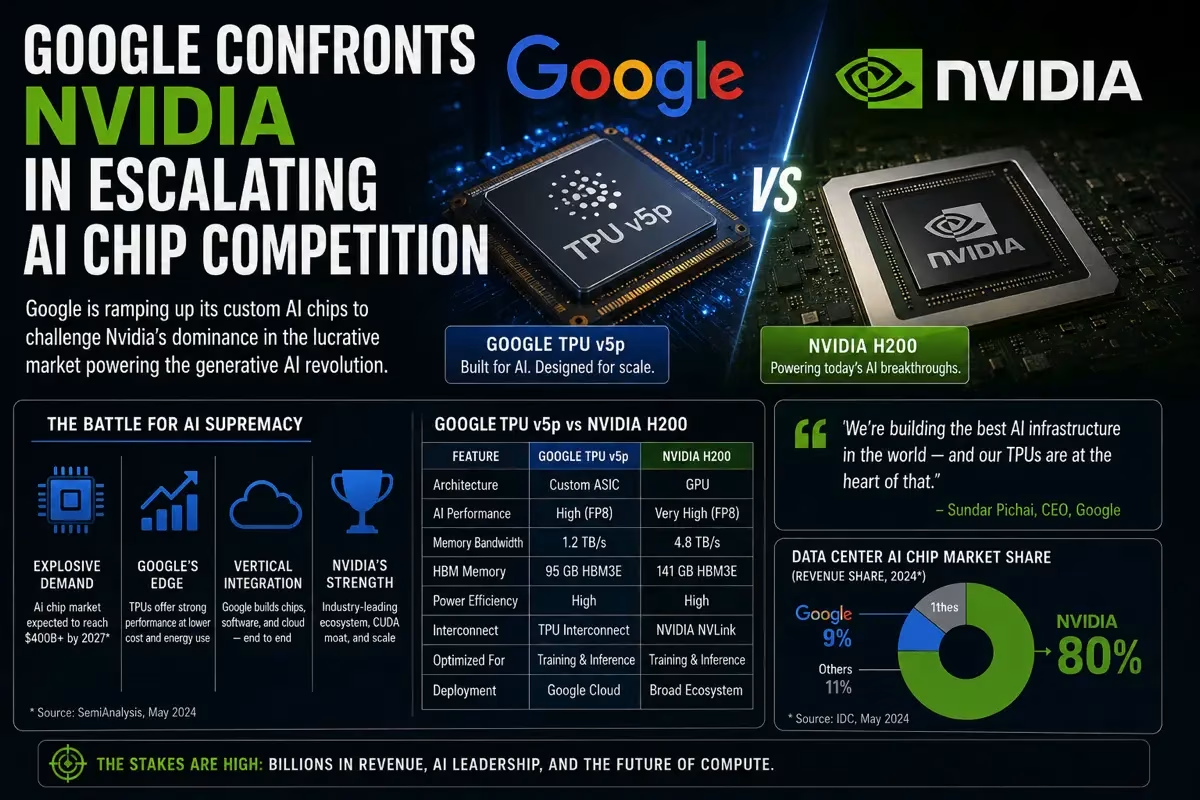
Alphabet Inc is intensifying efforts to challenge Nvidia Corporation’s dominance in the artificial intelligence chip sector through strategic commercial arrangements designed to expand adoption of its Tensor Processing Units beyond internal operations.
According to exclusive reporting from The Information’s Amir Efrati, the search giant has initiated discussions with specialised GPU cloud providers, commonly referred to as neo-clouds, many of which originated as cryptocurrency mining operations. Whilst hundreds of such firms exist, approximately half a dozen command significant market influence, and Google has approached these key players regarding integration of TPUs into their infrastructure offerings.
The company’s proposition centres on two principal arguments. First, adoption of TPUs would reduce dependence on Nvidia as a single supplier. Second, Google contends that its chip architecture has remained more consistent across generations, contrasting with Nvidia’s approach of implementing substantial architectural changes with each new release. These frequent modifications create considerable deployment challenges for data centre operators managing hardware installation and maintenance.
The competitive landscape is increasingly characterised by financial engineering rather than purely technical performance metrics. Nvidia has historically leveraged its balance sheet to support major customers, and Google is reportedly considering similar tactics. The company is exploring backstop arrangements with lenders, under which it would guarantee payments should businesses that finance TPU purchases fail to secure tenants or secondary buyers for the hardware.
Google possesses a structural advantage in this regard. Unsold or underutilised TPUs can be redirected into the company’s own cloud infrastructure, whereas Nvidia lacks a cloud operation of comparable scale to absorb surplus inventory. The logic extends to a joint venture with Blackstone aimed at establishing a TPU-based cloud provider.
Tensions have reportedly emerged, with suggestions that Nvidia became aware of Google’s engagement with neo-cloud provider Nscale and may have responded with additional commercial incentives to discourage TPU adoption. Nscale has publicly disputed this characterisation. Jensen Huang, Nvidia’s chief executive, is said to monitor Google’s semiconductor programme closely and views the company as a substantial competitive threat.
The rivalry exists within a framework of mutual dependence. Google remains among Nvidia’s largest customers, procuring GPUs at scale for cloud services offered to external clients. The company currently requires Nvidia’s supply capacity as much as Nvidia values the revenue stream.
Google’s external TPU business has nevertheless gained meaningful momentum. Anthropic, Apple and Meta are among confirmed clients, with Meta representing a particularly significant customer relationship.
Manufacturing capacity represents the next critical constraint. TSMC serves as the primary production bottleneck through which all advanced chip designs must pass. Google secures its manufacturing allocation through Broadcom as an intermediary. Production capacity for 2027 is currently being allocated, and the volume awarded to Google will signal TSMC’s assessment of TPU viability relative to competing demands from Nvidia and other clients.
The implications extend beyond semiconductor competition. With individual gigawatt-scale data centres requiring capital outlays between 50 billion and 60 billion US dollars and rising, the companies capable of guaranteeing such expenditure will fundamentally shape the infrastructure underpinning the artificial intelligence economy.
Post Disclaimer
The following content has been published by Stockmark.IT. All information utilised in the creation of this communication has been gathered from publicly available sources that we consider reliable. Nevertheless, we cannot guarantee the accuracy or completeness of this communication.
This communication is intended solely for informational purposes and should not be construed as an offer, recommendation, solicitation, inducement, or invitation by or on behalf of the Company or any affiliates to engage in any investment activities. The opinions and views expressed by the authors are their own and do not necessarily reflect those of the Company, its affiliates, or any other third party.
The services and products mentioned in this communication may not be suitable for all recipients, by continuing to read this website and its content you agree to the terms of this disclaimer.
Related Posts


Previous Post
Next Post