Now Reading: NHS to use AI on its app to direct patients to appropriate services
-
01
NHS to use AI on its app to direct patients to appropriate services
NHS to use AI on its app to direct patients to appropriate services
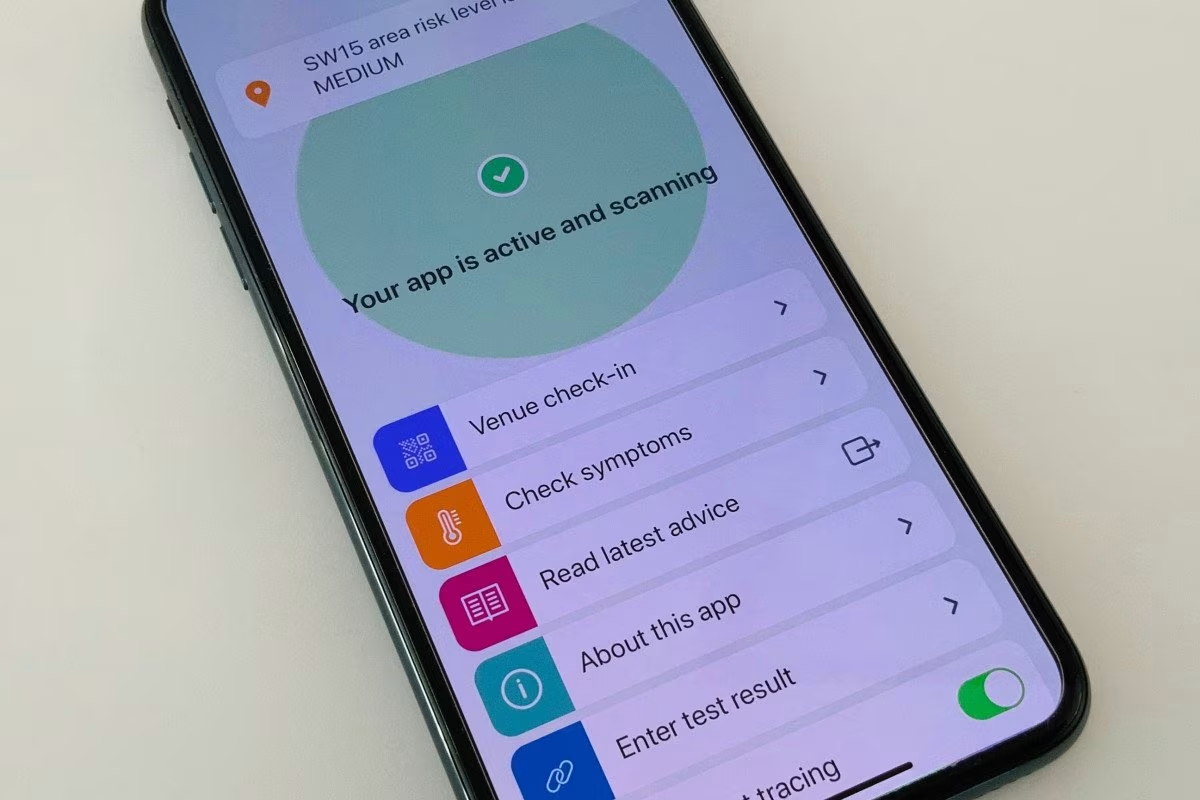
The NHS’s next attempt to tame demand begins, as so many modern reforms do, with a smartphone. Ministers and NHS England have confirmed that the NHS App will begin using artificial intelligence to triage patients and steer them towards the most appropriate service, including GP appointments, pharmacies or accident and emergency departments. The update is due to reach about 200,000 patients in England over the next year, with universal availability promised by April 2028.
On paper, the proposition is straightforward: replace the daily ritual of patients competing for scarce same day appointments with a guided route into care, informed by symptoms and risk. In practice, it asks the public to trust a new gatekeeper at the front door of general practice, and it asks clinicians to accept that a portion of their workload can be reduced not by adding staff, but by improving the accuracy and speed of the sorting process.
This initiative sits within a much larger political claim: that technology, properly funded and properly deployed, can release capacity across a health service that has become accustomed to rationing by waiting. The government has placed the app upgrade within a £10bn package to overhaul NHS technology and data systems, promising gains in efficiency and a reduction in administrative burden. The political prize is obvious. Ending the so called 8am scramble for same day GP appointments was presented as a central Labour manifesto promise before its 2024 election victory. A digital queue, ministers hope, will feel less like a queue at all.
The immediate evidence offered to support the change comes from a trial at Wealden Ridge Medical Partnership, which runs surgeries across Sussex. There, the government says, deploying the technology led to a 29% fall in the number of patients queueing for a GP appointment on phone lines. If that figure holds up beyond a pilot, it points to something important: not merely that patients are willing to use digital entry points, but that a meaningful share of demand may be redirected away from the most expensive and scarce parts of the system, at least at the moment of contact.
Yet a fall in phone queues is not the same as a fall in need, and it is not automatically a fall in clinician workload. Some of what disappears from a telephone line can reappear as online messages that still require processing and clinical review. A triage tool can shorten the first conversation while lengthening the second, especially if staff feel compelled to verify outputs, correct categorisations, or protect themselves against the risk of missing a serious condition. Efficiency gains in health care rarely arrive as a neat subtraction problem; they often move work around, change who does it, and alter the timing.
The same dynamic is visible in the other AI use case being advanced alongside the app triage: automated recording of consultations. Officials have framed this as a means of reducing the time clinicians spend typing notes. A trial led by Great Ormond Street hospital across nine sites in London is said to have found that staff spent 25% more time interacting with patients when using the tool. That claim, too, is plausible. Anyone who has watched a consultation punctuated by screenwork can see why. The question is where the labour goes next: into checking transcripts, correcting errors, and ensuring that a clinically defensible record exists, or into genuinely reclaimed time that can be redirected to care.
James Murray, the health secretary, has argued that technology will help get patients to the right care faster, free clinicians from paperwork, and drive down waiting times. The rhetoric is familiar, and not wholly unwarranted. The NHS has long suffered from fragmented IT, duplicated data entry, and a patchwork of digital maturity. It is difficult to build a 21st century service on systems that cannot easily share information, measure performance, or support modern workflows.
What is less clear is whether the current wave of AI tools, marketed as triage engines and ambient scribes, can do the heaviest lifting. The value of AI in healthcare is real, but its most reliable gains are often narrow: faster coding, better search, decision support in specific domains, and administrative automation where the stakes are lower than a clinical diagnosis. The risk with public policy announcements is that the language of transformation outruns the reality of deployment. For patients stuck waiting for a call back, a promise of an AI powered future by 2028 may land as distant reassurance rather than practical relief.
Health leaders have been careful to endorse the intent while warning about the assumptions. Lynn Woolsey, the Royal College of Nursing’s chief nursing officer, described the rollout as an important step in upgrading technology, but said there were warnings to heed, including concerns about overstated and overly optimistic assessments of productivity benefits from AI. She also noted the possibility that such systems could increase bureaucracy if staff must correct flawed or inaccurate work, and emphasised the need to reassure patients that tools handling information, including ambient voice technology, protect confidentiality.
Her caution reflects an uncomfortable truth about clinical settings: an AI that is right most of the time can still be costly if it is wrong in unpredictable ways. Clinicians are trained to live with uncertainty, but they are also trained to notice the unusual detail, the absence of a key symptom, the mismatch between what a patient says and what they mean. Triage is not simply categorising text. It is understanding people in context, including the way illness presents differently across age groups, cultures, and levels of health literacy. If an algorithm errs, it may do so systematically, and the consequences are not evenly distributed.
Tim Horton, deputy director of policy at the Health Foundation, called the announcement a positive recognition of the sustained investment needed to transform the NHS, while arguing that it must be part of a broader blueprint for reshaping how care is delivered. His warning was that without a wider strategy the NHS risks piecemeal adoption, struggling to achieve benefits at scale. That is an institutional diagnosis rather than a technical one. The NHS is large enough to pilot almost anything; it is not always structured to learn quickly, standardise sensibly, and retire systems that do not work.
The government’s £10bn figure is intended to signal seriousness, but spending is only the beginning. Technology programmes fail when procurement rewards glossy promises, when implementation is forced into timelines that do not match operational reality, or when frontline staff are expected to absorb change without time, training and ongoing support. A triage tool is not simply an app update; it is a redesign of access pathways, a reallocation of administrative roles, and potentially a shift in clinical risk. A consultation recording tool is not simply convenience; it changes documentation practices and raises questions about ownership, retention and use of recordings or transcripts.
These questions quickly become questions of trust. For triage, the patient must be confident that their symptoms will be understood and that the route suggested is safe. For clinicians, there must be clarity over responsibility. If a patient is directed away from an appointment they believe they need, or away from urgent care, the system must have a defensible explanation for that decision. The NHS has already seen warnings about legal exposure where AI tools contribute to mistakes, and the basic issue is not novel: when a tool influences clinical decisions, accountability cannot be outsourced to software.
Privacy is the other pillar of trust. The NHS holds some of the most sensitive data in British public life, and it has learned, through controversy, that public consent is fragile. AI driven triage requires capturing symptom information in a way that can be processed, possibly at scale, and possibly by vendors whose business models are shaped by data. Consultation recording tools raise even sharper concerns, because a spoken interaction can contain details that rarely appear in structured notes: family problems, fears, offhand remarks, and information offered in confidence. Patients may accept note taking as a clinical necessity; they may feel differently about a microphone capturing the room, even if the intent is benign.
Then there is the persistent question of digital exclusion, raised again by Pritesh Mistry at the King’s Fund. The promise of making care more convenient and empowering, digitally or physically, will fail if services become increasingly reliant on technology without a reliable alternative. Digital first can become digital only by inertia. In some communities, smartphones are shared, data plans are limited, and private space is scarce. In others, disability, language barriers, or simple unfamiliarity with apps makes digital access harder. A system that quietly shifts the default away from phone and walk in options risks widening disparities under the banner of modernisation.
Ciarán Devane, chief executive of the NHS Alliance, has also pointed to a practical issue that often decides the fate of national programmes: how investment translates into real support for local leaders. He argued for maximising local discretion to invest in technologies that fit local populations, while also asking for clarity on what will be mandatory and what expectations will be placed on organisations. He warned, too, against a familiar pattern in which capital budgets are squeezed for savings, leaving technology programmes underfunded precisely when they are most needed.
The tension between national standardisation and local flexibility is not administrative trivia. If every area chooses a different triage tool, learning is slower and integration harder. If a single system is imposed everywhere, it may fit nowhere particularly well, and local innovation can be stifled. The NHS app is one of the few truly national platforms available, which gives it reach and recognisability. That reach also raises the stakes of any error, bias or design flaw, and it magnifies the importance of careful testing, transparent evaluation, and routes for feedback that lead to rapid improvements.
What will matter most to patients is less the presence of AI than the experience it produces. If the app helps someone with an uncomplicated condition reach a pharmacist quickly, that is a win. If it guides someone with worrying symptoms towards urgent care without delay, that is a win. If it tells a patient to seek a GP appointment but none are available for weeks, the intelligence at the front end will feel cosmetic. The promise to end the morning scramble is ultimately a promise about capacity, not software. Technology can make scarce appointments easier to allocate; it cannot conjure them.
There is, nonetheless, a plausible route to meaningful improvement. A substantial share of contacts with general practice relate to minor illness, medication queries, and administrative requests that do not always require a GP. Better routing could strengthen the role of pharmacists and other clinicians, encourage self care where appropriate, and protect GP time for complex cases. Done well, triage can also improve safety by spotting red flags and standardising the first questions asked. Done poorly, it can add friction and increase repeat contacts as patients learn to work around it.
One of the more delicate consequences may be the effect on the relationship between patient and practice. For decades, access has been mediated by receptionists, often unfairly blamed for rationing decisions they did not create. AI triage shifts some of that mediation into an opaque logic engine. The frustration may not disappear; it may simply lose its human face. That can reduce conflict for staff, but it can also make the system feel less accountable, especially to those already sceptical of remote and algorithmic decision making.
The government’s timeline, reaching full availability by April 2028, suggests an awareness that scaling safely will be slow. That caution is wise, but it also implies that the policy is being asked to carry political expectations long before the whole country experiences the benefits. The next year, reaching 200,000 patients, will therefore be critical: not only for performance metrics, but for the public narrative that will form around early experiences. If the first wave is marked by errors, confusion or poor integration with local services, scepticism will harden. If it is accompanied by clear communication, robust safeguards and visible improvements in access, the NHS app may become a rare example of technology that feels like an upgrade rather than an imposition.
For now, the announcement reads as an opening move in a longer contest between demand, workforce constraints and public patience. AI may be a tool worth using, but it is not a substitute for the hard choices that shape primary care: staffing, continuity, funding, and the balance of responsibilities across the wider system. The test for the NHS will be whether it can deploy these tools with enough rigour to earn trust, and with enough humility to admit where the evidence is thin and the risks are real.
Post Disclaimer
The following content has been published by Stockmark.IT. All information utilised in the creation of this communication has been gathered from publicly available sources that we consider reliable. Nevertheless, we cannot guarantee the accuracy or completeness of this communication.
This communication is intended solely for informational purposes and should not be construed as an offer, recommendation, solicitation, inducement, or invitation by or on behalf of the Company or any affiliates to engage in any investment activities. The opinions and views expressed by the authors are their own and do not necessarily reflect those of the Company, its affiliates, or any other third party.
The services and products mentioned in this communication may not be suitable for all recipients, by continuing to read this website and its content you agree to the terms of this disclaimer.
Related Posts


Previous Post
Next Post