Now Reading: Issa brothers plot $9bn float for US petrol station chain
-
01
Issa brothers plot $9bn float for US petrol station chain
Issa brothers plot $9bn float for US petrol station chain
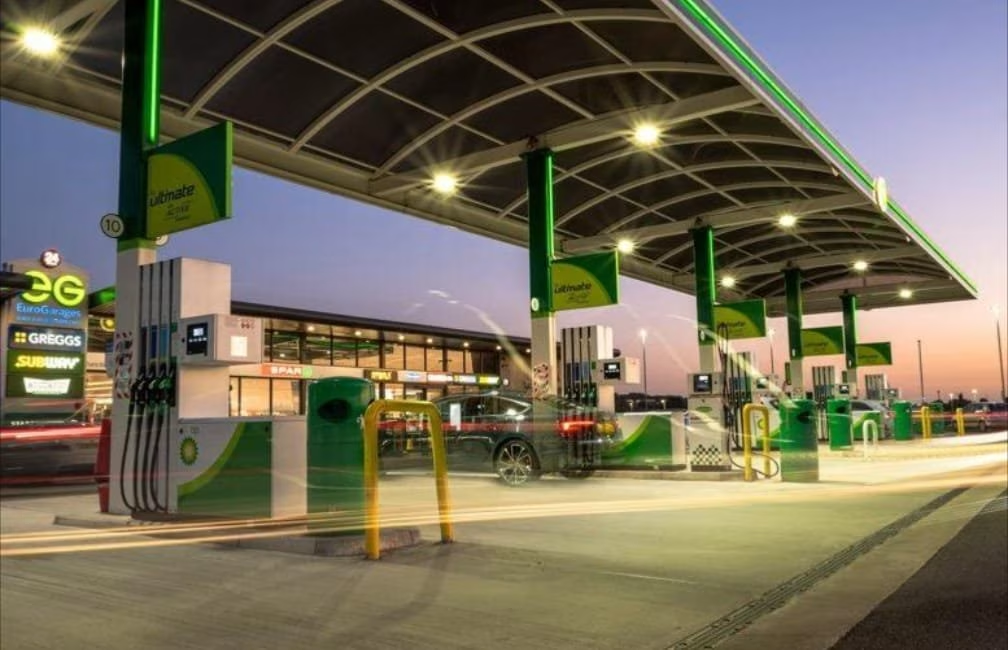
A decade ago, the Issa brothers were the sort of businessmen whose success was most easily measured in forecourts acquired and geography conquered. Now they are preparing for a different kind of reckoning: one administered by public investors, quarterly disclosures and the cool, unromantic arithmetic of a New York listing. Mohsin and Zuber Issa, the Blackburn-born siblings who built a sprawling fuel and convenience empire from a single petrol station in Bury in 2001, have filed confidentially with the US Securities and Exchange Commission for a flotation of Cumberland Farms, the American business that has become the public face of what was once known as EG Group.
If the contemplated valuation of about $9bn (£6.6bn) holds, it would not simply be another milestone in a long run of acquisitive ambition. It would crystallise wealth on a scale that is hard to overlook in Britain’s contemporary business landscape: shareholdings potentially worth around $2.3bn each for the brothers, and an opportunity for their private equity partner, TDR Capital, to begin stepping back from an investment that has been both lucrative and politically conspicuous. It is also a wager that US public markets will reward a business model that, for all its everyday mundanity, still sits at the junction of two of the biggest consumer habits in the West: refuelling and buying food on the move.
The company says it intends to list on the Nasdaq under the ticker “CMBY”. It has not yet disclosed the size or pricing of the offering, and the confidentiality of the filing allows the group to test investor appetite away from the scrutiny and volatility that can derail a deal before it begins. Yet the direction of travel is unmistakable. After years spent untangling a complex global footprint and paring back debt, Cumberland Farms is positioning itself as a US-centric, convenience-led retail business that happens to sell fuel. That framing matters, because in American capital markets, fuel retailers are not judged solely on the margins from petrol. They are judged on the steadier economics of coffee, snacks, prepared food and the ability to turn a routine stop into a high-frequency retail relationship.
For the Issas, the shift towards America is both strategic and symbolic. When they bought Cumberland Farms in 2019, the asset offered more than a cluster of sites in New England. It offered an established regional brand with customer familiarity and a culture of convenience retail, a field in which the United States has long been more sophisticated than Britain. This year the wider business adopted the Cumberland Farms name, and in the US the chain’s colloquial nickname, “Cumby’s”, has done what no corporate rebrand can do on its own: it has rooted the business in the vernacular. If the Issas are looking for a language in which to tell their story to Wall Street, that kind of local texture is an advantage.
The story they will tell begins, as these stories often do, with thrift, hustle and a fortunate sense of timing. Two brothers buying one petrol station in Greater Manchester is not, on its own, a tale that predicts a multinational empire. But the Issas understood early that the forecourt, often dismissed as a low-growth, low-glamour corner of the economy, is in fact a platform. It is real estate on commuter routes, an unplanned meeting point between consumer and retailer, and a place where the captive economics of proximity can turn small purchases into enduring profitability. Their company, which started as Euro Garages and later became EG Group, grew by rolling up fragmented operators across Europe, the US and Australia, in an era when cheap debt made scale feel almost inevitable.
That era also created its own logic, and its own hazards. Easy money encourages ambition, but it can also disguise fragility. The group’s acquisition-led expansion left it with a balance sheet that investors will scrutinise closely. Cumberland Farms reported revenues of $24.2bn in 2024, a figure that signals size and operational heft, but it also reported net debt of $5.3bn. Those numbers are not unusual for a business built through leverage and consolidation, yet they are precisely the sort of figures that change character when a company moves from private ownership to public accountability. In public markets, debt is not merely a financing tool. It is a story about resilience, vulnerability and the capacity to endure a downturn without sacrificing investment in sites, staff and systems.
Reports have suggested the flotation could raise as much as $1bn, with most of the proceeds used to strengthen the balance sheet rather than deliver a dramatic cash windfall for existing shareholders. That is the language of preparation, not celebration. It signals a business that knows the terms under which it will be judged: leverage reduced, complexity simplified, and the investment case made legible. It also suggests that the Issas and TDR, who own 25pc each and 50pc respectively, recognise that the most valuable thing an IPO can buy is credibility. A company that arrives at market promising discipline is more likely to be rewarded than one that arrives promising a payday.
The lead-up to the filing has been dominated by restructuring decisions designed to make the group easier to sell, and easier to value. In particular, the disposal of UK forecourts and convenience stores to Asda removed a set of operations that, while familiar to British readers, could muddy a US investor pitch. Those sites were later transferred into EG On The Move, a separate forecourt business controlled by Zuber Issa. The practical effect is that Cumberland Farms can present itself as increasingly American in focus, with European complexity diminished, and with a brand identity that is not tied to the Issas’ more controversial and politically charged UK retail exposure.
That UK exposure is inseparable from the Issas’ modern reputation. Their £6.8bn takeover of Asda in 2021, undertaken alongside TDR Capital, was the moment their business ceased to be an entrepreneurial curiosity and became a national talking point. Asda is not merely a supermarket chain. It is an institution in many towns, an employer, a symbol of price competition, and a proxy battleground for debates about debt, dividends and the responsibilities of ownership. The Issas became custodians of a business with millions of weekly customers and intense public scrutiny, and they did so using a financing structure that placed leverage at the centre of the story.
The brothers have since moved on in different ways. Mohsin Issa remains a minority shareholder in Asda. Zuber Issa sold his stake in 2024, a divergence that signalled more than a routine portfolio adjustment. It marked the gradual unwinding of a partnership that had been unusually tight even by family-business standards. Zuber also stepped down as co-chief executive in 2024, though he remains a director. In corporate Britain, such transitions are often wrapped in the language of succession planning. In reality, they can represent an attempt to separate interests, reduce shared risk and create distinct spheres of control. The emergence of EG On The Move under Zuber’s control, alongside a US flotation under the Cumberland Farms name, reads as a business empire reorganising itself into clearer, more personal territories.
For investors, the fraternal dynamic will matter less than the operational one, yet governance questions rarely stay outside the valuation. Public markets like clarity: who runs what, who decides strategy, and how conflicts are managed when founders’ interests diverge. If the Issas are no longer operating as a single unit, the structure around Cumberland Farms will need to show that the business is not hostage to family physics. Wall Street has seen enough founder-led companies to understand both the strengths and weaknesses of concentrated control. A convenience retailer selling fuel is not a technology company, but the disciplines of transparency and independent oversight are the same.
There is, too, the question of why New York, and why now. London has long complained of losing high-profile listings to the US, a drift accelerated by valuations, liquidity and the sheer depth of American capital. Yet Cumberland Farms is not a British consumer brand seeking a tech multiple. It is, increasingly, a US business, and choosing the Nasdaq is an acknowledgement that the most natural pool of investors for a convenience-led forecourt operator sits in America, where the comparable companies, analyst expertise and retail culture are entrenched. A US listing also offers a form of narrative alignment: an American brand on an American exchange, telling an American story, even if the founders’ accents and origins remain resolutely Lancashire.
The business case will hinge on what Cumberland Farms represents in an economy where the future of fuel is not as assured as it once was. Petrol stations are, on paper, threatened by electric vehicles and the gradual electrification of transport. Investors will ask how many years of reliable fuel demand remain, and what happens to forecourt economics when pumps are used less frequently or require longer dwell times. The answer is not simply to point to current volumes. It is to argue that forecourts are evolving into convenience hubs, and that electrification, while disruptive, can also create new retail patterns. A driver charging for 20 minutes is a customer who might buy coffee, food and essentials, provided the site is designed for it.
That is where the Issas’ history of operational pragmatism becomes relevant. Their success was never built on fuel margins alone. It was built on understanding that the forecourt is a place where brand partnerships, food-to-go, and rapid service can produce robust returns. In Britain, many petrol stations look like an afterthought to the road. In parts of America, they are miniature supermarkets, and Cumberland Farms sits closer to that model. The challenge is that upgrading sites, building charging infrastructure, and improving the offer requires capital and patient execution. A flotation that strengthens the balance sheet is therefore not merely financial housekeeping. It is a prerequisite for adaptation.
The scale of the footprint, more than 3,200 sites across the United States and Europe, provides both an advantage and a burden. A large network offers purchasing power, brand leverage and operational data. It also requires relentless maintenance and continuous reinvestment. Public investors can be supportive of that discipline when the story is coherent, but they can turn hostile when they sense drift. The Issas’ promise, implicit in the refocusing on Cumberland Farms and the reshaping of the group, is that the business now has a simpler centre of gravity. The sites, the brand and the growth narrative are increasingly in one country, under one name, with a clearer set of peers.
For TDR Capital, which owns half the business, the IPO is a familiar moment in the private equity lifecycle. It is the step from ownership to partial exit, from control to realisation. Yet it may not be a quick departure. If much of the proceeds go into the company rather than to selling shareholders, the listing may function as a staging post: establishing a market price, improving financial flexibility, and creating a route for gradual sell-down over time. That is often how these deals work when leverage is meaningful and when the business still has an investment programme to fund.
For the Issa brothers, the flotation is less about exit than about transformation. Their ascent was built on private deals and aggressive acquisitions, executed with a speed that public markets rarely tolerate. A listed Cumberland Farms would require a different tempo and a different kind of restraint. It would also, in a more personal sense, offer a form of permanence. Private wealth can feel theoretical until it is priced every day on a screen. If the valuation lands where advisers hope, the Issas will have crossed a threshold from successful operators to globally visible capitalists, their fortunes directly linked to the judgement of American investors.
The irony is that the product at the heart of the story remains stubbornly ordinary. Most customers will never think of share registers or SEC filings as they pull in for fuel, coffee or a sandwich. Yet the ordinariness is precisely the point. In a world of volatile technology narratives and fashion-driven investment themes, the appeal of a cash-generative convenience business can be its predictability. The Issas’ task is to persuade the market that their company can remain predictable while the underlying transport economy changes, and that the discipline they have shown in simplifying operations is not a temporary pre-IPO pose, but the start of a more durable corporate character.
If they succeed, the listing will read as the culmination of a very British entrepreneurial story that has quietly become an American one: two brothers from Lancashire, raised in a country that still argues about the legitimacy of wealth, choosing New York as the place to measure what they have built. The final valuation will depend on timing, sentiment and the fine detail of the prospectus. But the larger question is already answered by the filing itself. The Issa era of building in private, on borrowed money and through constant acquisition, is giving way to an era in which the same empire must justify itself in public, in plain numbers, to an audience that has no reason to indulge nostalgia for the Bury petrol station where it began.
Post Disclaimer
The following content has been published by Stockmark.IT. All information utilised in the creation of this communication has been gathered from publicly available sources that we consider reliable. Nevertheless, we cannot guarantee the accuracy or completeness of this communication.
This communication is intended solely for informational purposes and should not be construed as an offer, recommendation, solicitation, inducement, or invitation by or on behalf of the Company or any affiliates to engage in any investment activities. The opinions and views expressed by the authors are their own and do not necessarily reflect those of the Company, its affiliates, or any other third party.
The services and products mentioned in this communication may not be suitable for all recipients, by continuing to read this website and its content you agree to the terms of this disclaimer.
Related Posts


Previous Post
Next Post