Now Reading: Trump’s fossil-fuel revival and the climate politics Europe can no longer ignore
-
01
Trump’s fossil-fuel revival and the climate politics Europe can no longer ignore
Trump’s fossil-fuel revival and the climate politics Europe can no longer ignore
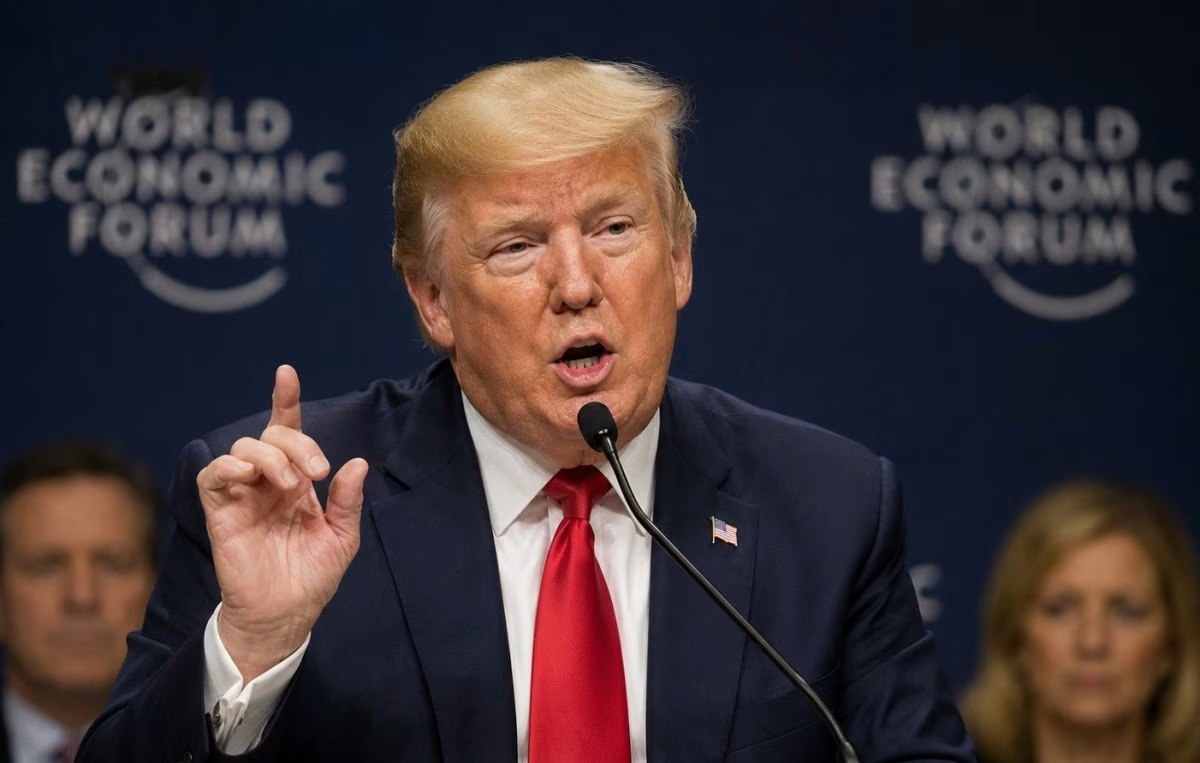
Donald Trump’s preference for fossil fuels over green energy has long been plain, but the latest signs from Washington suggest something more than a rhetorical flourish. What was once dismissed in Europe as an American culture war has become a structural political and industrial challenge, one that reaches from energy policy to manufacturing strategy, from trade to the broader question of how Western economies intend to grow in a carbon-constrained world.
For Europe, the problem is not simply that Trump is hostile to net zero ambitions. It is that his return to the global stage, and the influence he exerts over Republicans, has helped normalise a politics in which climate policy is framed not as an investment in resilience but as an ideological indulgence. That may play well to voters who are suspicious of higher bills and bureaucratic sermons, yet it leaves policymakers on this side of the Atlantic facing a harder and more immediate question: how to sustain industrial competitiveness when one of the world’s largest economies is retreating from the transition altogether.
The most immediate effect is psychological, but psychology matters in markets and in boardrooms. For years, Europe’s political class has insisted that the green transition is both morally necessary and economically advantageous. The argument has not been without merit. Investment in renewables, electric vehicles, grid infrastructure and cleaner industrial processes has created jobs, stimulated innovation and reduced dependence on imported fossil fuels. But the pace of that transition has also exposed a fragility. It depends on cheap capital, stable regulation and, above all, confidence that governments will stay the course. When Washington signals that the opposite is not only possible but likely, confidence begins to wobble.
Trump understands this instinctively. His politics are not built on consistency but on grievance, symbolism and a sharp reading of the anxieties of working-class and middle-income voters. Fossil fuels remain central to that appeal because they stand for a kind of material certainty. Oil, gas and coal are familiar, geographically anchored and associated with employment in places that feel neglected by metropolitan elites. Green energy, by contrast, is often presented in language that sounds technocratic, moralising or remote. The result is a narrative in which climate policy becomes easier to attack than to defend.
That framing has consequences beyond the United States. European leaders have spent the past decade treating the energy transition as a source of strategic advantage. They argued that early action would give the continent an industrial edge in batteries, wind turbines, heat pumps and low-carbon materials. Some of that has happened. But the scale of Chinese manufacturing, the volatility of subsidy regimes and the patchy delivery of European infrastructure have made the race far more complicated than the original political rhetoric suggested. Now Trump’s message adds a further complication by undermining the international consensus that once gave green investment some of its momentum.
The danger for Europe is not that it abandons climate policy altogether. That is not likely, nor is it politically feasible in most member states. The real risk is more subtle. Governments may continue to profess commitment to net zero while quietly diluting the measures needed to achieve it. That process is already visible in the growing gap between ambitious targets and weak implementation. Planning delays, grid bottlenecks, resistance to onshore wind, arguments over EV mandates and disputes about the cost of heating reforms all point in the same direction. Public support for action on climate remains broad in principle, but it is conditional and increasingly brittle when translated into household expense.
This is where Trump’s political style proves so effective. He does not need to win the argument on scientific merit. He only needs to convert climate policy into a symbol of elite detachment. In that sense, his disdain for green energy is not merely a policy preference but a cultural weapon. It allows him to cast environmental regulation as a burden imposed by people who will not themselves pay its costs. Europe is especially vulnerable to this kind of attack because its own politics are haunted by similar suspicions. The yellow vest protests in France, the farmer demonstrations against environmental rules and the recurring backlash against fuel taxes all illustrate how quickly climate policy can become a proxy for resentment.
Yet it would be a mistake to treat Trump’s position as an unmitigated setback for Europe. In some respects, it may force a useful reckoning. For too long, parts of the continent’s political establishment have spoken about decarbonisation as though the moral case were self-executing. They have underestimated the need for industrial strategy, infrastructure delivery and political candour. If voters are asked to shoulder costs in the present in exchange for benefits promised later, they will demand a clear account of who pays, who gains and what happens if the promised gains arrive too slowly. That is not climate denial. It is democratic realism.
The industrial consequences are already becoming apparent. European carmakers, once confident that they could make the transition to electric vehicles on their own terms, now face a more hostile global market than they expected. Chinese rivals have advanced rapidly in scale, cost and technology, while American policy under Trump has become less predictable and more protectionist. In that environment, European manufacturers are squeezed from both sides. They must invest heavily in new technologies while also confronting weaker consumer demand, higher energy costs and uncertainty about regulatory direction. The result is a dangerous squeeze on margins and employment.
There is also a deeper strategic irony. Many European politicians have argued that climate policy would strengthen the continent’s independence from external shocks, whether from Russian gas, Gulf oil or volatile global markets. That remains true in principle. But independence is not achieved simply by declaring targets. It requires a functioning industrial base, abundant low-carbon power and enough political coherence to sustain investment over decades. Without those things, the transition becomes another form of dependence, this time on imported technology, subsidised supply chains and state support.
Trump’s broader worldview also matters. His preference for fossil fuels is tied to a suspicion of multilateralism and a belief that economic competition is best won through unilateral advantage rather than coordinated restraint. That has implications well beyond energy. It reinforces a global environment in which countries are encouraged to prioritise immediate self-interest over collective risk management. In such a world, climate action becomes harder because it is inherently cross-border. Carbon emissions do not respect national ambition, and the cost of delay in one country can be amplified by inaction in another.
European leaders know this, of course, but they are constrained by domestic politics. In Britain, the debate has grown especially fraught. Ministers insist that net zero can be delivered without punishing households, yet they remain vulnerable to criticism that the costs are being pushed onto consumers while the benefits are uncertain or distant. The politics of energy prices have become even more delicate since the inflation shock of recent years. Any perception that climate policy is adding to bills is exploited ruthlessly by opponents who are happy to conflate the price of decarbonisation with the failings of government more generally.
That is why Trump’s ascent, and the language surrounding it, matters in London as much as in Brussels. It offers cover to those who want to slow the transition and ammunition to those who argue that the entire enterprise is elitist overreach. But it also exposes a weakness in the pro-green case, which has sometimes been overly reliant on aspiration and too hesitant about trade-offs. The public can accept difficulty when they believe the outcome is real, fair and shared. They resist it when policy appears improvised, costly and imposed from above.
There remains, however, a strong practical case for the transition that Trump’s politics cannot erase. Fossil fuels are exposed to geopolitical shocks, price volatility and long-term depletion. They tie consumer welfare to global instability in a way that cleaner domestic generation does not. Renewable power, properly integrated, can offer a more secure basis for economic planning. The challenge is to communicate that advantage in terms ordinary voters recognise. Energy independence, stable bills, cleaner air, better jobs and industrial renewal are more persuasive than moral exhortation alone.
The future of climate politics in Europe may depend on whether its leaders can make that translation. They will need to speak less like campaigners and more like stewards of a difficult national project. That means recognising the limits of public patience, the need for affordable transition pathways and the political damage caused by overpromising. It also means accepting that the contest with Trump-style fossil fuel populism will not be won by condemnation alone. It will be won only if green policy is made to work in the lives of people who do not read strategy papers and have little interest in ideological symbolism, but do care deeply about their wages, their heating bills and whether their children can find secure work.
That is the deeper significance of Trump’s assault on green energy. It is not just a rejection of climate orthodoxy. It is a challenge to the assumption that the transition will be accepted on faith. Europe can still pursue decarbonisation, and should. But it can no longer afford to pretend that the politics of doing so are benign. The task now is not to repeat the language of urgency. It is to prove, with institutions, investment and honesty, that the green economy is not a slogan but a durable model for prosperity.
Post Disclaimer
The following content has been published by Stockmark.IT. All information utilised in the creation of this communication has been gathered from publicly available sources that we consider reliable. Nevertheless, we cannot guarantee the accuracy or completeness of this communication.
This communication is intended solely for informational purposes and should not be construed as an offer, recommendation, solicitation, inducement, or invitation by or on behalf of the Company or any affiliates to engage in any investment activities. The opinions and views expressed by the authors are their own and do not necessarily reflect those of the Company, its affiliates, or any other third party.
The services and products mentioned in this communication may not be suitable for all recipients, by continuing to read this website and its content you agree to the terms of this disclaimer.
Related Posts


Previous Post
Next Post