
Now Reading: UAE’s New Port Strategy and the Global Oil Map
-
01
UAE’s New Port Strategy and the Global Oil Map
UAE’s New Port Strategy and the Global Oil Map
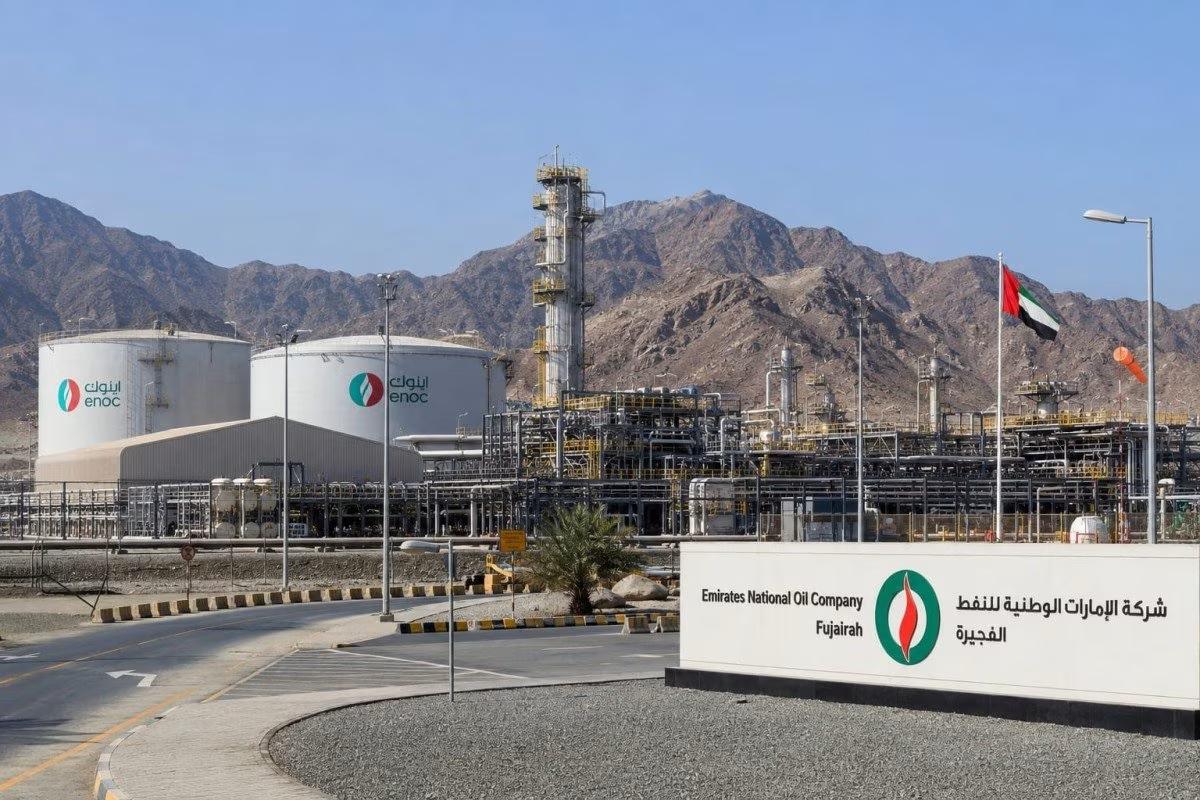
The United Arab Emirates has long prided itself on a sophisticated approach to energy policy that blends pragmatism with strategic patience. In recent years the emphasis has shifted from a narrow focus on production volumes to a broader contemplation of resilience and adaptability in the face of geopolitical risk. The latest initiative, centred on Fujairah and its eastern coastline, is more than a project of port terminals and pipelines. It is a statement about how a small but consequential player in the global energy system seeks to diversify its options in a world where chokepoints, sanctions, and conflicts can reconfigure trade routes in days rather than years. It is a move that invites scrutiny not only of UAE capacity but of the wider security architecture that underpins sea borne oil.
The idea of creating alternative routes for crude and refined products is not new. The Gulf has long been a theatre of strategic engineering, where state actors have sought to reduce exposure to a single artery that, if blocked or disrupted, can reverberate through prices and supply chains across continents. The GCC states have, at different times, pursued projects that increase their export flexibility, sometimes by expanding traditional pipelines, other times by establishing storage networks and bunkering hubs in places such as Fujairah. What distinguishes the UAE’s current strategy is the explicit linking of these physical assets to a broader belief in economic security as a national project. The aim is not merely to move more oil; it is to make the export system less vulnerable to the risks that have proven persistent in the region.
Fujairah already functions as a key node in regional logistics, offering storage capacity and refining support that complements other UAE assets. The new plans, however, are framed as a response to a specific vulnerability: Hormuz, the narrow strait whose control and security have for decades shaped the calculus of global energy markets. The strait is a reminder that the vast flows of the world’s energy can hinge on a single, relatively constrained corridor. In times of tension, rhetoric about access to energy can become an instrument of geopolitics, and the price of oil can move in response to perceived threats as much as to actual supply and demand. The Fujairah project, therefore, is not simply about capacity. It is about signalling that the UAE intends to hedge its fortunes through diversified channels that can sustain exports even when clear and present threats loom in other parts of the Gulf.
The strategic logic extends beyond the physical infrastructure. By increasing export paths that bypass Hormuz, Abu Dhabi is also seeking to diversify its risk profile in a manner that extends to partnerships, financing arrangements, and international credibility. A more dispersed export architecture is, in theory, harder to disrupt, more resilient to sanctions or blockades, and more attractive to customers who value reliability alongside price. In this light the Fujairah development can be seen as part of a broader effort to integrate the UAE more deeply into global energy governance, not merely as a producer but as a stabilising counterweight to volatility in the region. It is a role that suits a nation that often plays a quiet but crucial part in diplomacy through economic links and commercial pragmatism rather than through loud posturing or confrontation.
The technical dimensions of the project are equally consequential. The aim to augment export capacity through new port facilities, and to enhance cross border and cross seas connectivity, has to contend with the realities of weather, sea conditions, infrastructure load, and, crucially, security. The UAE sits in a region where industrial and geopolitical threats intersect, and where the threat landscape has evolved with the growth of regional rivalries, missile capabilities, and evolving drone warfare. Any plan that promises to move large volumes of crude and products must be robust against disruptions, whether from state actors, non state groups, or the hazards of supply chain fatigue. The emphasis on redundancy and diversification is therefore not simply prudent; it is essential to the credibility of a country that seeks to be both a reliable supplier and a responsible participant in regional stability.
From a market perspective, the potential impact of Emirati diversification on global oil pricing and logistics cannot be understated. Hormuz accounts for a considerable portion of the world’s oil flows, particularly from the Gulf. If more oil can be routed through alternate channels, traders and refiners gain a degree of optionality that can influence price dynamics. That said, the global oil market already operates with a high degree of interconnectedness, and the degree to which a port facility in Fujairah can meaningfully alter supply patterns depends on a range of factors. These include the rate at which additional capacity can be brought online, the efficiency of transfer and blending operations, the availability of storage for arbitrage opportunities, and the alignment of new routes with the logistics rails that already underpin the movement of crude and products to Asia, Europe, Africa, and the Americas. The market will weigh these variables with the same discernment that governs any major infrastructure decision in energy trading.
The geopolitical implications of the Fujairah project are equally complex. The Persian Gulf remains a focal point for great power competition, with a web of alliances and rivalries that shape both energy policy and security arrangements. The UAE’s posture, which includes a willingness to engage with diverse partners and to invest in capacity that improves resilience, mirrors a broader trend among Gulf states to diversify external relationships as a buffer against uncertainty. In doing so, Abu Dhabi joins a set of regional actors who understand that energy security is inseparable from political and strategic stability. The challenge lies in balancing the need for rapid, tangible progress with the risk that such high profile infrastructure could become a magnet for competition, miscalculation, or escalation. The balance between assertive policy and measured diplomacy will be critical to the long term success of any diversification initiative.
The message that flows from this initiative is as much about confidence as capability. It signals to markets and to partners that the UAE is ready to bear the costs and complexities of pursuing multiple export channels. It implies that the country believes stability and predictability in energy flows are as important to its own prosperity as growth in production. The ability to sustain exports under stress is a signal to customers that reliability can be maintained even when the traditional routes face challenges. That assurance is valuable not only in monetary terms but in the political calculus that governs international energy relationships. A reliable partner in oil markets is a partner that can be trusted to keep commitments even during periods of tension and disruption.
Yet the story is not without its uncertainties. Infrastructure projects of this scale are inherently long term and capital intensive. They can be delayed by financing constraints, supply chain bottlenecks, or shifts in regional security dynamics. In a region where political loyalties are fluid and where external events can compress or expand timelines, the risk of cost overruns, regulatory hurdles, and political pushback cannot be ignored. The capital markets will demand clarity on governance, risk management, and the ability to deliver benefits on a timeline that meets the expectations of investors and clients alike. The practical aspects of coordination with existing pipelines, storage facilities, and shipping routes will require sophisticated project management, open data, and transparent governance to reassure lenders and partners that the plan can be executed with the required precision.
In the wider context, the UAE is part of a Gulf that is slowly learning to operate with a broader sense of energy security as a collective rather than a purely national endeavour. The potential infrastructural shifts open space for new collaborations in areas such as coastal engineering, maritime safety, environmental protection, and technology transfer. They also raise questions about how regional competition might translate into new forms of interdependence, where shared interests in market stability and reliability could foster cooperation on issues such as piracy, weather risk, and cyber threats to critical energy infrastructure. The possibility exists that the Fujairah project, if implemented with a steady hand and a clear strategic focus, could become a constructive template for resilience that other producers might study and adapt.
Of course, the real test will be how the project translates on the ground. The engineers will speak in metrics and specifications, the financiers in guarantees and risk appetites, and the policymakers in the careful language of regional balance and international norms. The success will be measured not simply by the tonnage of oil redirected but by the degree to which the new infrastructure integrates seamlessly with global supply chains, supports price stability, and reinforces a sense of predictable energy governance in an era of geopolitical volatility. In that sense the Fujairah initiative is more than a technical undertaking; it is a test of the region’s capacity to convert strategic positioning into durable, credible outcomes that can withstand the shocks of a volatile energy landscape.
As the world continues to re assemble its energy map in response to changing patterns of demand and the emergence of new suppliers and technologies, the UAE’s approach offers a reminder that resilience in energy systems is achieved not through isolation but through diversification, coordination, and disciplined investment. The port and pipeline ambitions in Fujairah sit at the intersection of commerce and geopolitics, where decisions made now may influence the pace of development for years to come. If managed with candour and competence, they could contribute to a more resilient export framework that supports global energy security while reaffirming the UAE’s standing as a pragmatic, reliable operator in an increasingly complex world. The challenge will be to maintain balance between ambition and prudence, to align national aspiration with international duty, and to keep the delicate equilibrium that sustains a stable energy system in a region where the only constant is change.
Post Disclaimer
The following content has been published by Stockmark.IT. All information utilised in the creation of this communication has been gathered from publicly available sources that we consider reliable. Nevertheless, we cannot guarantee the accuracy or completeness of this communication.
This communication is intended solely for informational purposes and should not be construed as an offer, recommendation, solicitation, inducement, or invitation by or on behalf of the Company or any affiliates to engage in any investment activities. The opinions and views expressed by the authors are their own and do not necessarily reflect those of the Company, its affiliates, or any other third party.
The services and products mentioned in this communication may not be suitable for all recipients, by continuing to read this website and its content you agree to the terms of this disclaimer.
Related Posts


Previous Post
Next Post

