
Now Reading: Britain on the Brink: Economic Turmoil and Political Uncertainty Post-Truss
-
01
Britain on the Brink: Economic Turmoil and Political Uncertainty Post-Truss
Britain on the Brink: Economic Turmoil and Political Uncertainty Post-Truss
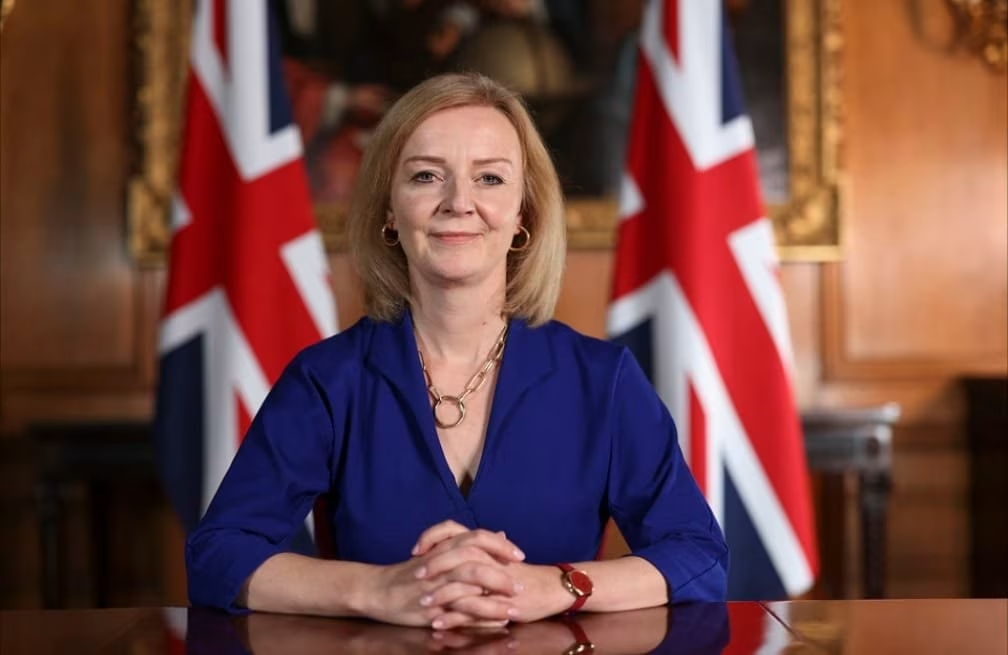
The spectre of economic upheaval looms large over Britain, as financial analysts cautiously draw parallels between the current political climate and the crisis that engulfed the nation during Liz Truss’s short-lived premiership. In a climate characterised by fragility and uncertainty, Sir Keir Starmer’s position is being closely scrutinised by investors, who are acutely aware of the potential for a repeat of the bond market meltdown that marked Truss’s tenure. As the Labour leader seeks to consolidate his political standing, the broader implications of his leadership will be felt across both the political and economic landscapes.
The events following Truss’s 2022 mini-Budget highlighted the vulnerabilities inherent within Britain’s financial architecture. In a bold bid to stimulate growth through unfunded tax cuts, her administration inadvertently triggered a storm that sent market confidence spiralling downward. The aftermath was a dramatic spike in government borrowing costs, a phenomenon that is now etched into the collective memory of investors and policymakers alike. Analysts have sounded alarms, suggesting that the lessons from that turbulent period remain unlearned, as the nation stands potentially on the precipice once more.
Amidst this precarious backdrop, Starmer’s political ambitions and strategies are under relentless examination. The Labour leader faces a significant challenge; he must navigate the complexities of a shifting political landscape while instilling confidence in a public wounded by economic woes. Recent polling data indicates that while Labour is favoured to win the next general election, the spectre of factionalism within the party could undermine their electoral chances. The ideological divides between the party’s moderate and leftist factions are becoming more pronounced, leading to fears of an internal conflict that could further jeopardise Labour’s fortunes.
The growing concerns over economic stability are not merely a benign backdrop to political negotiations. They are a crucible, shaping the decisions of political leaders and the mood of the electorate. A significant contributor to these anxieties is the growing spectre of an IMF bailout, an occurrence many have suggested may be closer than at any point in half a century. Such a possibility evokes memories of the turbulent 1970s and prompts questions regarding the resilience of Britain’s economic fundamentals in a modern context beset by geopolitical strife and inflationary pressures.
The current dynamics reflect a nation caught in a bind; the delicate equilibrium of fiscal policy, public sentiment, and political expediency appears increasingly fragile. A Labour government under Starmer may face immediate pressure to implement ambitious reforms to restore public trust while mitigating the risk of further economic instability. The state of the British economy leaves little room for error, a reality underscored by a stark warning from the chief executive of JP Morgan who signalled plans to withdraw £3 billion in investment from the UK should Labour veer too far left in its policymaking.
The gravity of these warnings cannot be overstated. Investors are acutely aware that the contours of governance directly influence market perceptions. The political missteps of Truss have left an indelible mark on investor confidence, leading many to adopt a wait-and-see approach as they assess Starmer’s commitment to fiscal discipline. The implications of any government policy oscillate between the promise of revitalisation and the risk of exacerbating existing economic strains. Starmer must tread carefully, balancing the expectations of a progressive base with the realities of a potentially hostile economic environment.
Meanwhile, a burgeoning discourse around education and economic literacy has emerged, sharply critical of figures like Angela Rayner who have faced accusations of lacking in-depth economic understanding. The notion that leadership requires not only charisma but also a substantive grasp of economic principles has gained traction. It becomes clear that the stakes surrounding governance extend beyond party lines; the capability to devise sound policy is crucial, irrespective of the political manifesto at play.
The cost of living crisis, which has harried households across the UK, serves as a poignant reminder of the urgency for effective policy intervention. Recent statistics show that private education costs have escalated to an astonishing £349,000 over a student’s academic journey, a figure that underscores the widening wealth gap and its ramifications for social mobility. These figures are more than numbers; they are indicators of the growing challenges faced by middle- and lower-income families, and the political ramifications are evident in the rising public dissatisfaction towards the ruling class.
The economic narratives surrounding the FTSE have also shifted, with discussions regarding cash reserves gaining prominence as investors seek safety amidst the turmoil. The stock market, often heralded as a barometer of public sentiment, is reflecting a cautious optimism tempered by the knowledge that adverse economic indicators and fragile political landscapes can pivot unexpectedly. Analysts now argue that sustainable economic policy, absent the spectre of political instability, is paramount to restoring investor faith in the UK’s financial resilience.
Further complicating the political tapestry is the ongoing debate around the energy sector and the management of natural resources. The Labour party has come under fire for perceived delays in critical energy projects, such as the anticipated 100-million-barrel North Sea oil venture. Critics posit that the party’s current indecision reflects broader ideological conflicts regarding energy policy; as climate concerns clash with energy security, the party finds itself at a crossroads that could have crippling effects on its electoral viability.
The interconnectedness of these economic and political threads culminates in a landscape rife with potential pitfalls, where the spectre of internal conflicts could erode public trust. Starmer must address not only the immediate policy concerns but also the foundational issue of party cohesion should he wish to present a credible alternative to the electorate at large. The management of diverse party interests will be essential to prevent a replay of past mistakes that have beleaguered Labour’s chances historically.
Public discourse is also shifting towards a broader recognition that economic intervention is not merely a political tool but a necessary aspect of modern governance. The idealism of austerity politics is waning in favour of a narrative that underscores the necessity of investment in public services. Nevertheless, this transition is fraught with peril; the right government strategy must navigate fiscal limitations while addressing public demands for social equity. The risk of overreach remains substantial, with the legacy of Truss ensuring that any miscalculated moves will be scrutinised for their potential to destabilise the economy further.
In conclusion, Britain finds itself at a critical juncture where political ambition intersects with economic necessity. The lessons from the Truss administration remain vivid, and Starmer must chart a path that respects historical realities while pushing forward with progressive reforms. Only through careful navigation of these treacherous waters can the political class hope to rebuild trust and lay the foundations for a stable economic future. As events unfold, the nation watches closely, holding both political leaders and the markets accountable for the decisions that will ultimately shape Britain’s trajectory in the years to come.
Post Disclaimer
The following content has been published by Stockmark.IT. All information utilised in the creation of this communication has been gathered from publicly available sources that we consider reliable. Nevertheless, we cannot guarantee the accuracy or completeness of this communication.
This communication is intended solely for informational purposes and should not be construed as an offer, recommendation, solicitation, inducement, or invitation by or on behalf of the Company or any affiliates to engage in any investment activities. The opinions and views expressed by the authors are their own and do not necessarily reflect those of the Company, its affiliates, or any other third party.
The services and products mentioned in this communication may not be suitable for all recipients, by continuing to read this website and its content you agree to the terms of this disclaimer.
Related Posts


Previous Post
Next Post

