
Now Reading: The Impact of Geopolitical Tensions on the Future of Artificial Intelligence
-
01
The Impact of Geopolitical Tensions on the Future of Artificial Intelligence
The Impact of Geopolitical Tensions on the Future of Artificial Intelligence
The Organisation for Economic Co-operation and Development (OECD) has issued a stark warning regarding the potential ramifications of the ongoing conflict between the United States and Iran. According to the OECD, a prolonged standoff could severely undermine the burgeoning investment landscape in artificial intelligence (AI), an industry currently riding high on optimism and record private investments. As demand for AI-driven technologies escalates, the spectre of escalating oil prices looms large, threatening to derail this promising trajectory and prompting concerns of a recalibration of market valuations, particularly for companies entrenched in the AI supply chain.
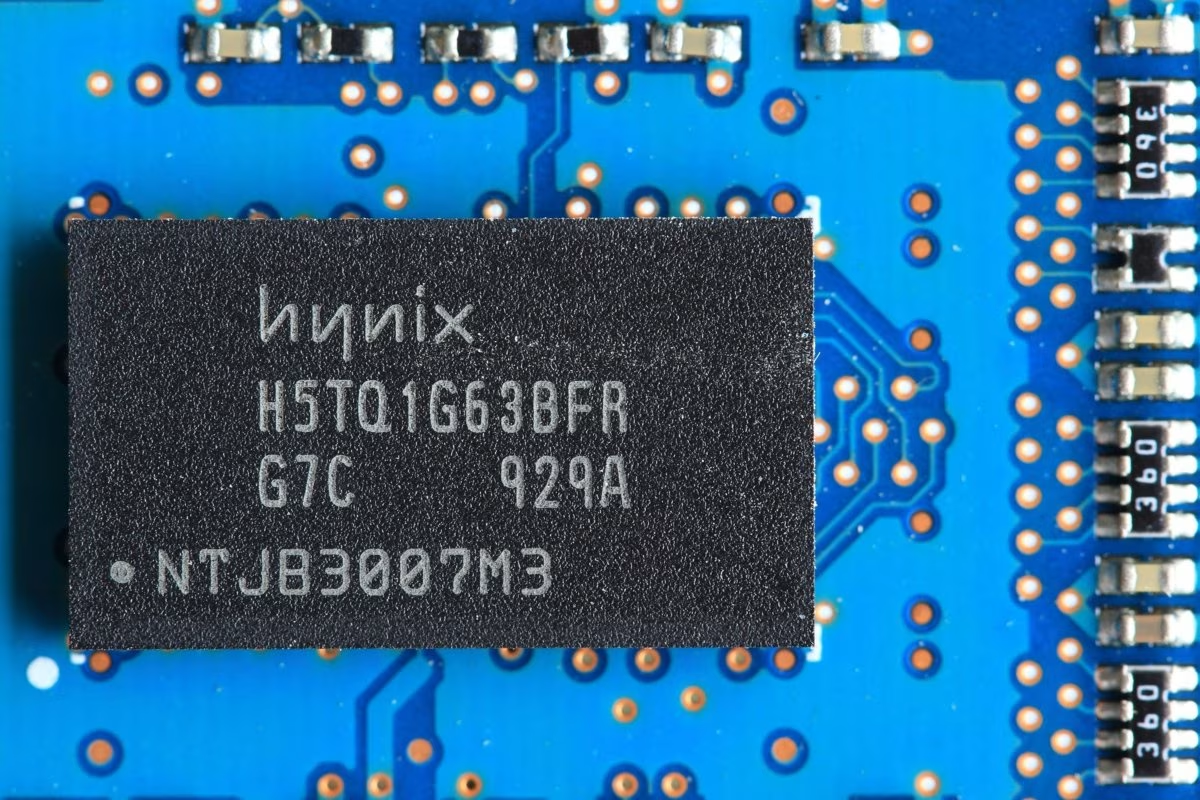
At this pivotal moment, it is critical to examine the interplay between energy markets, geopolitical instability, and technological investment. The OECD’s observations coincide with a period of unprecedented growth for AI firms and semiconductor manufacturers, which have flourished under a wave of surging demand and spiralling prices. Notably, South Korean giants such as SK Hynix and Samsung, alongside US-based Micron, have each reached the milestone of being valued at $1 trillion, indicative of the remarkable resilience of companies within the tech sector.
The picture painted by the OECD is one fraught with peril. It suggests that disruptions to the supply chains essential for AI development—particularly those tied to energy and raw materials—could dampen the industry’s prospects. With AI investment focusing heavily on building data centres, which incur energy costs constituting around 60 per cent of overall expenses, the stakes have never been higher. The manufacture of semiconductors—another linchpin of the industry—is equally energy-dependent, relying on imported materials like helium and aluminium that are themselves by-products of hydrocarbon processing. Given that Qatar produces approximately one-third of the world’s helium supply, any threat to the stability of this output could reverberate through the semiconductor supply chain.
The burgeoning conflict in the Middle East has already prompted significant disruptions. Attacks on Qatar’s liquefied natural gas facilities have halted helium production, a critical input for the cooling processes used in semiconductor manufacturing. The current situation has resulted in a doubling of spot prices for helium, according to experts at Kornbluth Helium Consulting, further intensifying the competitive pressures facing manufacturers. The capacity to outbid rivals for scarce resources will serve only to advantage the largest players—for now. However, the complexities surrounding helium storage render it a precarious resource, capable of delivering shocks to the market should conflict persist.
The consequences of such supply disruptions extend well beyond isolated businesses. The OECD warns of the potential for a global recession, predicting that prolonged tensions may lead to GDP growth dwindling from a projected 3.4 per cent in 2025 to as low as 1.8 per cent in 2027. Such a downturn would represent the weakest performance since the pandemic, departing from the bullish outlook that has characterised market sentiment in recent months. An escalation of energy pricing driven by geopolitical uncertainties could render further investments in AI—including those critical infrastructure projects dependent on stable energy supplies—intensely vulnerable.
The implications for countries operating at the nexus of commodity exports and AI development could be especially dire. Gulf economies, not only exporters of crucial commodities but also key players in the deployment of AI technology, face a double whammy. These nations often rely on sovereign wealth and state capital to fund data centre expansions, and an extended conflict could delay or halt pivotal projects, stymying the geographical distribution of AI infrastructure. This situation may precipitate a downward spiral, wherein stunted project pipelines further exacerbate economic woes within these regions.
As various AI firms prepare for high-stakes initial public offerings—including high-profile names like SpaceX, Anthropic, and OpenAI—investor eagerness must now contend with a stark reality. Worries about the impact of the US-Iran conflict on global equity markets inject a note of caution into what has, until recently, been an unbridled pursuit of technological advancement. While the excitement around AI investment has flourished, a precarious balancing act now lies ahead, as multiple stakeholders grapple with the potential fallout from ongoing geopolitical instability.
Moreover, while developed economies such as the UK and the US stand to benefit substantively from advancements in generative AI—predicted to add between 0.9 and 1 percentage point to GDP per head over the forthcoming decade—the external environment complicates this rosy prospect. If geopolitical events lead to widespread supply-chain disruptions, the resultant economic turbulence could threaten the very gains anticipated from AI innovation. For a sector that thrives on dependably low-cost energy and materials, the prospect of rising prices and diminished supply presents a significant challenge.
In this evolving narrative, the once-heralded relationship between technological advancements and ceaseless economic growth must now confront the stark reality of resource dependence and geopolitical instability. A dialogue about the future of AI cannot sidestep its inequities and risks. As the industry braces itself, the implications of a prolonged conflict demand serious scrutiny, as economic planners and policymakers alike ponder an uncertain future where innovation sits precariously alongside geopolitical tensions.
Thus, in examining the greater picture, the OECD’s findings compel us to consider not only the prospects for AI technology but its interconnections with existing global dynamics. The trajectory of an industry that has captured the imagination of investors and technophiles alike now hangs in the balance, teetering under the weight of international volatilities and resource scarcities. As we look ahead, the questions posed by the current geopolitical context force us to rethink prevailing assumptions about growth, sustainability, and the future of a world increasingly reliant on advanced technologies.
In this intricate web, every thread—whether it be energy prices, geopolitical tensions, or technological investments—plays a critical role in shaping outcomes. As stakeholders navigate this landscape, a holistic understanding of the interconnectedness of these factors may prove vital in ensuring that the promise of AI does not become obscured by external shocks and uncertainties.
With the specter of conflict looming, the story of AI’s future is one that demands vigilance and foresight. As the global economy stands on the cusp of what could be a transformative era, it is imperative that we remain acutely aware of the myriad influences that could either propel or restrain this ever-evolving narrative. The potential for the AI sector to drive economic growth exists, but it must be actively safeguarded from the tumultuous forces that underpin the geopolitical landscape.
Post Disclaimer
The following content has been published by Stockmark.IT. All information utilised in the creation of this communication has been gathered from publicly available sources that we consider reliable. Nevertheless, we cannot guarantee the accuracy or completeness of this communication.
This communication is intended solely for informational purposes and should not be construed as an offer, recommendation, solicitation, inducement, or invitation by or on behalf of the Company or any affiliates to engage in any investment activities. The opinions and views expressed by the authors are their own and do not necessarily reflect those of the Company, its affiliates, or any other third party.
The services and products mentioned in this communication may not be suitable for all recipients, by continuing to read this website and its content you agree to the terms of this disclaimer.
Related Posts


