Now Reading: Central Asia Metals PLC Investor Report: What the Cygnus Metals Acquisition Could Mean for Growth, Production and Risk
-
01
Central Asia Metals PLC Investor Report: What the Cygnus Metals Acquisition Could Mean for Growth, Production and Risk
Central Asia Metals PLC Investor Report: What the Cygnus Metals Acquisition Could Mean for Growth, Production and Risk
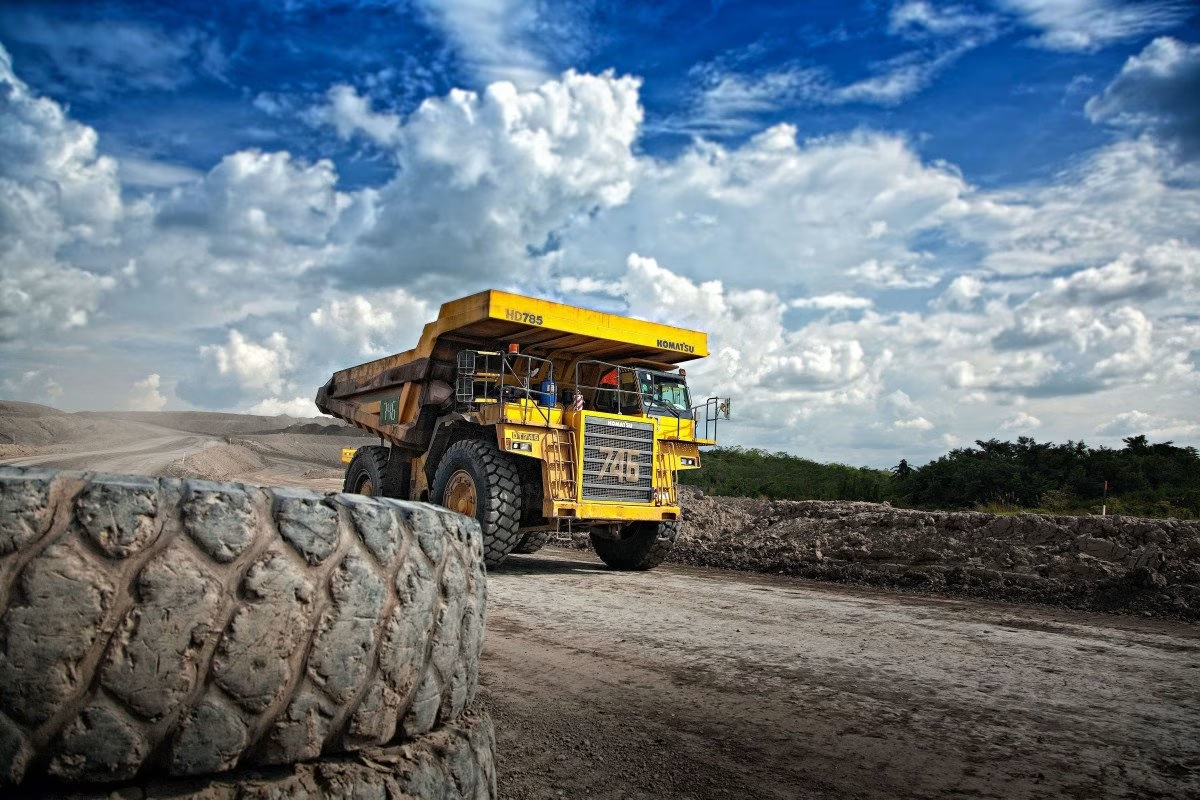
Central Asia Metals has announced a proposed acquisition of Cygnus Metals in a deal that would materially reshape the company’s growth profile. If completed, the transaction would bring in the Chibougamau copper-gold project in Quebec, add a significant brownfield development asset to the portfolio, and widen the group’s geographic footprint beyond Kazakhstan and North Macedonia.
For a company that has long been associated with cash generation from existing operations and selective exploration, this is a more ambitious move. Management has framed it as transformational, and on the surface the logic is clear. Chibougamau offers established resources, historical production, existing infrastructure, and substantial exploration upside in a top-tier mining jurisdiction.
That said, investors should look beyond the headline attraction of high grades and ask harder questions about capital intensity, permitting, development timing, integration risk and long-term returns. This report examines the strategic case, the resource base, the likely development pathway and the main issues that will matter as the market judges whether this acquisition can deliver the value implied.
Table of Contents
- The proposed transaction at a glance
- What Central Asia Metals is buying
- Why Chibougamau fits the company’s strategy
- The brownfield advantage
- Resource growth could be central to value creation
- What Central Asia Metals brings to the project
- Development timeline and what it implies
- Capital expenditure remains one of the key unknowns
- Dividend policy and capital allocation
- Permitting, environmental and community considerations
- Critical questions investors should keep asking
- Overall assessment
- FAQ
The proposed transaction at a glance
Central Asia Metals has agreed terms to acquire the entire issued share capital of Cygnus Metals through a scheme of arrangement in Australia. The transaction values Cygnus at A$232 million, with consideration of 17.6 Australian cents per share.
On a pro forma basis, the enlarged group would be owned roughly 70 per cent by existing Central Asia Metals shareholders and 30 per cent by Cygnus shareholders. The transaction remains subject to shareholder approvals, including a 75 per cent approval threshold from Cygnus shareholders and a simple majority from Central Asia Metals shareholders.
Support has already been secured from a meaningful portion of the Cygnus register through voting intention statements, and the Cygnus board is backing the deal. Management expects completion in September, while also seeking a Toronto Stock Exchange listing as part of the broader transaction process.
From a strategic perspective, this is not an incremental bolt-on. It is a portfolio-shaping acquisition designed to create a clearer route from exploration to development and eventually to production.
What Central Asia Metals is buying
The centrepiece of the acquisition is the Chibougamau project in Quebec, Canada. This is a high-grade copper-gold district with a long mining history and a large land package containing multiple deposits and prospects.
The current resource base includes five key deposits:
- Cedar Bay
- Golden Eye
- Devlin
- Corner Bay
- Joe Mann
Across the portfolio, the project hosts measured and indicated resources of 6.4 million tonnes at about 2.3 per cent copper, 0.8 grams per tonne gold and 7.6 grams per tonne silver. There is also a further 8.5 million tonnes of inferred resources at similar grades.
Those numbers matter. High grades help support project economics, particularly in underground mining, where unit costs can rise quickly if ore quality disappoints. They also reduce some of the early geological uncertainty, because Central Asia Metals is not acquiring a pure exploration concept. It is buying a resource base that has already been substantially defined.
The transaction also includes the Copper Rand processing plant, associated administrative facilities and a tailings site. These are not plug-and-play assets and will require refurbishment and additional equipment, but they offer an important head start compared with a greenfield development.
Why Chibougamau fits the company’s strategy
Central Asia Metals has described Chibougamau as the missing middle in its portfolio. That is a useful way to think about it.
The company already has producing operations in Kounrad and Sasa, which generate cash flow, and it has earlier-stage exploration exposure in Kazakhstan and Scotland. What it has lacked is a more advanced development asset capable of becoming a meaningful future production centre. Chibougamau fills that gap.
Several strategic benefits stand out.
1. Medium-term production growth
Based on current resources, grade and plant capacity, management sees a plausible route to meaningful additional copper and gold production over time. While no production profile has yet been published by Central Asia Metals, the existence of an updated preliminary economic assessment programme suggests a more refined development plan is in progress.
2. Exploration upside without pure discovery risk
The existing 15 million tonnes of resources are only part of the appeal. The wider district offers around 18 kilometres of strike with multiple targets and historical producers. Several assets remain open at depth and along strike, which often provides fertile ground for resource growth.
That is especially important for brownfield projects. It is generally easier and cheaper to find more ore around established mineralisation than to discover an entirely new system elsewhere.
3. Jurisdictional quality
Quebec is widely regarded as one of the strongest mining jurisdictions globally. Access to power, water, transport links, permitting frameworks and skilled labour all improve the likelihood of a project moving ahead in an orderly way, even if timing remains uncertain.
4. Diversification
Adding Canada broadens the company’s geopolitical exposure. For a miner with operations in Kazakhstan and North Macedonia, that diversification may be welcomed by investors who prefer a spread of jurisdictional risk.
The brownfield advantage
One of the most compelling parts of the investment case is the brownfield nature of Chibougamau. This is not a remote or undeveloped district lacking basic infrastructure. It is located near the town of Chibougamau, a long-established mining centre with year-round access by road, rail and air.
That has practical consequences for project execution:
- Workforce access: the area has mining skills and support services nearby.
- Logistics: reagent supply, equipment delivery and concentrate transport should all be more straightforward than at remote sites.
- Power and water: essential utilities are already accessible.
- Infrastructure base: existing plant and tailings facilities offer a starting point, even if major refurbishment is needed.
- Permitting context: past production can help establish a clearer baseline for environmental and operational planning.
Management has also highlighted the proximity of a smelter, which could strengthen commercial flexibility depending on future concentrate specifications and offtake options.
Still, brownfield should not be mistaken for low effort. Rehabilitating and modernising old assets can be complex, especially when today’s environmental expectations are far stricter than those that applied during historical operations.
Resource growth could be central to value creation
While the current resource inventory is attractive, the exploration story may be where a significant share of long-term upside lies.
Central Asia Metals has made clear that Cygnus has already advanced the geological understanding of the district by applying modern exploration methods, including geophysics and the compilation of historical data using artificial intelligence-assisted techniques. That matters in mature camps, where past drilling and mine records are often fragmented and underused.
The district includes a number of former producers beyond the core five deposits. Historical production from targets such as Henderson, Portage and Jaculet has added to the appeal, with substantial past output of both copper and gold. For geologists, the combination of known mineral systems, underexplored extensions and modern reinterpretation can create a strong platform for future discoveries.
If further drilling converts this potential into additional resources, the economics of refurbishing the plant and infrastructure could strengthen materially. More tonnes and longer mine life typically improve capital efficiency by spreading upfront investment across a broader production base.
What Central Asia Metals brings to the project
The strategic rationale is not only about what is being acquired. It is also about whether the buyer has the capability to unlock value from it.
Central Asia Metals believes it does, and there is a coherent basis for that claim.
- Underground mining experience: relevant to the proposed mining methods at Chibougamau.
- Base metals operating know-how: useful in processing and operational optimisation.
- Tailings expertise: especially important given the preference for dry stack tailings.
- Cold-weather operating experience: a practical advantage in Quebec conditions.
- Strong balance sheet: the combined cash position is expected to exceed US$100 million.
- Limited gearing and banking relationships: potentially helpful when future project funding decisions arise.
- Community and environmental track record: important for permitting and stakeholder engagement.
The company also gains a Canadian team already familiar with the asset. That continuity should help reduce integration friction and preserve project momentum through the study phase.
Development timeline and what it implies
Investors hoping for a rapid production start should temper expectations. Management has indicated that first production is more likely on a timeline of five years or more.
That reflects the work still to be completed:
- Finalise and refine the preliminary economic assessment.
- Continue drilling and metallurgical testing.
- Advance mine design and infrastructure planning.
- Move into a definitive feasibility study.
- Progress environmental baseline work and impact assessment.
- Apply for and secure the necessary permits.
- Refurbish and equip plant and site infrastructure.
- Develop mine access and start-up systems.
Management’s own commentary suggests that the feasibility and technical study stage alone could take close to three years before formal permitting applications are fully in place. In other words, this is a serious medium-term development project, not a near-term production catalyst.
That distinction is important for valuation. The market will need confidence not only in resource quality, but also in disciplined execution over a multi-year period.
Capital expenditure remains one of the key unknowns
A central unanswered question is the eventual capital cost of bringing Chibougamau back into production.
Management has not provided a fresh capex figure due to regulatory constraints, though it has pointed to an earlier preliminary economic assessment lodged in the public domain. It has also stated that its own internal assumptions are above the older published number, reflecting a more conservative view after technical due diligence and site inspections.
That caution is sensible. Refurbishment projects can be notorious for cost creep, especially where legacy infrastructure requires more replacement than first expected. Inflation in equipment, labour and construction inputs only adds to that risk.
For investors, this creates an obvious area for scrutiny. The eventual capital bill will influence:
- Project returns
- Funding strategy
- Potential equity dilution
- Dividend flexibility
- Balance sheet risk
Until more updated technical work is published, it is difficult to judge whether the acquisition price and subsequent development capital together will generate attractive returns on invested capital.
Dividend policy and capital allocation
Central Asia Metals has said it intends to keep its dividend policy unchanged at 30 to 50 per cent of free cash flow. At the same time, management has signalled that share buy-backs are unlikely to be a priority while capital is being directed into the business.
That appears logical. A company taking on a major development project should generally preserve flexibility rather than attempting to maximise short-term capital returns. However, this stance does raise a balancing act.
Income-focused shareholders may accept a lower emphasis on buy-backs if they believe Chibougamau can create long-term value. But they will want reassurance that capital discipline remains firm, particularly if copper prices weaken or development studies become more expensive than expected.
The dividend framework gives management some room to adapt payouts in line with commodity prices and cash generation. That flexibility should be useful, but it also means distributions could become more variable if the growth agenda absorbs a larger share of cash flow.
Permitting, environmental and community considerations
No mining development in Canada can be assessed purely on grade and engineering. Permitting and stakeholder relationships are just as critical.
Central Asia Metals has emphasised the importance of working with the local host communities, the City of Chibougamau, the Government of Quebec and the Ouje-Bougoumou Cree Nation. That is encouraging and entirely necessary.
Environmental baseline studies are already under way, which should help support future applications. Management has not identified acid-generating rock as a major issue from its due diligence, and no material red flags were highlighted on that front. Even so, these matters require continued detailed assessment as studies progress.
For investors, this is an area where progress should be monitored closely. Technical competence alone does not guarantee a social licence to operate. The quality of consultation, transparency and environmental planning will have a direct bearing on the project’s timetable and credibility.
Critical questions investors should keep asking
The deal has clear industrial logic, but prudent investors should continue to press for more detail in several areas.
- What is the updated capex range? Without that, project economics remain incomplete.
- What production profile is realistic from the current resource base? Grade is attractive, but mine scheduling and recovery assumptions will matter.
- How much of the inferred resource is likely to convert? This will affect mine life and confidence levels.
- What level of sustaining capital will be required? Refurbished assets can carry hidden future costs.
- How will the company fund development? Cash on hand is helpful, but may not be enough for full build-out.
- How quickly can permitting move in practice? Brownfield status helps, but should not be overestimated.
- What does success look like for exploration? A clear framework for drilling priorities and value milestones would be useful.
Overall assessment
On balance, the proposed Cygnus acquisition looks strategically coherent and potentially value-accretive if execution is disciplined. It gives Central Asia Metals a high-grade copper-gold development asset in a strong jurisdiction, supported by existing infrastructure, an established team and meaningful exploration upside.
It also addresses a long-standing strategic gap by adding a more advanced project between early-stage exploration and mature cash-generating operations. In that sense, management’s description of the deal as transformational is justified.
However, transformation cuts both ways. The enlarged group would be taking on greater development complexity, longer time horizons and more exposure to execution risk. The investment case therefore rests less on the attraction of the rocks alone and more on whether Central Asia Metals can convert geological promise into a bankable, permittable and financeable mine plan.
If it can, the acquisition may indeed help secure the company’s future production and cash flow base. If it cannot, then the market will eventually focus on the opportunity cost of tying up capital in a long-dated project.
For now, the proposed transaction appears to offer credible long-term upside, but it also demands patience and close attention to the next set of technical and financial disclosures.
FAQ
What is Central Asia Metals acquiring from Cygnus Metals?
The company is acquiring the entire issued share capital of Cygnus Metals, with the main attraction being the Chibougamau copper-gold project in Quebec. This includes multiple deposits, an existing processing plant, related infrastructure and a broader exploration land package.
Why is the Chibougamau project considered attractive?
The project combines high-grade copper and gold resources, historical production, brownfield infrastructure, strong exploration potential and location within a top-tier mining jurisdiction. These features can improve the odds of development compared with an early-stage greenfield asset.
When could first production happen?
Management has indicated that production is likely to be at least five years away. The project still needs updated economic studies, further drilling, feasibility work, permitting and refurbishment before any restart is possible.
Will the acquisition affect the dividend policy?
Central Asia Metals has said it intends to maintain its dividend policy of distributing 30 to 50 per cent of free cash flow. However, future payouts may depend on commodity prices, development spending and broader capital allocation priorities.
Are share buy-backs likely to continue?
At present, management has indicated that buy-backs are unlikely to be reinstated as a priority. Capital is expected to be directed towards project development, exploration and maintaining shareholder returns through the existing dividend framework.
What are the biggest risks for investors to monitor?
The main risks include capital cost inflation, permitting delays, integration challenges, resource conversion, refurbishment complexity and the possibility that project economics are weaker than expected once updated technical studies are released.
Post Disclaimer
The following content has been published by Stockmark.IT. All information utilised in the creation of this communication has been gathered from publicly available sources that we consider reliable. Nevertheless, we cannot guarantee the accuracy or completeness of this communication.
This communication is intended solely for informational purposes and should not be construed as an offer, recommendation, solicitation, inducement, or invitation by or on behalf of the Company or any affiliates to engage in any investment activities. The opinions and views expressed by the authors are their own and do not necessarily reflect those of the Company, its affiliates, or any other third party.
The services and products mentioned in this communication may not be suitable for all recipients, by continuing to read this website and its content you agree to the terms of this disclaimer.