Now Reading: Burnham Urged to Consider Modernising Building Societies Act Amid Election Dispute
-
01
Burnham Urged to Consider Modernising Building Societies Act Amid Election Dispute
Burnham Urged to Consider Modernising Building Societies Act Amid Election Dispute
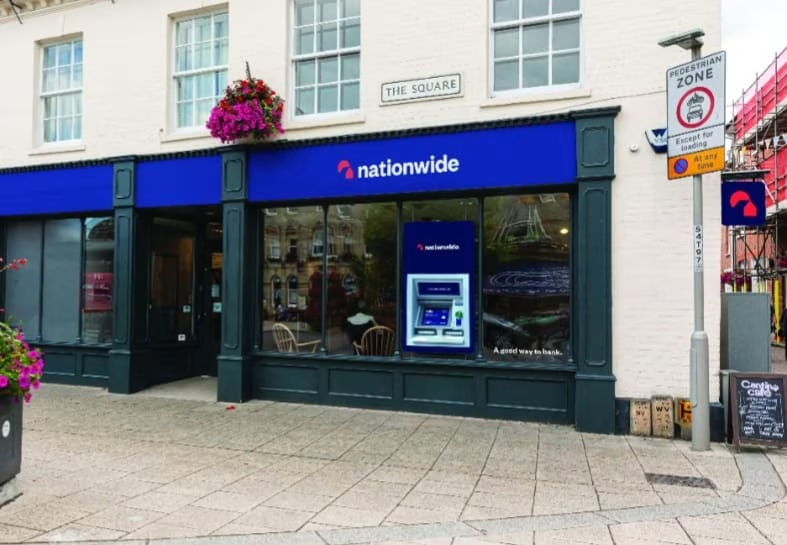
A significant challenge to the established order within Britain’s mutual sector has prompted a senior member nominated candidate to appeal directly to Andy Burnham, the Labour leader and widely regarded as a potential prime minister in waiting. James Sherwin-Smith, who is seeking a place on the board of Nationwide Building Society, has written an open letter to Mr Burnham urging him to contemplate legislative reform that would update the governance framework for building societies. The argument rests on the claim that the current regulatory landscape, largely defined by the Building Societies Act 1986, is not fit for purpose in reflecting contemporary expectations of member democracy and corporate accountability in a time of rapid change in financial services and digital engagement.
The intervention comes at a critical moment for Nationwide, whose annual general meeting is imminent. Sherwin-Smith’s campaign marks the first instance in more than two decades of a member-nominated candidate appearing on the ballot for a board seat at Britain’s largest building society. His challenge has been accompanied by a protracted dispute over the conduct of the election process, including how votes are tallied and how members are invited to participate in the proceedings. The open letter to Mr Burnham, supported by a cluster of parliamentarians and figures from the world of governance, is framed as a broader appeal to reassert the membership’s voice in a sector that is central to household savings in the United Kingdom.
The signatories to the letter include two members of the House of Lords, Lord Biggar of Castle Douglas and Lord Young of Acton, together with David Duffy, the chairman of the Corporate Governance Institute, and Navendu Mishra, the Labour MP for Stockport. Mishra has previously raised concerns about Nationwide’s voting procedures, indicating a wider unease within political circles about how mutuals are governed. The group argues that governance practices within the mutual sector have drifted away from public expectations and that parliamentary time should be found to debate how the Building Societies Act might be updated to strengthen member democracy and accountability. They contend that the legislation, crafted four decades ago, remains inadequate to ensure robust governance in an era of heightened transparency and scrutiny of financial institutions.
The timing of the appeal is deliberate. Nationwide’s annual meeting is approaching, and the issue has gained added momentum because advanced voting had already closed, while online participation remained possible on the day of the gathering. This adds a layer of immediacy to the questions about how member engagement is balanced against efficiency and the convenience that digital voting affords. Sherwin-Smith, a former consultant, has argued that the current arrangements allow a board or management to exercise disproportionate influence over the composition of the board, a concern that resonates with broader debates about executive power, governance, and the rights of ordinary savers who hold the mutual’s shares by virtue of membership rather than ownership by external investors.
Central to the controversy is what the campaign terms a “quick vote” mechanism. This feature enables members to approve a slate of resolutions with a single affirmation, effectively substituting the board’s recommendations for a more granular member vote on each item. Sherwin-Smith suggests that such a mechanism can suppress dissent and diminish the evidence of genuine member oversight. The other focal point is the decision to run the annual meeting in a virtual format, a choice that Sherwin-Smith argues compromises the ability of members to engage in unscripted dialogue with board members and executives. In a sector where personal contact and community ties are often cited as strengths of mutual organisations, the shift to a virtual format is seen by critics as a potential erosion of democratic participation and accountability.
The letter to Mr Burnham, which exhorts Parliament to prioritise parliamentary scrutiny of the Building Societies Act, presents a broader thesis about the stewardship of mutual financial institutions in the modern era. The signatories insist that any governance framework must reflect the high standards the public rightly expects from the mutual model, especially in a landscape where digital channels enable rapid information flows and where members increasingly demand transparency, accessibility, and meaningful channels for feedback. The argument goes beyond the specifics of Nationwide’s election to articulate a principle: that the mutual sector, which is structurally designed to serve its members, needs a governance architecture that underwrites accountability and prevents complacency or obfuscation by those who control the electoral and governance levers within these organisations.
On the substance of the case, Sherwin-Smith has emphasised that Britain values its mutual sector and that maintaining public trust requires governance arrangements that are beyond reproach. He contends that compliance with existing legislation is not sufficient if the spirit of openness and participation has withered under the weight of procedural complexity or perceived influence by incumbents. The argument implies that modern governance should be more than a compliance exercise: it should be a living contract with members, one that is responsive to their needs and capable of evolving in step with technological and social changes. In other words, the call for a parliamentary debate on the Building Societies Act is a call for a more dynamic, more accountable mutual sector that remains faithful to its founding principles while embracing the tools and norms of the 21st century.
The cadre of supporters for the reform agenda highlights the weight behind the push. Lord Biggar of Castle Douglas and Lord Young of Acton bring constitutional and governance credibility, while David Duffy’s leadership of the Corporate Governance Institute signals a practical interest in how mutuals are governed. Navendu Mishra’s involvement underscores the inclination within Parliament to scrutinise the practical mechanics of mutual governance, including the balance of power between boards and members and the safeguards necessary to ensure that member interests are not diluted by procedural shortcuts or the optics of corporate convenience. If this coalition succeeds in placing the Building Societies Act on the parliamentary agenda, it could mark a turning point for a sector that has long prided itself on proximity to its members yet has faced questions about responsiveness to contemporary expectations of accountability and engagement.
Despite the heightened attention, the parties involved have largely declined to comment in detail. Burnham’s office was contacted for comment, while Nationwide Building Society issued a brief statement indicating that it had nothing further to add at this stage. The muted public response is itself telling. In a sector where public relations and reputational considerations are in constant play, the absence of a substantive response can be read as an acceptance that the issue is politically and commercially delicate. It also reflects a broader reality in which mutuals are navigating public expectations, regulatory frameworks, and the practical realities of governance in a fast-changing environment.
The debate sparked by Sherwin-Smith’s candidacy and his appeal to a senior political figure is about more than one institution and one ballot. It speaks to a wider question about how a model founded on member ownership can remain relevant when governance practices, technology, and social norms evolve rapidly. The Building Societies Act of 1986 was written in a different era, one in which the regulatory architecture was designed to provide stability amid a shifting financial landscape. Over the subsequent decades the sector has been subject to a patchwork of oversight, voluntary codes, and evolving norms of governance. Critics argue that while this framework has delivered stability, it may not be nimble enough to accommodate a world in which members expect real-time information, straightforward participation, and clear lines of accountability without the frictions that can accompany large, member-based organisations.
Supporters of reform argue that a more modern legal underpinning could enhance resilience and legitimacy. They posit that parliamentary debate could yield an updated set of rules that better regulate voting mechanisms, the use of electronic and remote participation, the clarity of disclosures to members, and the thresholds for accountability when governance decisions are contested. Proponents believe that such reforms would not diminish the mutual ethos but rather strengthen it by ensuring that members feel their voices are heard and that those who govern are answerable to them in a way that is visible, testable, and subject to democratic scrutiny. In this sense, the dispute at Nationwide is a microcosm of a larger conversation about how to preserve the mutual advantage while ensuring legitimacy in an age when information asymmetries can undermine trust if not carefully mitigated.
Whether the initiative will translate into concrete legislative change remains uncertain. The political calendar, the willingness of peers and MPs to prioritise private and public sector governance issues, and the practical political calculus of what a Building Societies Act reform would entail all weigh on the probability of a parliamentary debate ever taking place. Yet the very act of raising the issue in a public, high profile form ensures that mutual governance will be only a passing concern in polite, quiet corners of Westminster no longer. The debate has the potential to become a broader referendum on how Britain’s mutual sector, which has enjoyed a long tradition of serving ordinary savers, can adapt to the demands of an era in which citizen participation, openness, and accountability are not optional ornaments but essential foundations of public trust.
For Nationwide, the immediate question is whether the election dispute can be resolved in a way that preserves the integrity of the process and preserves the confidence of its large membership. For Sherwin-Smith and his allies, the aim is not merely to secure a seat on the board but to catalyse a broader rethink of governance norms that could outlast any one campaign. In the end, the outcome may hinge on whether Parliament is prepared to engage with this call for reform, and whether the mutual sector can demonstrate in concrete terms that it is capable of evolving while staying true to its core purpose: to serve the interests of its members through governance that is principled, transparent, and accountable. The next few months will tell whether this is a moment of introspection that could yield lasting change or a temporary flare in a longstanding dialogue about the future direction of Britain’s mutuals.
Post Disclaimer
The following content has been published by Stockmark.IT. All information utilised in the creation of this communication has been gathered from publicly available sources that we consider reliable. Nevertheless, we cannot guarantee the accuracy or completeness of this communication.
This communication is intended solely for informational purposes and should not be construed as an offer, recommendation, solicitation, inducement, or invitation by or on behalf of the Company or any affiliates to engage in any investment activities. The opinions and views expressed by the authors are their own and do not necessarily reflect those of the Company, its affiliates, or any other third party.
The services and products mentioned in this communication may not be suitable for all recipients, by continuing to read this website and its content you agree to the terms of this disclaimer.
Related Posts


Previous Post
Next Post