
Now Reading: Disability benefits are failing claimants and taxpayers alike, a government review finds
-
01
Disability benefits are failing claimants and taxpayers alike, a government review finds
Disability benefits are failing claimants and taxpayers alike, a government review finds
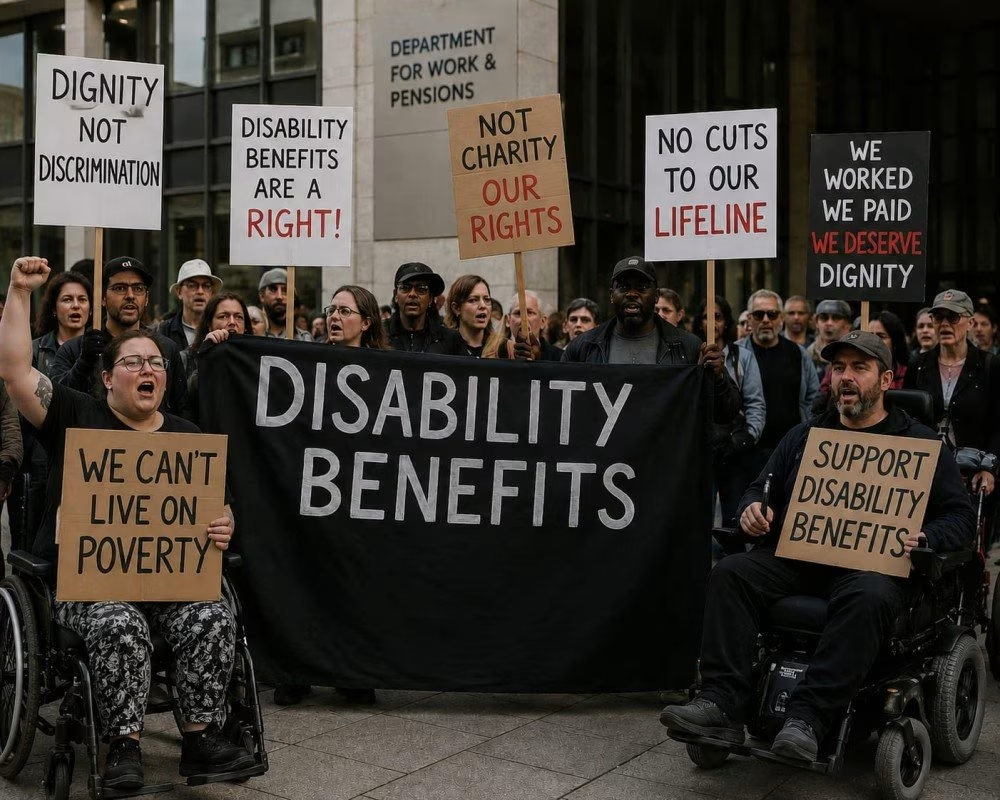
A government-commissioned review has delivered a blunt verdict on Britain’s main disability benefit. Personal Independence Payment, designed to help people with long-term illness or disability meet the extra costs of daily life, is “not fit for purpose” and is no longer working as intended. Yet the interim report, led by Sir Stephen Timms, the social security minister, stops short of offering the remedies that a system under fiscal and political strain now plainly demands.
The timing is as revealing as the content. The review was launched last autumn after Labour ministers were forced into a humiliating retreat over proposals to cut spending on PIP. Plans for around £5bn of reductions were abandoned in the face of a backbench revolt. The result is a document that reads less like a blueprint for reform than a diagnosis delivered in a waiting room: detailed, serious in tone, and heavy with evidence, but postponing the difficult decisions until later. Sir Stephen has promised recommendations in September.
That delay matters because the pressures on PIP are not theoretical. The cost is projected to rise to around £41bn by the end of the decade, a figure that has become a lightning rod in arguments about the sustainability of welfare spending. PIP is already a large and growing item within the social security budget, and it has acquired a political significance that goes far beyond the programme itself. It has become a proxy for the state’s capacity to distinguish between need and entitlement, for the public’s willingness to support redistribution, and for the credibility of ministers who insist they can be both compassionate and prudent.
Sir Stephen’s interim report is built on almost 39,000 responses to a call for evidence. The sheer volume is itself telling: disability benefits are not a niche policy concern but a front-line experience for millions, and a constant source of anxiety for those navigating the system. The report’s central message is that while PIP remains “widely valued”, it has drifted from its purpose and now requires “fundamental change”.
The original promise of PIP was relatively clear. Introduced in 2013, it was intended to contribute towards the additional costs associated with disability, from adaptations in the home to help with mobility and daily living. It is not means-tested, and it can be claimed by those in or out of work. In principle, the design sought to separate disability support from out-of-work benefits, reducing the perverse incentive for claimants to avoid employment.
In practice, the lines have blurred. PIP increasingly functions as a gateway to other forms of support. Eligibility can unlock additional benefits and schemes, including the high-profile Motability programme that provides access to subsidised cars. Each new role PIP takes on increases the stakes of the assessment, heightens the sense of injustice for those who are refused, and sharpens the political criticism when costs rise.
The report finds the programme now sits uneasily between competing demands. Many respondents argue it does not cover what it ought to cover. PIP can be worth up to £778 a month, yet more than half of those who submitted evidence complained that the benefit was not generous enough to meet their needs. This is not merely a plea for a higher cheque. It is a sign that for a significant portion of claimants, disability support is being pulled into the orbit of the wider cost-of-living crisis. Sir Stephen’s review notes that recipients are increasingly using the money for basics such as food, energy and transport. That shift suggests a benefit meant to address extra costs is being used to cover ordinary costs that are rising faster than incomes for many households.
That is politically awkward for ministers because it points to a structural problem that cannot be fixed by tinkering with assessment questions. If PIP is being used to keep the lights on, reform becomes inseparable from debates about wages, housing, energy prices and the adequacy of the broader social security system. A programme can be failing at its stated mission while still being essential to those who receive it.
The other tension is between support and work. Sir Stephen’s report records that some respondents believe PIP discourages people from seeking employment because the income makes them more financially secure. One submission quoted in the report describes friends and colleagues “on PIP and don’t need to be”, alleging that the money removes any incentive to take formal work and enables undeclared earnings. The review also cites research from the Institute for Fiscal Studies suggesting that when benefits are reduced, people are more likely to seek work.
Yet the evidence from claimants also runs in the opposite direction. Some recipients say they are frightened to take jobs because they worry assessors will interpret employment as proof of improved health, leading to payments being reduced or withdrawn. This is the cruel logic of conditional support: the very steps encouraged by government can be experienced as a threat. PIP is officially compatible with work, but the human reality is often shaped by fear of reassessment, uncertainty about the rules and the memory of past decisions that felt arbitrary.
Only about a fifth of those receiving PIP are in employment. That figure does not in itself prove a disincentive, since many claimants have conditions that severely restrict their ability to work. But the number is politically potent. It feeds the suspicion that the system is inadvertently warehousing people outside the labour market, at a time when ministers are under pressure to increase participation and reduce inactivity.
Public trust is the third fault line. The report acknowledges that “the public reputation of PIP is low” and that public support for welfare spending on disabled people has decreased. It goes further, warning that perceptions of claimants as “scroungers” have contributed to eroding inclusiveness in society. That matters because welfare states depend on a sense of reciprocity and fairness, not just on legislation. When a benefit becomes associated in the public mind with gaming, resentment grows and political consent weakens. Conversely, when the system is seen to humiliate legitimate claimants, moral authority collapses from the other direction.
This is the toxic bind revealed by Sir Stephen’s evidence: PIP is simultaneously experienced as inadequate by many who rely on it and as too easily obtained by those who see abuse. When both beliefs take hold, confidence drains away. The state appears both mean and naive, a combination that encourages cynicism and corrodes solidarity.
The assessment process sits at the centre of this crisis of legitimacy. PIP relies on a points-based test intended to capture how a condition affects day-to-day functioning. Many respondents to the review describe the experience as “dehumanising” and “humiliating”. Such language is familiar from years of testimony about disability assessments. It suggests a bureaucracy that has come to treat vulnerability as a problem to be managed rather than a reality to be understood.
There is an inherent difficulty in designing assessments that are consistent, robust against fraud and sensitive to fluctuating or invisible conditions. But the persistence of these complaints indicates something deeper than administrative roughness. When large numbers of claimants describe a process as degrading, it implies a system that is not only stressful but also culturally misaligned with the purpose of disability support. Sir Stephen has hinted that assessments will need to be overhauled, but the interim report leaves the method and timetable undefined.
The political response has been swift. Conservatives have attacked the review for acknowledging the scale of the problem while declining to propose savings. Helen Whately, the shadow work and pensions secretary, argues that Labour is “in denial” about welfare and has interpreted “broken” to mean that benefits are too hard to obtain and not generous enough. She points to forecasts that spending on PIP will double by the end of the decade, and insists the government should pursue tougher measures: a return to face-to-face assessments, and a curtailing of sickness benefits for conditions such as anxiety, low mood and ADHD, which she describes as the fastest-growing reasons for claiming, particularly among younger people.
Her critique captures an opposition strategy that is likely to intensify as costs rise. The argument is not simply about money but about diagnosis. If the growth in claims reflects worsening mental health and social pressures, reform might focus on treatment, employment support and wider preventative policy. If it reflects a lowering of thresholds and an assessment system struggling to scrutinise claims, reform leans towards restriction. Each diagnosis carries a different moral claim about who deserves help and why.
Sir Stephen’s report notes the sharp increase in PIP claims since the pandemic, particularly among younger people claiming for mental health conditions. The headline figures give a sense of scale. In 2024-25 there were 2.9 million working-age claimants, up more than 74 per cent since 2019-20. The number has since risen to 3.3 million, with a further 680,000 pensioners receiving the benefit. These are not marginal changes. They represent a structural shift in demand for disability support, and they pose uncomfortable questions about the nation’s health, working life and social resilience.
What the interim review does effectively is show that PIP can no longer be treated as a technical programme whose difficulties can be resolved by administrative tweaks. It is now entangled with labour market participation, public confidence in the welfare state, and the distributional consequences of a high-cost economy. When recipients use the benefit to pay for essentials, PIP begins to resemble an income support top-up, even if that was never the intention. When claimants fear that employment will be used against them, PIP becomes a brake on the government’s own ambitions to encourage work. When the public reputation collapses, the politics become ever more brutal, with claimants pushed into the crossfire.
The most striking feature of the Timms review is that it recognises these dynamics yet refuses to settle them. That may be a genuine attempt to create political space for consultation and coalition-building with disability charities. It may also reflect the reality that ministers are boxed in by their own recent history. Having already abandoned planned cuts, the government faces a credibility problem if it now pivots to harsher reform. If it does not, it risks being accused of letting a costly system drift while public support withers.
There is, however, a deeper dilemma that no minister can dodge indefinitely. Disability benefits are both a measure of a society’s decency and a test of its institutional competence. A generous system that cannot command public trust will not remain generous. A strict system that humiliates legitimate claimants will not remain legitimate. The purpose of reform is not merely to reduce a bill, nor merely to soothe a scandal, but to rebuild a settlement that can endure.
That settlement requires honesty on several fronts. It requires acknowledging that the rise in mental health claims among younger people may reflect real need, and that a modern economy can grind down those who are less resilient. It also requires confronting the possibility that an assessment framework built for physical impairment has struggled to adapt to complex, fluctuating and less visible conditions, leaving both genuine claimants and sceptical taxpayers dissatisfied. It requires clarity about what PIP is for: extra costs, income replacement, or a broader form of social insurance against disability. Without that clarity, the programme will continue to sprawl into roles it cannot properly fulfil.
The interim review makes a persuasive case that PIP has reached a turning point. The question now is whether government can produce a reform plan that is rigorous enough to restore confidence, humane enough to treat claimants with dignity, and coherent enough to align support with work rather than setting them in opposition. Sir Stephen has offered the diagnosis. By autumn, he will be expected to produce something rarer: a cure that does not create a new disease.
Post Disclaimer
The following content has been published by Stockmark.IT. All information utilised in the creation of this communication has been gathered from publicly available sources that we consider reliable. Nevertheless, we cannot guarantee the accuracy or completeness of this communication.
This communication is intended solely for informational purposes and should not be construed as an offer, recommendation, solicitation, inducement, or invitation by or on behalf of the Company or any affiliates to engage in any investment activities. The opinions and views expressed by the authors are their own and do not necessarily reflect those of the Company, its affiliates, or any other third party.
The services and products mentioned in this communication may not be suitable for all recipients, by continuing to read this website and its content you agree to the terms of this disclaimer.
Related Posts


Previous Post
Next Post

