Now Reading: Fears for Christmas trade as Royal Mail puts cap on collections
-
01
Fears for Christmas trade as Royal Mail puts cap on collections
Fears for Christmas trade as Royal Mail puts cap on collections
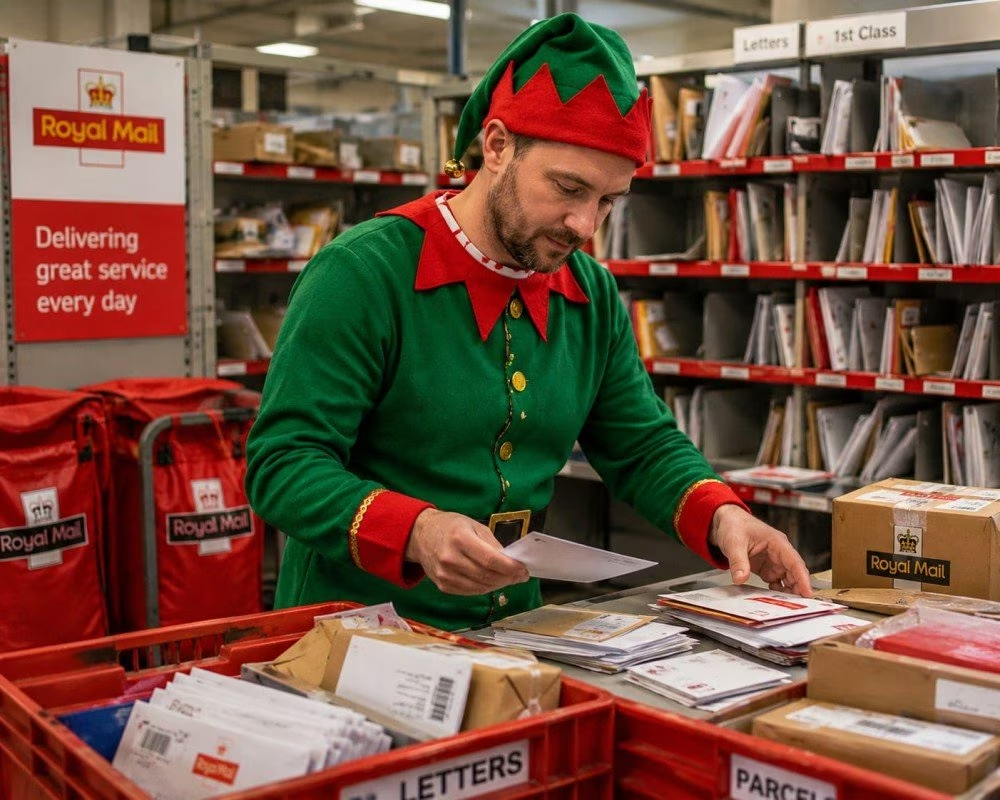
For the small firms that make Britain’s Christmas economy feel local, personal and worth paying for, the festive season is not a gentle uplift but a hard sprint. It is when the year’s stock decisions, marketing gambles and late-night packing sessions are either vindicated or punished. It is also, increasingly, when their fortunes depend less on what they can sell than on what they can physically move. Royal Mail’s decision to cap daily business collection capacity during November and December has therefore landed not as a minor contractual tweak but as a warning shot across the bows of thousands of enterprises whose growth arrives, inconveniently, all at once.
The change, communicated to business customers as part of revised terms, limits daily collections in the peak months to a maximum of three times a customer’s usual collection capacity. Royal Mail frames it as routine peak planning intended to preserve reliability when volumes surge. It insists the restriction will affect only a small minority, arguing that “very few customers require more than three times our usual collection capacity”. On paper, the cap sounds generous: three times the norm is a wide margin in most industries. In the peculiar arithmetic of Christmas retail, it can be a ceiling set uncomfortably low.
The anxiety is most acute among businesses with a high seasonal skew, especially those that sell giftable, shippable items and depend on daily collections rather than sporadic depot drop-offs. These firms are not merely busier in December; many are transformed. A company that dispatches a modest number of parcels on an average summer day may need to ship ten, fifteen or twenty times that volume once Advent begins. They are not hoarding demand for attention, but responding to it. When the logistics chain tightens at precisely the moment customers are least forgiving, the costs are immediate: delayed deliveries, refund requests, bad reviews, abandoned baskets next year, and reputational damage that outlasts the tinsel.
The Federation of Small Businesses has condemned the cap in unusually blunt terms, warning that it could throttle firms at a “make or break” point in the year. That phrase is not rhetoric for many owner-managers. Christmas profits frequently subsidise lean months, finance new product lines or pay down stock loans. They also create the cash buffer that allows a business to recruit, invest or simply withstand a slow quarter. A constraint on collections is therefore not just an operational nuisance but a potential brake on working capital. A parcel not collected is money not yet realised.
Royal Mail’s position is that it is trying to prevent a repeat of peak-season fragility. The logic is familiar to anyone who watched the postal system strain in recent years as consumer habits shifted decisively towards home delivery. Capacity planning is not romantic work. Vehicles, cages, staffing rotas and depot throughput have hard limits, and the public expectation is not sympathy but punctuality. Set no guardrails and the system is overwhelmed; set them too tightly and you transfer the risk from the operator to the customer. In this case, the customers include not just households waiting for presents but businesses whose brand is effectively carried by someone else’s van.
The difficulty is that “usual collection capacity” is an ambiguous measure of commercial reality. For established firms with stable volumes, it may correspond reasonably well to a baseline that can be flexed within agreed parameters. For younger businesses, fast-growing sellers and makers whose year-to-year numbers are rising, “usual” can be a moving target that lags behind current performance. A firm that has doubled its sales since last Christmas may find its baseline defined by last year’s quieter months, leaving the three-times cap misaligned with the new scale of demand. In an economy where policymakers routinely exhort small businesses to export, digitise and scale, a rule that effectively rewards steadiness over expansion feels like an institutional shrug.
It also arrives at a moment when distribution costs are already climbing. Royal Mail has raised its fuel and energy surcharge for domestic services, lifting the add-on from 11 per cent to 16 per cent. For small traders, surcharges land like a tax on ambition: the more you sell, the more you pay, and the less you can absorb without lifting prices. Larger retailers can renegotiate, diversify carriers, or offset shipping costs across a broad product mix. Microbusinesses often cannot. When delivery becomes both more expensive and less predictable, the business model that underpins much of Britain’s online craft, speciality food and independent retail sector begins to wobble.
Royal Mail’s own pressures are not hard to discern. The company has been fined by Ofcom for failing to meet delivery targets, a public mark of underperformance that threatens confidence in the universal service provider. In parallel it is engaged in an operational push under its owner, Daniel Kretinsky, as management seeks to improve delivery rates and restore credibility. The promised investment, reported as £500 million over five years, is intended to upgrade performance in a market where private carriers have long since learned to be selective, targeting profitable routes and leaving costly coverage obligations to the incumbent.
The tension sits in plain view: Royal Mail is asked to behave like a modern logistics business while remaining, in crucial respects, a national utility. That dual identity is the root of many disputes about pricing, service levels and reform. The universal service obligation, the expectation of delivery everywhere for a regulated price, is politically cherished and commercially punishing. Any attempt to improve performance tends to involve choices that offend someone. Plans to end Saturday second-class deliveries, for instance, may make operational sense on spreadsheets and may help concentrate resources on the services customers use most, but they also touch nerves about national standards and the quiet erosion of everyday public services.
Within that landscape, the cap on business collections can be read as another attempt to impose predictability on an unpredictable peak. Yet predictability for the operator can translate into uncertainty for the customer. The firm that is told it may send only three times its usual volume is left with awkward options. It can throttle sales by limiting stock online, sacrificing revenue and the chance to win new customers. It can attempt to divert parcels to alternative carriers, often at higher cost and with less integrated collection arrangements. Or it can attempt to manage fulfilment more slowly, risking late deliveries in the fortnight when the nation’s patience evaporates.
The case of Natural & Noble, a business selling DIY drinks kits, illustrates the mismatch between a contractual cap and seasonal reality. The company expects Christmas demand to multiply its typical volume not by three but by fifteen to twenty times. That is not a marginal overshoot but a different order of magnitude. If a customer wants to buy a kit on 18 December, and the company can produce it but cannot get it collected in time, the sale is effectively lost. The cap does not merely constrain the business; it constrains the market’s ability to function as a market. Demand exists, supply exists, and the transaction fails because the connecting pipe has been narrowed.
Royal Mail would argue that the company is entitled, even obliged, to manage that pipe so it does not burst. It may also point out, with some justification, that extraordinarily peaky businesses should plan for extraordinary capacity rather than assuming a single carrier can stretch without limit. In most industries, reliance on one supplier for a critical function is considered risky. But small firms do not choose single-carrier dependence out of complacency. They choose it because it simplifies operations, provides national reach, and, historically, has carried a presumption of public-service continuity. The universal provider has been the default precisely because it was supposed to be there.
What makes the present moment more fraught is that the logistics sector has become a competitive battleground at the same time as consumer expectations have hardened. Next-day delivery, evening delivery, parcel tracking and narrow time windows have shifted from premium features to baseline expectations, set not by small firms but by retail giants. Royal Mail must compete with private carriers whose networks have been built around parcels rather than letters, and whose commercial freedom allows them to price and route in ways a regulated incumbent cannot. Yet small businesses are often ill placed to play that competitive field. Many do not have the volume needed to secure favourable rates elsewhere. Many are located in rural areas where alternative collection options are patchier. Many are staffed by people who do everything from product design to customer service, leaving little time to become logistics procurement specialists.
The policy also raises a question about how Britain wants its small business economy to behave. For years the rhetoric has celebrated the entrepreneurial surge enabled by online platforms: the bakery that sells nationwide, the homeware maker that ships from a spare room, the drinks brand that finds customers through social media rather than supermarket shelves. Yet that model depends on a mundane infrastructure of collections, depots and reliable last-mile delivery. When that infrastructure signals that growth beyond a modest multiple will not be accommodated at the peak, it implicitly nudges firms towards a different pattern of business: smaller, steadier, less seasonal, and perhaps less ambitious.
There is, too, an inequality of bargaining power that sits beneath the contractual language. A large retailer can secure bespoke arrangements, additional capacity, or at least a hearing. A small firm receives a letter. The phrase “limited to a maximum of three times the usual collection capacity used” reads like a general rule, applied at scale. Royal Mail may say it affects very few, but the firms that do fall into that category are not necessarily niche curiosities; they are often precisely the sort of fast-growing, gift-heavy businesses that capture the modern Christmas market. Their success is the success that ministers point to when they talk about a dynamic economy. The cap tells them to slow down at the point of maximum opportunity.
For Royal Mail, the strategic calculation is likely that a controlled restriction is preferable to a network-wide collapse. A broadly reliable service that inconveniences a minority may be seen as better than a chaotic service that disappoints everyone. From a regulator’s perspective, meeting delivery targets is not optional. From a brand perspective, a repeat of peak-season headlines about backlogs would be damaging. From a workforce perspective, unmanaged surges can create intolerable strain. These arguments will find an audience, particularly among households who care less about the fate of microbusinesses than about whether their own parcels arrive before Christmas Eve.
Even so, the measure feels like another episode in the long transition from letters to parcels, and from public service assumptions to commercial negotiation. Royal Mail is being reshaped by forces it did not choose: the collapse in letter volumes, the surge in parcel traffic, and the unforgiving economics of last-mile delivery. Its owners and managers may be able to invest, reorganise and modify service patterns. Small businesses do not have equivalent room to manoeuvre. They live closer to the edge, and their margins are often thinner than the rhetoric around entrepreneurship suggests.
The immediate question for affected firms is practical: how to plan for a peak now bounded by a cap. Some will try to persuade customers to order earlier, a sensible strategy that is also notoriously difficult. Others will explore alternative carriers, splitting shipments across networks, accepting higher costs, and hoping the customer experience does not fracture. Some will attempt to recalibrate their “usual” baseline by increasing volumes earlier in the year, a perverse incentive that could raise costs simply to secure a higher peak allowance. None of these options is elegant. All of them consume time and attention that could have been spent on product, marketing or hiring.
In the longer term, the cap underlines how logistics has become an industrial policy issue, whether or not ministers choose to call it that. If small businesses are to thrive, their ability to reach customers must not be treated as an afterthought. That does not necessarily mean subsidising Royal Mail or freezing prices in perpetuity. It may mean a more honest conversation about what the universal service can realistically provide, how peak capacity is financed, and how small firms can be protected from sudden rule changes that land in the very months they depend on most.
For now, the festive economy is being asked to absorb another layer of constraint. Christmas will still come, as it always does, and parcels will still move in their millions. The question is which businesses will be able to ride that surge and which will find, at the moment they most need the system to stretch, that the system has decided it cannot.
Post Disclaimer
The following content has been published by Stockmark.IT. All information utilised in the creation of this communication has been gathered from publicly available sources that we consider reliable. Nevertheless, we cannot guarantee the accuracy or completeness of this communication.
This communication is intended solely for informational purposes and should not be construed as an offer, recommendation, solicitation, inducement, or invitation by or on behalf of the Company or any affiliates to engage in any investment activities. The opinions and views expressed by the authors are their own and do not necessarily reflect those of the Company, its affiliates, or any other third party.
The services and products mentioned in this communication may not be suitable for all recipients, by continuing to read this website and its content you agree to the terms of this disclaimer.
Related Posts


Previous Post
Next Post