Now Reading: Hawsons Iron: New Study Lifts Flagship Project NPV to A$1.87bn
-
01
Hawsons Iron: New Study Lifts Flagship Project NPV to A$1.87bn
Hawsons Iron: New Study Lifts Flagship Project NPV to A$1.87bn
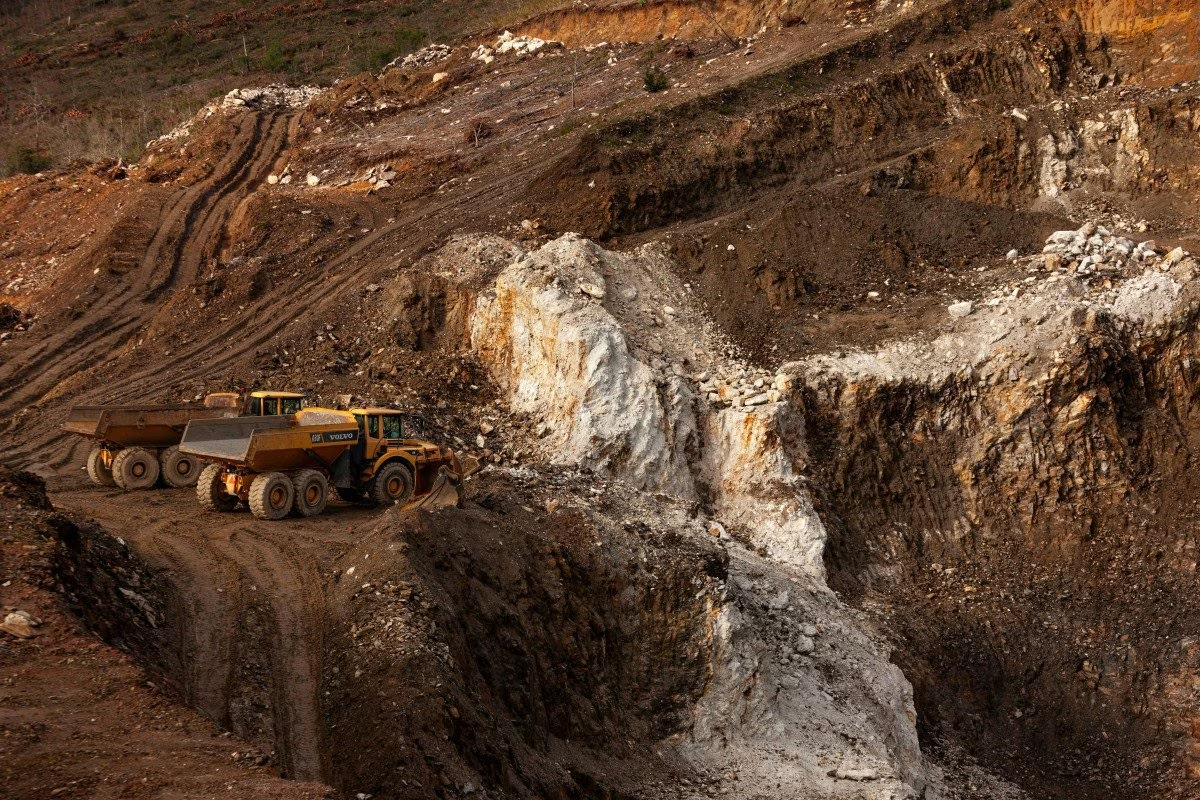
Hawsons Iron has outlined a meaningful upgrade to the economics of its flagship iron ore development, with a targeted engineering change helping to lift the project’s net present value to A$1.87 billion. The update follows a revised prefeasibility study that incorporates a waste handling optimisation programme, replacing a large truck haulage fleet with a conveying and stacking system.
On the surface, the change is highly technical. In practice, it goes to the heart of what separates a large mineral resource from a financeable mining project. By lowering operating costs, reducing diesel dependency, trimming power demand, and improving the project’s environmental profile, Hawsons appears to be building a more compelling case for investors, lenders, and future offtake partners.
For a project of this scale, those gains matter. Large iron ore developments demand substantial upfront capital and long construction periods. They also need to demonstrate resilience across commodity cycles, environmental scrutiny, and financing negotiations. Hawsons’ latest update suggests management is trying to improve the project on all three fronts at once.
Table of Contents
- The change at the centre of the upgrade
- Why this is more than a cost-cutting exercise
- Financing implications: why KfW IPEX matters
- How large is the opportunity?
- Pricing assumptions and the iron ore market
- The strategic importance of product quality
- Another possible value lever: hematite recovery
- What comes next for the project
- Why investors are paying attention
- FAQ
The change at the centre of the upgrade
The key adjustment in the updated prefeasibility study concerns how waste material would be moved from the plant site to the co-disposal facility. Under the earlier design, Hawsons expected to rely on a truck fleet to haul around 90 million tonnes per annum of dry process waste and dry mine waste.
Management concluded there had to be a more efficient solution and brought in specialist engineering group Takraf to assess an alternative. The result was a shift to a conveying and stacking system, a more complex design on paper, but one that materially improves the operating model.
This matters because waste movement is not a side issue in large-scale mining. It is one of the enduring cost centres of any long-life bulk commodity operation. If a company can move vast quantities of material more cheaply, more consistently, and with lower energy intensity, the impact on project economics can be significant.
That is precisely what Hawsons is highlighting here. The revised waste handling approach has helped reduce the project’s CFR cost, or delivered cost to end markets such as China, from roughly US$90 per tonne to US$85 per tonne.
Applied across an annual production profile of around 12 million tonnes, that translates into very substantial savings. Management’s assessment is that a relatively modest study cost of about A$150,000 has added around A$500 million to the project’s NPV.
Few mining companies get that sort of leverage from a targeted engineering review. It underlines how much latent value can still be unlocked between prefeasibility and final feasibility, particularly when the original design already has industrial scale.
Why this is more than a cost-cutting exercise
The revised design is not just about saving money. It also strengthens one of the most important themes in modern mining project development: sustainability as a financing and permitting advantage.
Hawsons has been positioning its project as a supplier into the green steel supply chain, and that ambition demands more than simply producing high-grade iron ore. It requires a project design that reflects tighter expectations around water use, energy demand, carbon intensity, and tailings management.
The company’s broader project evolution already points in that direction. Management says water demand has been reduced from roughly 35 gigalitres per year under an earlier design to around 12 to 14 gigalitres per year. That is a notable reduction for a large minerals processing operation and could improve both regulatory perception and practical project execution.
Power demand has also fallen sharply, from around 300 megawatts to roughly 180 megawatts. That is particularly striking because the move away from diesel trucks to electrically powered conveyors might initially suggest higher grid power consumption. Instead, Hawsons says the revised process flow allows it to remove additional equipment stages that were previously required for handling and compacting waste material, leading to an overall reduction in energy needs.
The operational benefits are broad:
- Lower diesel consumption, which reduces carbon emissions and fuel exposure
- Fewer truck-related personnel requirements, including drivers and maintenance teams
- Reduced accommodation needs at site camps
- Simplified downstream waste handling, with material moving directly onto conveyors
- Potentially improved environmental outcomes, including lower tailings-related complexity
For investors, the significance lies in the cumulative effect. A project with lower operating costs and a lower environmental footprint is not only more attractive in valuation terms. It is also likely to face fewer obstacles when seeking debt, strategic partners, and regulatory support.
Financing implications: why KfW IPEX matters
One of the more consequential points in Hawsons’ update is the expression of interest from KfW IPEX, a German state-backed banking institution involved in export and project finance. This is not financing secured, but it is more than a casual indication of support.
Hawsons estimates that of its roughly A$3.8 billion initial capital cost, around A$1.3 billion to A$1.4 billion could be linked to German equipment and supply packages. This includes items such as conveyors, vertical roller mills, thickeners, filters and sizing equipment.
KfW IPEX has indicated interest in funding up to 85% of that German-sourced component, subject to terms and compliance requirements, and at what management describes as a low interest rate.
That matters because large project financing packages are often assembled in layers, with export credit support, commercial debt, strategic capital and sponsor equity all playing a part. If Hawsons can anchor a meaningful portion of its funding stack through a major export-finance institution, it may improve the overall credibility of the financing plan and reduce the burden on other funding channels.
Just as importantly, the interest from KfW IPEX appears linked directly to the project’s design choices. Management says the bank responded positively to several features:
- Exposure to a commodity aligned with decarbonisation in steelmaking
- Lower water and power intensity
- Reduced reliance on conventional tailings dams
- A long operating life
- Use of German equipment and engineering capability
In other words, sustainability is not being presented merely as a public relations benefit. It is part of the capital formation story.
Hawsons also says it is working to ensure the project aligns with the Equator Principles, IFC standards, and ICMM standards. For institutional lenders and export credit agencies, these frameworks are often central to due diligence. Compliance does not guarantee funding, but failure to meet such benchmarks can quickly narrow financing options.
How large is the opportunity?
An NPV of A$1.87 billion is substantial by any junior or emerging developer standard, but management argues the market should look beyond that headline and consider the full earnings potential of the project once operational.
Hawsons describes the development as comparable in some respects to large mining and LNG projects: high upfront capex, extended build periods, but the potential for powerful cash generation once production begins.
At full output, management believes the operation could generate around A$800 million to A$900 million per annum in net earnings. Applying a fairly standard market earnings multiple to that level of profitability, it suggests a much larger potential valuation over time than the present NPV figure alone might imply.
That does not remove the execution challenge. Projects of this scale are difficult to finance, slow to construct, and highly sensitive to disciplined delivery. But the investment case being put forward is clear: if the company can successfully navigate the development curve, the economics point to an asset of national scale rather than a niche iron ore play.
Pricing assumptions and the iron ore market
One area where mining studies are often scrutinised is commodity price assumptions. Overly optimistic pricing can make almost any project look attractive on paper. Hawsons has taken a more grounded approach in its financial modelling.
Rather than relying on aggressive long-term forecasts, the company says it used the prevailing 62% iron ore price averaged over two years, which came out at around A$106 per tonne at the time of assessment. It then layered in a premium for its expected product quality, based on consultant input and current market conditions.
That premium is significant because Hawsons is targeting a very high-grade iron product of around 68.5% to 69% iron. High-grade material is increasingly relevant to steelmakers seeking better furnace efficiency and lower emissions. According to management, market commentary supported a premium in the region of 30% to 40% over the benchmark 62% iron ore price.
This approach is noteworthy for two reasons.
- It keeps the study anchored in observable market pricing rather than speculative upside.
- It allows investors to form their own view on whether iron ore prices or high-grade premiums could move higher over time, particularly if demand linked to greener steelmaking continues to strengthen.
In short, the company appears to be saying that the current economics are supportable in today’s price environment, with additional upside available if market conditions improve.
The strategic importance of product quality
Hawsons’ focus on high-grade magnetite concentrate is central to the investment thesis. Not all iron ore is equal, and product grade can have a decisive influence on pricing, customer demand and strategic relevance.
A 68.5% to 69% iron product sits above the standard 62% benchmark used in much of the seaborne trade. For steelmakers, higher-grade feed can improve efficiency and reduce the amount of energy and unwanted impurities involved in production. As decarbonisation pressures rise across heavy industry, premium iron ore products are widely seen as increasingly valuable.
That helps explain why Hawsons is framing its project within the green steel narrative. It is not only a bulk commodity story. It is also a quality story, and increasingly those two factors are converging in the iron ore market.
Another possible value lever: hematite recovery
Alongside the waste handling optimisation, Hawsons is also evaluating another potentially important enhancement. The company is studying whether it can recover hematite, or non-magnetic iron, from the existing waste stream.
At present, the project is centred on extracting high-grade magnetite using magnetic separation. However, management notes that the waste stream also contains hematite material which, in a conventional setup, could simply report to tailings.
If that hematite can be extracted economically, Hawsons could potentially produce two saleable products:
- A high-grade magnetite product
- A high-grade hematite product
The appeal is obvious. The material has already been mined, crushed, ground and processed through several stages. Recovering additional iron units from what would otherwise be discarded could improve revenue from the first day of operation and enhance the broader project economics.
Management says technical work is under way with experienced specialists to define the opportunity properly and reduce integration risk before any change is embedded in the flowsheet. If successful, this could become the next meaningful upgrade to the development case.
What comes next for the project
The immediate focus for Hawsons appears to be split across three workstreams.
1. Advancing financing discussions
The company is continuing detailed engagement with KfW IPEX, with the aim of moving from an expression of interest towards a more formal structure. It is also exploring whether the German-linked funding component can be expanded beyond the initial A$1.3 billion to A$1.4 billion estimate.
One route could involve broader engineering, procurement and construction packages with German groups, where suppliers do not just provide equipment but also install and commission it. If achieved, this could increase the amount of project capex eligible for export-backed support.
2. Testing further process improvements
The hematite recovery opportunity is the main technical upside currently being examined. Given the impact of the latest optimisation study, the market is likely to pay close attention to any further signs that the process route can be improved without materially increasing risk.
3. Engaging strategic investors and partners
Management is also in discussions with strategic parties that may have an interest in participating at the corporate level, the project level, or through offtake. These discussions are common for large-scale iron ore developments, particularly where product quality may be attractive to industrial buyers seeking long-term secure supply.
All of this feeds into the next major milestone: the commencement of a final feasibility study, which Hawsons is targeting towards the end of the year.
Why investors are paying attention
For the market, the latest update offers more than a revised NPV. It demonstrates that Hawsons is still finding ways to improve the project before final feasibility, and that those improvements are not cosmetic. They affect operating costs, environmental performance, and financing appeal simultaneously.
That combination is important in the current market environment. Mining projects are no longer judged solely on resource size or headline margins. Investors and lenders increasingly ask tougher questions:
- Can the project operate with lower emissions?
- Does it minimise water use?
- Is the process route practical at scale?
- Can it attract credible debt support?
- Does the product have strategic relevance to future industrial demand?
Hawsons is attempting to answer each of those questions positively. It still has a long road ahead, especially given the capital intensity involved, but the revised prefeasibility work strengthens the argument that this is a project with both scale and improving quality.
If the company can convert technical optimisation into financing momentum, and financing momentum into final feasibility confidence, the market may begin to assess Hawsons less as a concept-stage developer and more as a serious future producer in premium iron ore.
FAQ
What drove the increase in Hawsons Iron’s project NPV to A$1.87 billion?
The increase was driven by an updated prefeasibility study that incorporated a waste handling optimisation. The company replaced a planned truck haulage system with a conveying and stacking system, reducing operating costs and improving project economics.
How much did the waste handling change reduce costs?
Management says the change reduced CFR costs from about US$90 per tonne to US$85 per tonne. Across annual production of roughly 12 million tonnes, that creates a meaningful operating cost benefit.
Why is electrification important for the project?
Electrification lowers diesel use, reduces carbon intensity, and simplifies site logistics. Hawsons also says the revised design cuts overall power demand because it removes some equipment stages that were previously needed in the process flow.
What is the significance of KfW IPEX’s interest?
KfW IPEX has expressed interest in funding up to 85% of the German-sourced portion of the project’s capital cost, estimated at A$1.3 billion to A$1.4 billion. This could become an important component of the project’s broader financing package.
What kind of iron ore product is Hawsons targeting?
The project is designed to produce a high-grade iron product of around 68.5% to 69% iron. This premium grade is expected to attract stronger pricing than standard 62% benchmark ore, particularly in markets focused on greener steelmaking.
Could the project produce more than one iron product?
Possibly. Hawsons is evaluating whether hematite can be recovered from the waste stream in addition to the main magnetite product. If successful, this could increase revenue and enhance overall project returns.
What are the next major milestones for Hawsons Iron?
The company is progressing financing discussions, continuing technical studies including hematite recovery, speaking with strategic investors and offtake groups, and preparing to move towards a final feasibility study later in the year.
Important notice: This investor report is for informational purposes only and should not be considered investment advice or a recommendation to buy or sell shares.
Post Disclaimer
The following content has been published by Stockmark.IT. All information utilised in the creation of this communication has been gathered from publicly available sources that we consider reliable. Nevertheless, we cannot guarantee the accuracy or completeness of this communication.
This communication is intended solely for informational purposes and should not be construed as an offer, recommendation, solicitation, inducement, or invitation by or on behalf of the Company or any affiliates to engage in any investment activities. The opinions and views expressed by the authors are their own and do not necessarily reflect those of the Company, its affiliates, or any other third party.
The services and products mentioned in this communication may not be suitable for all recipients, by continuing to read this website and its content you agree to the terms of this disclaimer.