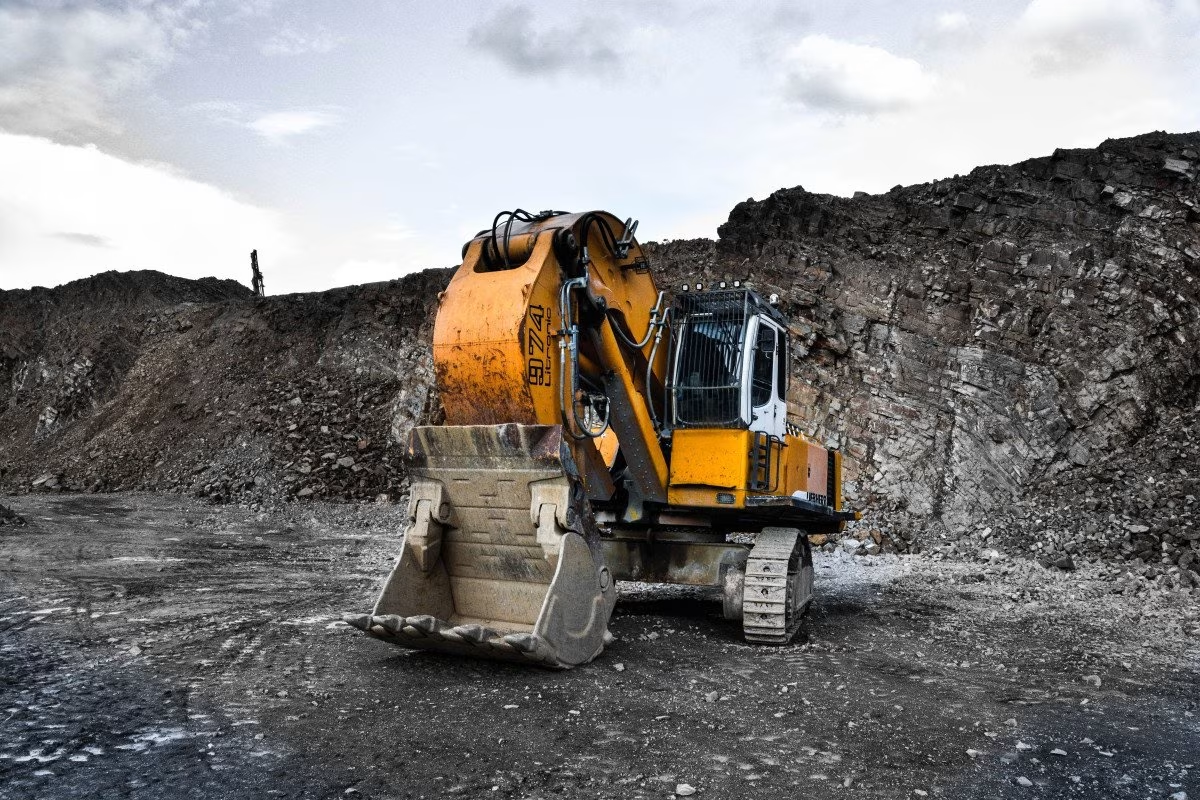
Now Reading: Kazera Global Enters 50/50 Production Sharing Agreement at Walviskop: What It Means for Cash Flow, HMS Production and the Bigger 2A Opportunity
-
01
Kazera Global Enters 50/50 Production Sharing Agreement at Walviskop: What It Means for Cash Flow, HMS Production and the Bigger 2A Opportunity
Kazera Global Enters 50/50 Production Sharing Agreement at Walviskop: What It Means for Cash Flow, HMS Production and the Bigger 2A Opportunity
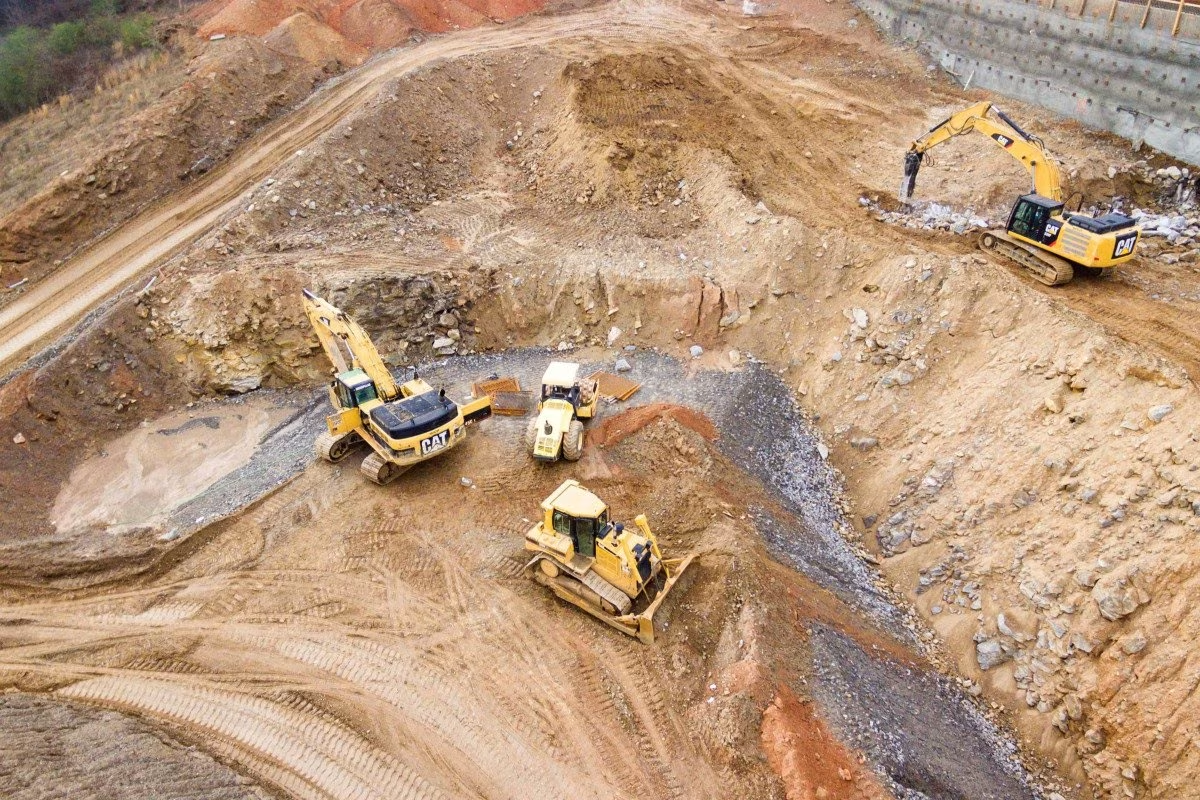
Kazera Global’s new 50/50 production sharing agreement at the Walviskop heavy mineral sands project marks a notable shift in strategy for the South African asset. Rather than trying to develop the operation alone, the company has opted to partner with Rare Earth Minerals International, or REMI, a South African group with mining, mineral processing and logistics experience.
For investors, the significance of the deal is straightforward. Management is attempting to solve a problem that has persisted for years: Walviskop has offered visible geological promise, but operationally it has failed to convert that potential into consistent, meaningful returns. The new arrangement is intended to change that by bringing in specialist processing equipment, local operating capability and logistical know-how, while also reducing Kazera’s funding burden.
The immediate objective is not simply to improve operations at Walviskop. It is to turn the project into a self-financing platform and, in doing so, support the company’s broader ambitions around the much larger 2A licence area. That makes this more than a routine joint operating update. It is a test of whether Kazera can finally establish a commercially viable heavy mineral sands business in the Northern Cape.
Table of Contents
- Why Kazera has chosen to share Walviskop
- Who is Rare Earth Minerals International?
- What each side brings to the partnership
- The operational challenge at Walviskop
- Cutting the cost base and stemming the cash drain
- When could Walviskop become cash generative?
- Why the diamonds are not the main story
- Walviskop as a pilot for the larger 2A opportunity
- The key investment considerations
- A more realistic, more focused Kazera narrative
- FAQ
Why Kazera has chosen to share Walviskop
Interim chief executive Richard Jennings framed the decision in blunt commercial terms. In essence, the company would rather own 50 per cent of a functioning, cash-generative operation than 100 per cent of an asset that has yet to deliver. For a company that has spent years committing capital to South Africa without generating the desired operational momentum, that logic is difficult to ignore.
The issue has not been the apparent existence of mineral sands. Management’s view is that the potential of the sands at Walviskop is visible and compelling. The problem has been execution. Over the past two years, despite equipment being placed on site and a plant established, operations never fully got going in a way that translated into sustainable output and profitability.
This is the backdrop to the REMI agreement. The company has concluded that specialist expertise on the ground is necessary to lift grades, increase throughput and manage the practical challenges of producing and transporting heavy mineral sands from a remote location.
Jennings, who noted that he is the company’s largest shareholder, made clear that the decision was taken with capital preservation firmly in mind. He has also been underwriting operating costs through loan facilitation, so the push to reduce cash burn is not theoretical. It is immediate.
Who is Rare Earth Minerals International?
REMI is a South African group formed by four principals with backgrounds spanning mining, heavy mineral sands, chrome and logistics. Although the business itself is relatively new, having been set up roughly 10 to 11 months ago, the individuals behind it are not new to mineral operations.
The relationship appears to have grown out of earlier offtake discussions linked to Kazera’s heavy mineral sands product. One of REMI’s principals, Sean Setty, was already familiar with the opportunity, not only at Walviskop but also at the larger 2A area. That awareness developed into a more formal review of the project, including several months of on-site assessment before the agreement was finalised.
That due diligence matters. REMI has not arrived as a purely financial backer. It has spent time on the ground, brought equipment to site, and begun construction work connected to processing infrastructure. This suggests a partner that is entering the arrangement with operational intent rather than simply strategic optionality.
What each side brings to the partnership
The structure of the arrangement reflects a practical division of roles.
Kazera contributes:
- The licence and legal right to operate and exploit the opportunity
- Existing site infrastructure
- On-the-ground staff with local operating experience
- Oversight of health, safety and site management
- Access to the Walviskop opportunity under the wider Alexkor arrangement
REMI contributes:
- Processing equipment, including additional spirals and a wet magnetic separator
- Mining and mineral processing expertise
- Logistics capability, which is especially important given the project’s remote location
- Supplementary capital support
- Operational momentum and specialist focus on heavy mineral sands
This is not a conventional arrangement where one side simply finances and the other side operates. Rather, it is designed as a complementary partnership. Kazera holds the asset and local operating base. REMI is expected to improve the technical and commercial execution needed to make that asset work.
The operational challenge at Walviskop
At the heart of the project is a basic commercial equation: the operation only becomes attractive if both volume and grade improve enough to overcome mining and transport costs.
Walviskop is located in the Northern Cape, and one of the practical constraints is geography. The site is a considerable distance from export routes, whether via Lüderitz or Cape Town. In heavy mineral sands, logistics can quickly erode project economics if product quality is not sufficiently high.
Management’s stated target is to push volumes towards 10,000 tonnes per month while also increasing the titanium oxide grade. Without that uplift, the company’s own view is that the venture would remain only marginally profitable, if profitable at all.
That is why processing is so central to the REMI tie-up. The key equipment additions are intended to upgrade feedstock more effectively before sale.
Why spirals matter
Once material has gone through the trommel screen and the diamond gravels are removed, the heavy mineral sands need to be processed through spirals. This gravity-based separation method helps split out minerals such as ilmenite and garnet.
In practical terms, improved spiral processing should help raise concentrate quality. For Kazera, that matters because better grade translates into better realised value per tonne, which in turn helps absorb transport and operating costs.
The role of wet magnetic separation
REMI has also introduced a wet magnetic separator. Management expects this to help access higher-value heavy mineral sands components, including zircon and rutile. The company noted that monazite is not a significant component in its sands, so the focus is on the minerals that can most clearly improve the product mix and economics.
The broader goal is simple: produce a higher-value HMS product rather than shipping lower-grade material that struggles to generate adequate margin.
Cutting the cost base and stemming the cash drain
One of the most immediate benefits of the agreement is financial. As part of the arrangement, REMI will contribute ZAR600,000 per month. Management indicated that this represents roughly half of what it believes the monthly operating cost run rate to be for mining both the diamond gravels and the heavy mineral sands feedstock.
That contribution matters for two reasons.
- It reduces Kazera’s direct monthly cash exposure in South Africa by around half.
- It gives the company more time to move the operation towards self-sustaining cash generation.
Jennings has been explicit that one of his first priorities after taking control in early April was to stop the long-running financial haemorrhage associated with the South African operations. The REMI deal is therefore not only an operating partnership. It is a restructuring tool aimed at lowering the burden on the group while preserving upside.
For investors assessing risk, this point is central. In junior resource companies, the path to value creation is often undermined less by geology than by repeated equity dilution or ongoing unsecured funding needs. Any credible reduction in monthly burn can materially alter the investment case.
When could Walviskop become cash generative?
Kazera’s current expectation is that the operation could be producing meaningful positive cash flow by the middle to latter part of summer, with August identified as the latest point by which management hopes to see the business in a materially cash flow positive position.
That timeline is based on internal modelling completed with technical input from the company’s in-house expert and REMI. It assumes progress on the two key drivers already identified:
- Higher volumes, moving closer to the 10,000 tonnes per month target
- Improved grades, so that transport and mining costs are sufficiently covered and profits can emerge
If this works, the significance extends beyond near-term cash flow. Management’s intent is that any further site-level investment required in South Africa, excluding 2A, can be financed from profits generated by this initial Walviskop venture rather than by continued external support.
That would be a substantial shift from the pattern of the past several years.
Why the diamonds are not the main story
One of the clearest messages from management is that investors should not treat diamonds as the core value driver.
Diamonds remain part of the operational picture because the gravels pass through the trommel screen and any diamond recovery provides additional value. However, the company has been careful to position this as a secondary benefit rather than the centrepiece of the investment case.
Jennings was particularly direct on this point. In his assessment, diamonds have always been a sideshow and should never have been presented as the primary long-term profit engine for Kazera. If the heavy mineral sands process is set up correctly, then diamonds may provide a useful credit, but they are not what the company is building around.
That distinction is important because it sharpens the strategic narrative. Kazera is not seeking to become a diamond-led story with some additional mineral sands potential attached. It is pursuing a heavy mineral sands opportunity in which diamond recoveries may offer incremental upside.
For investors, that should improve clarity. It aligns operating decisions, capital allocation and partnership strategy around the part of the asset base that management believes has the strongest commercial future.
Walviskop as a pilot for the larger 2A opportunity
Walviskop is not being positioned as the endgame. It is being treated as a pilot operation for the larger prize: the 2A licence area.
Management has repeatedly signalled that 2A represents the major opportunity within the company’s South African portfolio. The plan appears to be to progress the licence, support that process with a competent person’s report, and ultimately look at a development structure that may mirror the REMI approach by bringing in an operator with both capital and specialist expertise.
This is a sensible stance for a smaller listed company. Large-scale mineral sands development demands more than geological potential. It requires processing capability, funding, logistics and operating discipline. Demonstrating at Walviskop that the business can mine, upgrade, move and sell product profitably could strengthen Kazera’s credibility as it seeks to unlock 2A.
There is also a wider strategic logic at work. A functioning Walviskop operation could provide:
- Operational proof of concept
- A local team with practical production experience
- Relationships with processing and logistics partners
- A potential internal funding source for non-2A site requirements
- Greater negotiating leverage when discussing larger-scale development options
In that sense, the REMI agreement should be viewed not only through the lens of near-term operating cash flow, but also as groundwork for a much bigger strategic objective.
The key investment considerations
The market will ultimately judge this agreement on execution rather than intent. Even so, the investment case now has a clearer framework than before.
Potential positives
- Reduced monthly cash burn: REMI’s contribution lowers Kazera’s immediate funding requirement.
- Operational expertise: The partner brings experience in processing and logistics, both of which have been missing pieces.
- Improved processing capability: Additional spirals and wet magnetic separation could materially improve product quality.
- Cash flow ambition: Management has set out a relatively near-term target for positive cash generation.
- Strategic alignment: Walviskop is being used as a stepping stone towards unlocking 2A.
Points to watch
- Delivery against volume targets: The 10,000 tonnes per month goal remains critical.
- Grade improvement: Without sufficient uplift in titanium oxide and other value-bearing minerals, margins may remain thin.
- Logistics economics: Remote operations can deteriorate quickly if transport costs outpace product value.
- Timeline risk: Positive cash flow by late summer is an ambition, not a guarantee.
- 2A progression: The long-term re-rating potential still depends heavily on advancing the larger licence opportunity.
A more realistic, more focused Kazera narrative
Perhaps the most encouraging feature of the latest update is its realism. The company is no longer implying that existing structures alone will be enough to turn South Africa around. Instead, it has acknowledged the need for a partner, specialist equipment and a more disciplined commercial model.
It has also clarified what the business is, and is not, about. This is fundamentally an HMS story. Diamonds may add value at the margin, but they are not the strategic core. Walviskop may generate cash, but 2A remains the larger prize. And 100 per cent ownership has little value if an asset does not produce acceptable returns.
That clearer focus should help investors assess the company more rationally. The next phase will depend on whether REMI can help translate evident geological potential into consistent operational performance. If it can, Walviskop may finally become what management now wants it to be: a meaningful, self-financing business with relevance far beyond its own footprint.
FAQ
What is the new agreement at Walviskop?
Kazera Global has entered a 50/50 production sharing agreement with Rare Earth Minerals International covering mining and heavy mineral sands production at Walviskop in South Africa. The deal is designed to combine Kazera’s licence position and site infrastructure with REMI’s processing equipment, operational know-how and logistics expertise.
Why did Kazera give up 50 per cent of the project?
Management’s position is that half of a profitable, functioning operation is preferable to full ownership of an underperforming asset. The partnership also reduces Kazera’s monthly cost burden and brings in specialist skills that the company believes are necessary to make Walviskop commercially viable.
Who is Rare Earth Minerals International?
REMI is a South African group formed by four principals with backgrounds in mining, heavy mineral sands, chrome and logistics. Although the company itself is relatively new, its founders bring sector experience and have already spent several months assessing and working at the Walviskop site.
How is the partnership expected to improve Walviskop economics?
The focus is on increasing both production volumes and product grade. REMI has brought additional spirals and a wet magnetic separator to site, which should help upgrade the sands and improve the value of the final product. Better grades are essential because transport costs from the remote Northern Cape location are significant.
When does Kazera expect Walviskop to become cash flow positive?
The company is targeting meaningful positive cash flow by the middle to latter part of summer, with August cited as the latest point by which management hopes the operation will be in a materially cash flow positive position.
Are diamonds still important to the investment case?
Management has made clear that diamonds are secondary. They may provide a useful by-product credit from the gravels processed at site, but Kazera’s strategy is centred on heavy mineral sands rather than diamonds.
Why is 2A considered the bigger opportunity?
Walviskop is being treated as a pilot operation, while 2A is viewed as the larger strategic prize. Success at Walviskop could help validate the operational model, improve credibility and support future efforts to develop or partner around the larger 2A licence area.
Post Disclaimer
The following content has been published by Stockmark.IT. All information utilised in the creation of this communication has been gathered from publicly available sources that we consider reliable. Nevertheless, we cannot guarantee the accuracy or completeness of this communication.
This communication is intended solely for informational purposes and should not be construed as an offer, recommendation, solicitation, inducement, or invitation by or on behalf of the Company or any affiliates to engage in any investment activities. The opinions and views expressed by the authors are their own and do not necessarily reflect those of the Company, its affiliates, or any other third party.
The services and products mentioned in this communication may not be suitable for all recipients, by continuing to read this website and its content you agree to the terms of this disclaimer.
Previous Post
Next Post