
Now Reading: Maersk Faces $500 Million Monthly Costs Amid Middle East Conflict
-
01
Maersk Faces $500 Million Monthly Costs Amid Middle East Conflict
Maersk Faces $500 Million Monthly Costs Amid Middle East Conflict
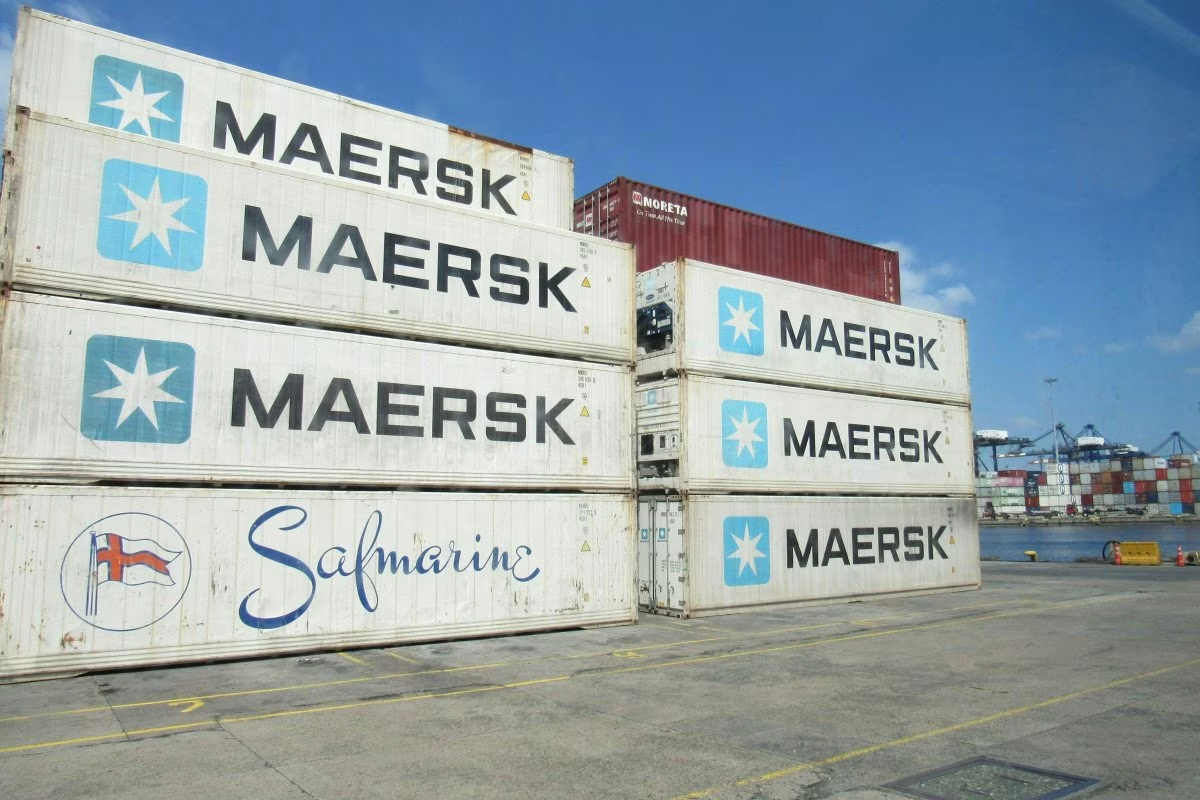
In a stark revelation of the impact of geopolitical turmoil on global trade, A.P. Moller-Maersk, one of the world’s foremost shipping giants, has reported that it is incurring an astonishingly high monthly cost of $500 million as a direct consequence of the ongoing conflict in the Middle East. The company’s chief executive, Vincent Clerc, has termed the situation as the “most comprehensive energy shock in our lifetimes,” illuminating the extent to which rising oil prices and disrupted shipping routes can wreak havoc on international logistics.
The Iranian conflict, which has severely affected operations in the vital Strait of Hormuz, has placed tremendous pressure on Maersk and, by extension, the global economy. This vital waterway is responsible for the transit of a significant volume of the world’s crude oil and is a crucial artery in the supply chain. With shipping traffic virtually at a standstill, the repercussions are being felt in every corner of the market. Maersk, which transports roughly one in five of the world’s seaborne containers, has found itself in a precarious position as it tries to navigate these turbulent waters.
Clerc’s concerns extend beyond mere financial implications; he fears that prolonged instability could lead to a broader collapse in trade as rising operational costs inevitably lead to diminished demand from consumers. This predicament has emerged as a double-edged sword; while freight rates have surged since the onset of hostilities, these gains have been eroded by higher fuel prices and escalating insurance premiums necessary to cover the perceived risks of operating in such a volatile environment.
As Maersk grapples with its daunting fiscal burden, the company also reported a dramatic decline in its pre-tax profits. In the first quarter of this year, profits plummeted to $292 million, down from an impressive $1.4 billion a year earlier. This drop, while disappointing, was nevertheless seen as better than analysts had forecasted, hinting at a perhaps more resilient core than some observers might suggest amid the developing crisis. Revenues similarly fell by 2.6 per cent to $13 billion—a reflection of both the economic climate and the inherent unpredictability of global shipping operations in the current era.
Despite these challenges, Maersk has held firm to its guidance for modest growth in the global container market. The company anticipates a growth range of 2 to 4 per cent. However, the conditions underpinning this forecast remain tenuous at best, imbued with uncertainty and volatility. Factors such as ongoing hostilities and oversupply due to new vessel deliveries complicate any optimistic projections. While the Strait of Hormuz remains a flashpoint, with over 800 ships and approximately 20,000 crew members currently stranded, the sense of urgency is palpable. Some vessels, like the American-flagged Alliance Fairfax, have been able to navigate the strait with military assistance, yet the general landscape is fraught with unpredictability.
Clerc candidly acknowledged the challenges ahead, stating that while the company is endeavouring to mitigate costs, there is only so much that can be done in terms of internal efficiency. In such an extreme environment, passing on costs to customers is becoming necessary, though this action carries its own set of risks. The size of the cost increases is unprecedented in recent memory, raising concerns about whether Maersk can continue to absorb these shocks without significant repercussions to its client base.
In comments reflective of the broader economic sentiments, Clerc noted the unique nature of this energy shock, driven largely by external forces beyond the control of shipping companies. He asserted the necessity of adapting to this changing landscape while remaining vigilant about the secondary effects of rising inflation and a potential decline in consumer demand. As the conflict unfolds and the situation in the Strait of Hormuz remains precarious—with parts of it reportedly mined—the spectre of further disruption looms large over the shipping industry.
The ramifications of these developments resonate beyond the shipping sector. A failure to resolve the situation in the Middle East will undoubtedly accentuate existing strains within global trade dynamics. Clerc’s concerns resonate widely with economists and analysts who fear that ongoing instability may lead to inflationary pressures and contractions in market demand. The repercussions could be felt across a multitude of sectors reliant on smooth logistical operations and access to affordable energy resources.
Setting the stage for an uncertain economic landscape, Maersk’s predicament encapsulates the fundamental vulnerabilities in today’s interconnected global economy. As it stands, shipping companies like Maersk must not only contend with the intricate realities of cost control but also navigate the treacherous waters of geopolitical tensions that can have far-reaching effects on supply chains.
Moreover, the unfolding situation has cast a long shadow over the shipping industry, leading to questions about future profitability and sustainability. With fluctuations not just confined to oil prices but also woven into the fabric of international politics, the prospect of navigating such a tumultuous environment becomes increasingly complex.
In reflecting on the current state of affairs, one cannot ignore the critical role played by shipping companies in sustaining global trade. As pivotal players like Maersk articulate their challenges, the broader implications of their struggles become painfully clear. The essential nature of supply chain integrity cannot be overstated—an industry on the brink can lead to scarcity and rising prices on goods across the board. The need for stable and secure shipping routes is more pressing than ever as uncertainties multiply, and companies around the world hold their breath in anticipation of both resolution and renewal.
As we remain observers of this unfolding narrative, it is essential to consider both the immediate and long-term consequences that may iterate from this crisis. Strategically, the ability of firms to adapt to such drastic changes will likely define their trajectories moving forward. In the face of daunting pressures, the resilience of Maersk and similarly situated firms will be put to the test in the weeks and months ahead, underscoring the intricate tapestry of commerce that binds nations together in this age of uncertainty.
Post Disclaimer
The following content has been published by Stockmark.IT. All information utilised in the creation of this communication has been gathered from publicly available sources that we consider reliable. Nevertheless, we cannot guarantee the accuracy or completeness of this communication.
This communication is intended solely for informational purposes and should not be construed as an offer, recommendation, solicitation, inducement, or invitation by or on behalf of the Company or any affiliates to engage in any investment activities. The opinions and views expressed by the authors are their own and do not necessarily reflect those of the Company, its affiliates, or any other third party.
The services and products mentioned in this communication may not be suitable for all recipients, by continuing to read this website and its content you agree to the terms of this disclaimer.
Related Posts


Previous Post
Next Post


