
Now Reading: Palantir contract ban will cut Met police jobs
-
01
Palantir contract ban will cut Met police jobs
Palantir contract ban will cut Met police jobs
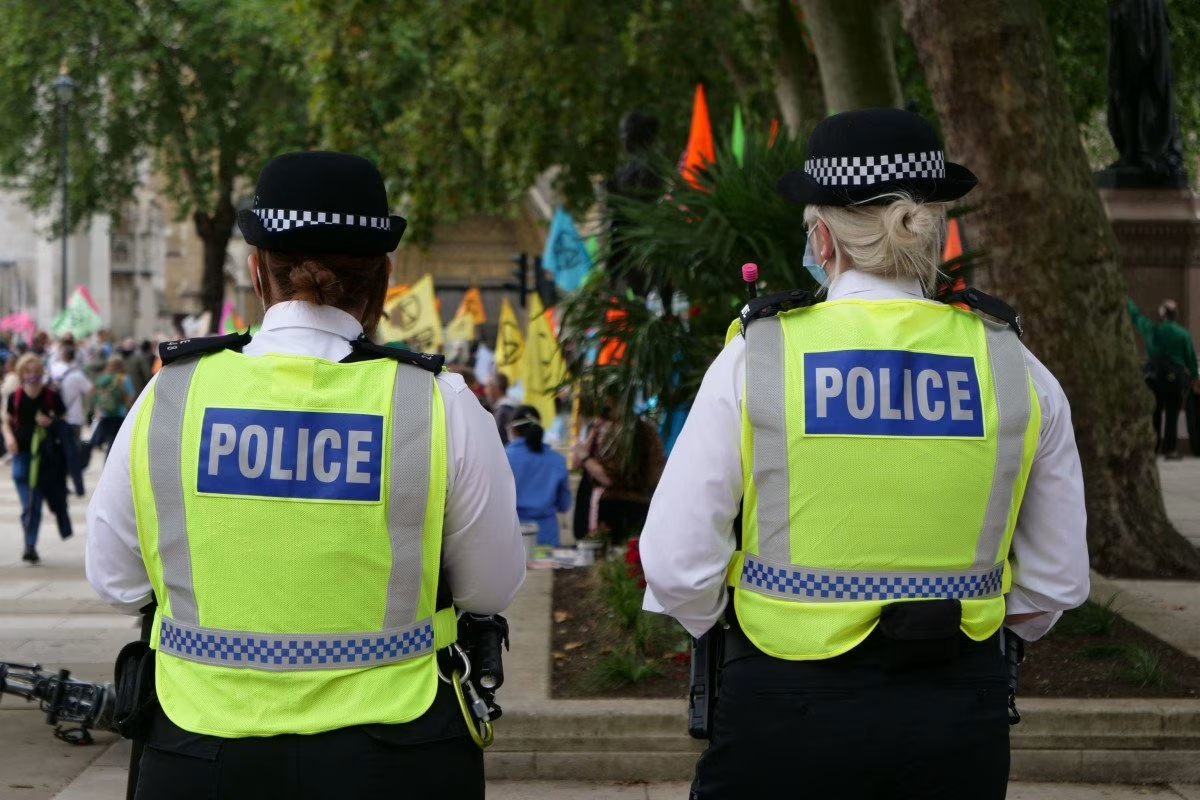
The High Court hearing into the Metropolitan Police and Palantir raises more than a single commercial dispute. It exposes a collision between the ambition to deploy advanced analytics in policing and the political fragility that surrounds public procurement in a time of heightened scrutiny over public spending, civil liberties, and the ethical boundaries of technology vendors. The court documents presented by Palantir portray a firm convinced that the mayor of London acted beyond his authority when he blocked a £50 million contract to supply a data driven policing platform. The Met Police, for its part, supports that narrative while insisting that the decision was not merely a commercial setback but a consequential choice about the operational integrity of frontline policing at a moment when analytics could have reshaped how officers deploy resources and respond to incidents.
What lies at the heart of this dispute is a tension familiar to anyone watching the interaction between state institutions and private technology suppliers in the digital age. Palantir presents itself as a capable supplier offering sophisticated tools designed to automate repetitive tasks and to speed up criminal investigations through real time data analysis. In its description of the project, the company framed Unified Operational Analytics as a system capable of delivering faster insights, freeing officers from bureaucratic drudgery, and enabling them to focus on investigative work that requires human judgment. The assertion that automation would translate into tangible cost savings resonates with a government economy that has grown increasingly explicit about the need to balance efficiency with public service delivery. If the Met could have used the platform to streamline routine tasks, it stands to reason that police time would be redirected to frontline duties rather than absorbed by administrative processes.
The counter narrative, advanced by the mayor and Mopac, is equally forceful. It rests on a procedural debate about how decisions are made in procurement and whether due consideration was given to the wider implications of choosing a single supplier. Mopac has argued that there was a clear and serious breach of procurement rules, a claim that situates the dispute within a wider political conversation about transparency and fairness in public sector contracting. For the Met and Palantir, the procurement argument is not purely technical; it is an argument about the legitimacy and legitimacy of the decisions that underwrite public money. If the contract was considered in isolation without taking into account potential ethical concerns raised by the mayor, Palantir contends, then the process itself is vulnerable to challenge. The Met defence is that the platform would have changed the way policing is managed on the ground, potentially increasing the speed and precision of investigations while simultaneously reducing costs through automation. The court therefore sits at the fulcrum of two competing logics: a procurement process anchored in rules and openness, and a policing strategy that emphasises operational efficiency and intelligence led policing.
The claimed consequences for policing are stark in the Palantir submissions. The company argues that the Met will face unpalatable cuts to frontline services as a direct result of the decision to cancel the contract. This is not simply a budget line in a departmental ledger; it is a statement about the effect of procurement choices on the ability of officers to respond effectively to crime. The line about frontline policing is a way of translating abstract procurement decisions into tangible outcomes for the public. It is a reminder that technology choices at the centre of government do not exist in a vacuum; they ripple through the daily work of those tasked with maintaining public safety. If Palantir’s analytics would have reduced the burden of administrative tasks and increased the speed of intelligence led operations, then the potential for improved outcomes is plausible. The challenge is to demonstrate that the benefits would have translated into measurable improvements for communities and that these improvements would not have been offset by other risks or costs.
The Met’s position that Palantir’s AI based analytics would have lowered costs through automation carries intuitive appeal but also invites scrutiny. Technology in policing has long promised greater efficiency and better outcomes, yet it also raises legitimate concerns about data governance, algorithmic bias, and accountability. The court will have to weigh the efficiency arguments against the potential for unintended consequences in the use of sensitive data, the risk of overreliance on automated processes, and the safeguards that were or were not in place to manage those risks. The Met’s desire to automate “bureaucratic processes” and to enable “faster analytics” points to a broader ambition to reconfigure how work is distributed within the force. It implies a shift from manual, time consuming tasks to automated workflows that can be scaled and repeated. The question that remains is whether such automation would have preserved, or perhaps enhanced, the quality of policing, while ensuring that the decision making remained firmly under human oversight.
Within this setting, the political dimension cannot be ignored. The government’s broader review of Palantir’s NHS contract, together with calls from Labour MPs and unions to block Palantir from public sector work, underscores the intersection of procurement policy, national political optics, and the perception of national security implications in vendor selection. Palantir’s sense of vulnerability here is not that of a single contract at risk, but of a business model that could become increasingly difficult to sustain if contractors face repeated political scrutiny and reputational harm. The company’s argument that other public bodies might be deterred from engaging with Palantir suggests a wider market risk, a cost in reputational depreciation that extends beyond the London Met. In this light the case is not merely about the merits of a single suite of analytics tools; it is about the reputational capital of a technology provider and the willingness of public bodies to take decisions that may be perceived as ethically or legally controversial.
On the side of the mayor and Mopac, the procurement critique operates as a necessary check on process and governance. In public procurement, rules exist to ensure competition, fairness, and value for money, but those rules are not a guarantee that the best technological outcome will be chosen. The ethical objections invoked by the mayor in relation to Palantir’s work for the Israeli military and US immigration enforcement reflect a broader debate about the alignment of government purchasing with a political conscience. Critics argue that procurement policies should not simply be about cost and capability, but also about the values that public bodies are seen to uphold. If the court finds that those objections breached procurement rules in a legally actionable way, the decision could be interpreted as a vindication of procedural norms over techno political considerations.
The back and forth between public policy and private capability has important implications for how cities plan their futures in a world where data analytics, artificial intelligence and machine learning promise to reshape the speed and quality of decision making. Proponents of analytics believe that routine tasks can be automated, freeing up human resources for more complex analytical work and for frontline policing. In a policing context, this is valuable, but it also raises concerns about the risk of over confidence in models, the potential for misinterpretation of data, and the danger of compromising human oversight in the pursuit of efficiency. The Met is careful to couple technological ambition with a commitment to safeguarding civil liberties and maintaining accountability, as these are not merely abstract concerns but practical requirements in maintaining public trust.
The legal context of the High Court hearing adds another layer of complexity. If Palantir’s case succeeds on the grounds of unlawful blocking of a contract, the decision could set an important precedent about the scope of executive power in procurement and the extent to which political considerations can shape decisions otherwise governed by statutory rules. Conversely, if Mopac’s position is upheld, it would reinforce the primacy of rigorous procurement processes, even when those processes involve decisions about high value, potentially transformative technology. Either outcome would influence how public bodies assess risk, manage vendor relationships and think through the governance frameworks that sit around the deployment of cutting edge tools.
The broader political economy question is whether public sector bodies should be seen as laboratories for innovation or as cautious stewards of public money where every decision is subject to intensive scrutiny. The NHS review, the Met’s front line focus, and the Labour and union criticisms together illustrate a nation wrestling with the competing imperatives of innovation and accountability. In practical terms, this means that future deployments of similar analytics platforms will likely be accompanied by clearer evidentiary requirements, more robust data governance, and a more explicit articulation of measurable outcomes. It is not enough to claim that automation will bring down costs or increase speed; the case for such improvements must be demonstrable and demonstrably in the public interest.
From a metropolitan policy perspective, the implications extend beyond the immediate contract in question. London has long positioned itself as a city at the nexus of finance, technology and public service administration. The Palantir episode tests how far the city is willing to go in embracing data driven approaches to policing and how it weighs those ambitions against the political sensitivities that accompany controversial procurement decisions. The Met’s leadership has argued that the shift to analytics is about enabling officers to focus more intently on investigative work, potentially changing the character of the police response from one of administrative burden to one more attuned to crime solving. If realised, this could represent a meaningful step in modernising a force that must operate under intense public scrutiny and adapt to a rapidly evolving threat landscape.
In the immediate term, the dispute will unfold in the High Court. The court’s interpretation of whether the mayor’s decision breached procurement rules or whether the blocking action was a proportionate reaction to legitimate concerns about ethics will determine not only the fate of Palantir’s contract but also the reputational and operational consequences for both sides. For Palantir, a successful challenge would reinforce the idea that governance and rule of law can coexist with rapid technological adoption, while a failure would reinforce the message that procurement decisions in the public sector are as much political as they are professional. For the Met, a finding in favour of the department could be seen as vindicating the need for careful vendor selection, even in a world where analytics promise efficiency. For the Mayor’s office, a ruling upholding Mopac would reinforce the importance of maintaining oversight and ensuring that any engagement with private providers falls within the bounds of policy and procedure.
This episode also sits within a longer arc about the role of private firms in public safety and the boundaries of public sector data use. Palantir’s claims of potential broader adverse commercial consequences threaten to shift the debate from a case specific to London to a wider discussion about the sustainability of data driven policing models. If public bodies begin to view private sector partners with greater caution, there is a risk that promising innovations could be stymied by concerns over procurement and ethics. Yet the counter argument is equally persuasive: the public sector must guard against the risks of procurement shortcuts, untested governance frameworks, or vendors whose claimed capabilities cannot be independently verified. The balance between these risks and rewards will shape how city hall decisions are made and how the relationship with technology suppliers evolves in the years ahead.
At stake is the core question of what modern policing should look like in a city as complex and diverse as London. The desire to harness AI for analysis and decision making sits alongside a duty to protect civil liberties, to maintain public trust, and to ensure that policy instruments are applied fairly and transparently. The court case thus acts as a stage on which these fundamental questions are debated, with real world consequences for how Londoners experience policing and how public institutions manage both cost and capability in an era of rapid technological change.
As the proceedings progress, observers will be watching closely for signs of how the court interprets the balance between procedural propriety and operational urgency. Palantir’s position is to present the case as one of procedural fairness and the necessity of considering the cost of inaction in frontline policing. The Met and Mopac will argue that the integrity of the procurement process and the ethical safeguards around procurement are paramount, even when the implications for policing capability and efficiency are potentially significant. The judgment will not just determine whether a single contract is reinstated, but will help define the parameters within which public sector innovation can proceed. In London, the debate sits at an uncomfortable intersection of economic efficiency, political accountability, and the simple, human reality that policing decisions matter to people living in communities where safety is a daily concern.
If the outcome favours Palantir, public bodies may be emboldened to seek out data driven methods with greater confidence, provided they can demonstrate robust governance and accountability. If the ruling favours Mopac, there will be a strong signal that procurement rules will be rigorously applied and that policy and ethics must shape even the most compelling technological proposals. Either way, the episode will contribute to a broader public policy conversation about how cities navigate the promises and perils of big data, and about the degree to which the state should rely on private sector capabilities to deliver essential services. It is a reminder that decisions taken in parliament square or in a court room have a direct bearing on the day to day safety and security of city residents, and that the path to smarter policing remains a work in progress rather than a guaranteed improvement.
Post Disclaimer
The following content has been published by Stockmark.IT. All information utilised in the creation of this communication has been gathered from publicly available sources that we consider reliable. Nevertheless, we cannot guarantee the accuracy or completeness of this communication.
This communication is intended solely for informational purposes and should not be construed as an offer, recommendation, solicitation, inducement, or invitation by or on behalf of the Company or any affiliates to engage in any investment activities. The opinions and views expressed by the authors are their own and do not necessarily reflect those of the Company, its affiliates, or any other third party.
The services and products mentioned in this communication may not be suitable for all recipients, by continuing to read this website and its content you agree to the terms of this disclaimer.
Related Posts


Previous Post
Next Post

