
Now Reading: Amid Economic Turmoil, Germany Faces Political Upheaval
-
01
Amid Economic Turmoil, Germany Faces Political Upheaval
Amid Economic Turmoil, Germany Faces Political Upheaval
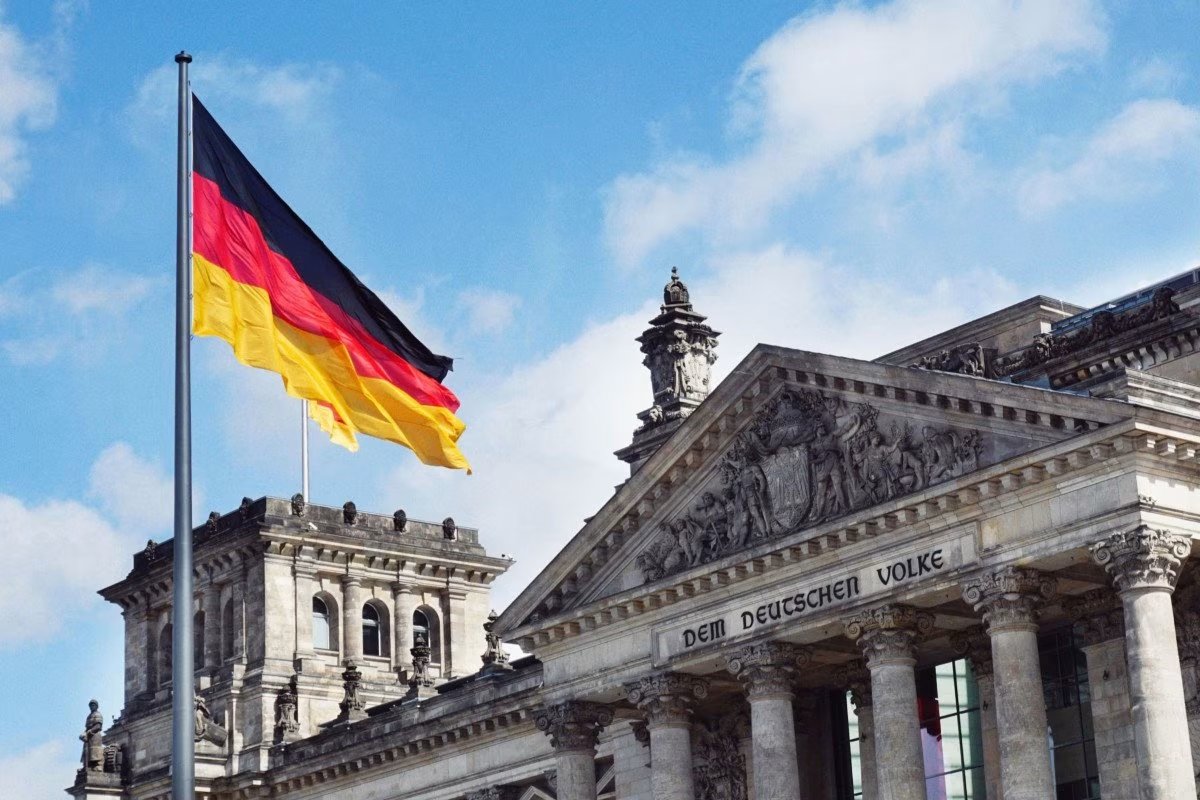
In the unassuming town of Bernburg, nestled within the state of Saxony-Anhalt, an impending political transformation looms large over Germany. The tranquil riverside locality has become an unlikely focal point for a dramatic election cycle, one that threatens to reshape the nation’s political landscape. As Saxony-Anhalt prepares for its state election on September 6, political parties are engaged in an increasingly desperate bid to sway public opinion. However, the scene reveals a stark divide; while traditional parties showcase their platforms through festival activities, the Right-wing populist Alternative für Deutschland (AfD) stands apart, attracting a crowd that overwhelms its competitors.
Ulrich Siegmund, the charismatic leader of the AfD in Saxony-Anhalt, has taken centre stage, drawing the adoration of supporters much like a pop idol. “He’s committed to things that the other parties are neglecting,” a young voter remarked after a spirited conversation with Siegmund. Polls indicate that the AfD is not merely gaining traction; it commands a staggering 41% in voter intent, a figure that more than doubles its previous election performance.
The Christian Democratic Union (CDU), led by Chancellor Friedrich Merz, trails significantly with around 25%, a dramatic decline from its previous coalition with the Social Democratic Party (SPD) and the Free Democratic Party (FDP). This electoral shift, unprecedented for Germany in recent history, invites both trepidation and excitement. Political analysts caution that should the AfD secure its position in the state government, it will usher in a new paradigm that mirrors anxieties seen elsewhere across Europe.
Local sentiment illustrates a growing discontent amongst voters. In conversations with residents, a prevailing sense of neglect emerges in relation to issues long sidelined by the political elite. This disillusionment has empowered the AfD, particularly among those who perceive their concerns regarding economic stability, immigration, and welfare as inadequately addressed by mainstream parties. “Many people who vote for AfD are not extremists,” noted Jan Mentrup from the industrial union IG Metall. “They are individuals feeling left behind, disappointed, and eager to signal their frustration.”
The broader context cannot be ignored. Germany wrestles with a multitude of economic challenges, coupled with pervasive inflation and rising costs of living. The perception that immigration levels are unsustainable further fuels resentment towards the political establishment. Citizens are increasingly critical of the welfare system, viewing it as overly generous to migrants while neglecting the needs of native Germans. Such sentiments resonate through the fertile grounds that the AfD utilises to cultivate support.
Germany’s economic malaise is evident in dismal growth figures. Since the rebound following the Covid-19 pandemic, the economy has failed to break the 1% growth barrier in any quarter, positing a stagnant landscape that citizens can palpably feel. The German Council of Economic Advisers recently projected meagre growth rates of 0.5% this year and 0.8% next, shackled by rising inflation and energy costs—a situation familiar to the broader context of economic disarray gripping the continent.
In discussions with economists, a systemic lack of confidence emerges. Tax increases and burdensome bureaucracy stifle growth, while the skilled labour exodus threatens to further exacerbate economic stagnation. “It’s a complex tapestry of issues,” remarked Carsten Brzeski, an economist at ING. “Energy costs are soaring, bureaucratic red tape is rampant, and job security is a fading promise for many.” The perception of an ailing economic model only heightens public outcry, producing fertile ground for an insurgent party to flourish.
Public discontent has duly evolved into political disillusionment, and the AfD, leading the charge as an alternative voice, effectively articulates this growing frustration. Their messaging targets key anxieties, particularly immigration policies. The resurgence of migration following both the Syrian refugee crisis and the recent influx of Ukrainian migrants has become a potent political issue. With a quarter of Germany’s population now composed of migrants, calls for tighter immigration controls resonate widely across demographics.
Traditional parties have struggled to address these fears, leading many citizens to question the sustainability of the welfare system in the face of rising migration. CDU member Ulrich Thomas acknowledged the necessity of qualified immigration but emphasised the need for a measured approach, devoid of uncontrolled influxes. “What we need are immigrants who are ready to integrate,” he noted, succinctly summarising the prevalent sentiment among moderate conservatives.
Meanwhile, the AfD adopts a more radical stance, calling for deportations and stringent immigration controls. Their messaging is simple yet impactful: “We want our old, safe Germany back.” This slogan finds echoes in the concerns of working-class citizens who feel that existing welfare policies reward inaction rather than hard work, perpetuating a cycle of dependency amongst certain segments of the population. The narrative that native citizens work tirelessly only to see benefits disproportionately favouring newcomers strikes a chord, galvanising support among disenfranchised voters.
The forthcoming election acts as a litmus test for the future of Germany’s political landscape. Should the AfD succeed in gaining governmental office, their ascendance would signal a marked departure from the post-war political consensus. Questions loom large over the implications of such a shift. Intriguingly, opponents of the AfD, including figures from the CDU, caution that their triumph would not only render the party an influential player but could set a precedent for other regions, both in Germany and beyond.
The electoral stakes are compounded by broader societal issues, including rising health care and pension costs, which have emerged as focal points for Merz’s administration. Efforts to reform welfare provisions reflect a growing recognition that the current system is unsustainable. However, changes proposed may ring hollow to a populace that feels increasingly disenfranchised, potentially wishing for diminished contributions to bear equitable results.
In this climate of disillusionment, older political paradigms face severe critique. The notion that established parties can address the substantial grievances among the populace is increasingly questioned amid feelings of betrayal over stagnating economic prospects. Political actors, adept at exploiting these sentiments, find their stock rises with the promise to address neglected issues. Recent movement among political factions only highlights the uncertainty governing this election cycle.
As the election date approaches, the implications of an AfD victory loom over the political discourse. Whether an acceleration towards populist policies heralds a shift in party dynamics or a reversion towards more autocratic measures remains to be seen. Each policy discourse emits a warning to traditional parties, a call to rethink how they engage with their constituents, and a reminder that insistent public engagement on pressing fiscal and social issues cannot be disregarded.
In Bernburg, as political tensions mount, the juxtaposition of celebratory festival activities and competitive electoral campaigning paints a vivid picture of a nation at a crossroads. The cacophony of voices reflects not only a discontent with the ruling political class but also an urgent societal demand for authentic engagement in shaping future governance. For the moment, the emergence of the AfD has thrown into stark relief the existing fractures within German politics, with implications reverberating far beyond the borders of Saxony-Anhalt. The foundations of the German establishment appear increasingly vulnerable, heralding a possible recalibration in how citizens interact with their political destiny.
Post Disclaimer
The following content has been published by Stockmark.IT. All information utilised in the creation of this communication has been gathered from publicly available sources that we consider reliable. Nevertheless, we cannot guarantee the accuracy or completeness of this communication.
This communication is intended solely for informational purposes and should not be construed as an offer, recommendation, solicitation, inducement, or invitation by or on behalf of the Company or any affiliates to engage in any investment activities. The opinions and views expressed by the authors are their own and do not necessarily reflect those of the Company, its affiliates, or any other third party.
The services and products mentioned in this communication may not be suitable for all recipients, by continuing to read this website and its content you agree to the terms of this disclaimer.
Related Posts


Previous Post
Next Post

