
Now Reading: Russia bans diesel exports after Ukraine refinery strikes
-
01
Russia bans diesel exports after Ukraine refinery strikes
Russia bans diesel exports after Ukraine refinery strikes
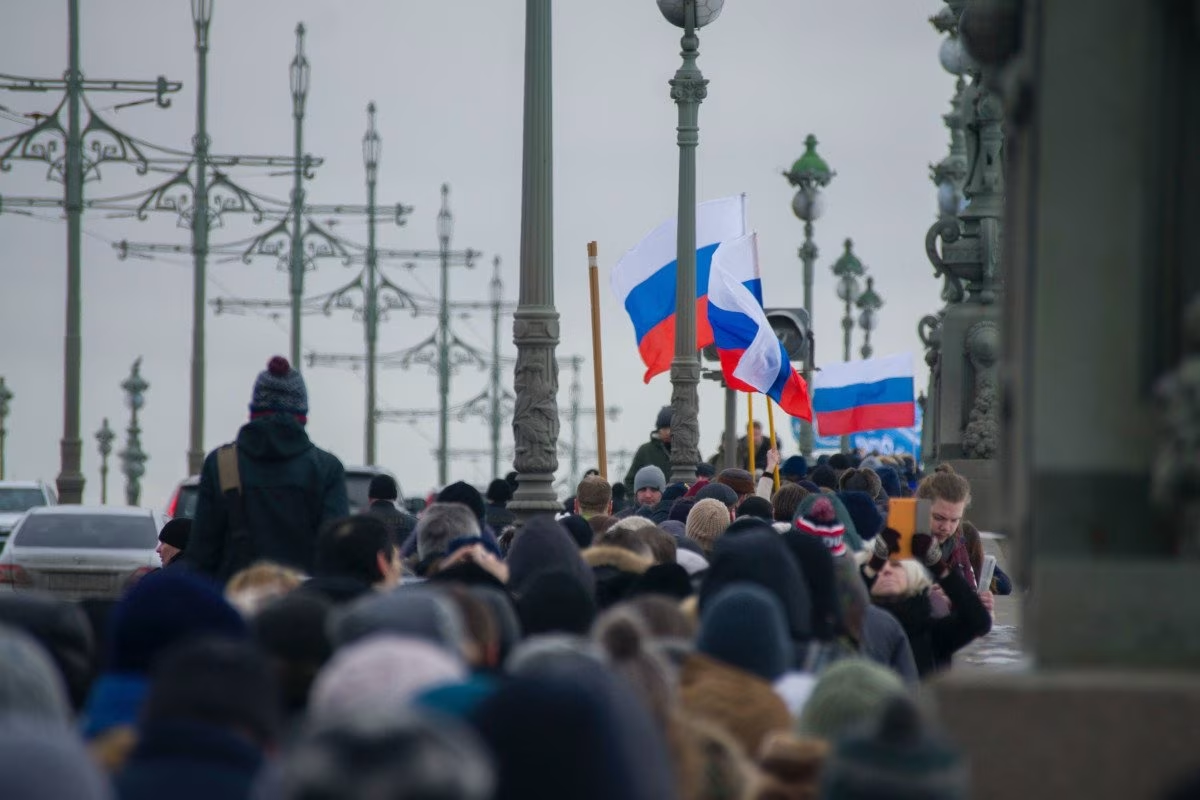
For a state that has long treated energy as both its birthright and its bargaining chip, Russia’s sudden decision to choke off its own diesel exports is a revealing act of defensive politics. Announced after a Kremlin meeting on Wednesday and set to run until July 31, the ban is being sold as a tidy administrative fix: keep more fuel at home, calm the queues, reassure an increasingly irritated public. In practice it reads less like routine market management and more like an admission that a critical system is under sustained strain.
The pressure point is not crude production but the more prosaic, more politically exposed business of turning oil into usable fuel and getting it to forecourts. A series of Ukrainian drone strikes on refineries and related infrastructure has disrupted that chain, and the consequences have been visible in an image the Kremlin loathes: long lines at petrol stations, day after day, across multiple regions. Shortages are not merely an economic statistic in a country built on the promise of abundance; they are a test of competence and a test of narrative.
Alexander Novak, the deputy prime minister, chose an unusually blunt register when he confirmed the export ban in a televised meeting. “Today, a ban on diesel fuel exports was introduced, and this will make it possible to increase supplies to the domestic market,” he said, before conceding the obvious political danger: “It is clear that the current situation at filling stations is causing concern among the public.” The point was not simply to communicate policy but to demonstrate that the state is present and responsive, that the shortages are being managed rather than endured.
Yet the surrounding details undermine the impression of control. The Kremlin’s own language, that supplies remained fragile, is not the rhetoric of a government confident in its buffers. Nor is the parallel announcement, that Russia intends to increase fuel imports from Asia, easy to square with the self-image of an oil-rich power insulated from ordinary constraints. Importing refined fuel is not, in itself, a strategic collapse, but it carries a sharp symbolic weight for a country whose leadership has spent years insisting that sanctions and wartime disruption have only strengthened domestic resilience.
Ukraine’s campaign has been building since April, increasingly aimed at Russia’s largest refineries, the nodes that matter most for both domestic supply and export earnings. The strikes have also demonstrated reach. This week’s attack on a major refinery in Western Siberia, described as one of the longest-range operations yet, was significant not only for what it may have damaged but for what it signalled: that distance from the front line is no longer a guarantee of safety for strategic assets. The war, already entering its fourth year, is continuing to broaden its practical geography.
The immediate response inside Russia has been the kind of rationing that governments prefer not to call by its name. Many regions have imposed restrictions on sales, limiting how much drivers can buy or banning the use of canisters at pumps. Such measures are designed to stop panic buying and to spread scarcity more evenly, but they also act as a public marker that the normal order has been disturbed. Once motorists begin to plan their days around refuelling rules, the conflict ceases to be an abstraction maintained at a distance by television and official statements.
It is in this sense that diesel becomes more than a commodity. Russia’s war economy rests on the ability to keep heavy transport moving and to keep revenues flowing, but it also rests on a quieter bargain with society: that the hardships of conflict will be managed, localised, and cushioned. Fuel shortages disrupt that bargain. They translate battlefield decisions and drone engineering into a daily inconvenience that people can photograph, complain about, and gossip over. Even in a tightly controlled media environment, queues do not need a newspaper to circulate.
Vladimir Putin, speaking at the same meeting, framed Ukraine’s strikes as psychological warfare: an attempt to damage Russia’s economy and “create a sense of anxiety in society”. He insisted that the goal was “unattainable” and that the resilience of Russia’s power system was “very high”, among the highest in the world. The formulation was classic Putin: an acknowledgement of hostile intent paired with a dismissal of its efficacy, a claim of robustness offered as reassurance and deterrent at once. But the export ban, by its nature, is a response to precisely the kind of vulnerability he was denying.
Kyiv’s stated objective has been more direct. Ukraine has said attacks on energy infrastructure are intended to force Moscow to the negotiating table. This is strategy by pressure rather than by symbolism. Refineries are not merely industrial sites; they are a conversion mechanism that turns Russia’s natural endowment into usable military and economic power. Disrupt refining capacity and the state must choose between internal stability and external earning, between keeping lorries moving at home and maintaining exports abroad. The Kremlin’s ban amounts to a decision, at least temporarily, to prioritise domestic calm.
That choice matters for the outside world because Russia is not a minor player in this market. It is normally the world’s second-largest exporter of diesel and gas oil, and those sales have helped fund its war effort. Even before the formal ban, Russia was reported to have been stopping some companies from selling diesel abroad. The numbers hinted at a tightening well in advance of Wednesday’s announcement: exports of seaborne diesel and gas oil fell by 39 per cent in June compared with a month earlier, as the country sought to shore up supplies. In other words, what is being presented as a sudden emergency is also the culmination of a month of constraint.
The geography of Russia’s diesel trade has already been reshaped by the West’s attempt to distance itself from Russian energy. In recent years Moscow has shipped fuel to markets such as Turkey and Brazil, redirecting flows that once went elsewhere. These arrangements have been part of the Kremlin’s broader argument that Russia can always find willing buyers, that efforts to isolate it simply create alternative networks. A prolonged export ban, even a nominally temporary one, tests that confidence. Buyers may tolerate volatility when prices are attractive, but they also plan around reliability, and diesel is not a niche cargo that can be swapped in and out without consequence.
There is also a political calculus in how long the ban is set to last. Ending it on July 31 gives the Kremlin a neat date that implies the problem is containable, a short-term episode rather than a structural shock. It leaves room for extension if the situation worsens, while allowing officials to claim success if queues ease. It is a timeline designed for messaging as much as for logistics. The government needs a sense of direction: the promise that this is being handled, that the state can still deliver basics, that the disruption is temporary and externally imposed.
Still, the decision to import fuel from Asia hints at how tight the margins may be. Russia has crude, but crude is not what motorists buy. Refined fuel depends on functioning plants, intact infrastructure, and distribution that can absorb disruption. Ukrainian drones have targeted precisely the assets where those margins are thinnest. When supply chains become brittle, governments reach for the blunt instruments that are easiest to explain: export bans, rationing rules, public scoldings of officials, and symbolic visits. These are familiar moves in states that pride themselves on strength but are wary of public irritation.
It would be a mistake, however, to imagine that this is only about motorists and forecourts. Diesel is the working fuel of a large, cold country that moves goods over vast distances. It matters to agriculture, construction, and freight, and shortages in one region can become shortages elsewhere as distributors and consumers try to anticipate the next pinch point. This is why governments treat fuel supply as a matter of state, not merely commerce. The fact that restrictions have been imposed across most regions suggests a worry not simply about local scarcity but about the dynamics of contagion, where fear travels faster than tankers.
For the Kremlin, the deeper risk is reputational. Modern Russia’s governing story has been one of restored order, material improvement, and the competence of central authority. War complicates that story but does not automatically destroy it; leaders can insist that sacrifice is necessary, that hardship is patriotic, that enemies are to blame. Yet certain kinds of disruption strike at the legitimacy of managerial power. If an oil superpower cannot keep fuel on the forecourt without banning exports and seeking imports, it raises uncomfortable questions about capacity, vulnerability, and the costs of a conflict that shows no sign of concluding.
For Ukraine, the effectiveness of the refinery strikes is measured not only by physical damage but by the forced choices they impose. The export ban is one such choice made visible. It broadcasts that Russia is having to defend the home front materially, not just rhetorically. It also suggests that even a state with enormous resources can be manoeuvred into reactive policy when critical infrastructure is repeatedly threatened. The campaign’s success, if it continues, will be judged by whether it can sustain pressure long enough to alter Moscow’s calculations, rather than merely to trigger another set of temporary controls.
In the short term, the Kremlin will hope that a combination of diverted supply, enforced restrictions, and additional imports will be enough to shorten queues and quieten complaint. But the episode has already exposed a change in the texture of the war. It is no longer confined to the battlefield or to the balance sheets of sanctioned companies. It is registering in the rhythms of ordinary life, in the friction of daily errands, in the anxious glance at a fuel gauge. That is the terrain Ukraine is trying to exploit, and it is why Russia, for all its oil wealth, has found itself resorting to an export ban to protect the appearance of normality at home.
Post Disclaimer
The following content has been published by Stockmark.IT. All information utilised in the creation of this communication has been gathered from publicly available sources that we consider reliable. Nevertheless, we cannot guarantee the accuracy or completeness of this communication.
This communication is intended solely for informational purposes and should not be construed as an offer, recommendation, solicitation, inducement, or invitation by or on behalf of the Company or any affiliates to engage in any investment activities. The opinions and views expressed by the authors are their own and do not necessarily reflect those of the Company, its affiliates, or any other third party.
The services and products mentioned in this communication may not be suitable for all recipients, by continuing to read this website and its content you agree to the terms of this disclaimer.
Related Posts


Previous Post
Next Post

