
Now Reading: Arkle Resources: Uranium Targets Defined and Drilling Imminent at the Erongo Project in Namibia
-
01
Arkle Resources: Uranium Targets Defined and Drilling Imminent at the Erongo Project in Namibia
Arkle Resources: Uranium Targets Defined and Drilling Imminent at the Erongo Project in Namibia
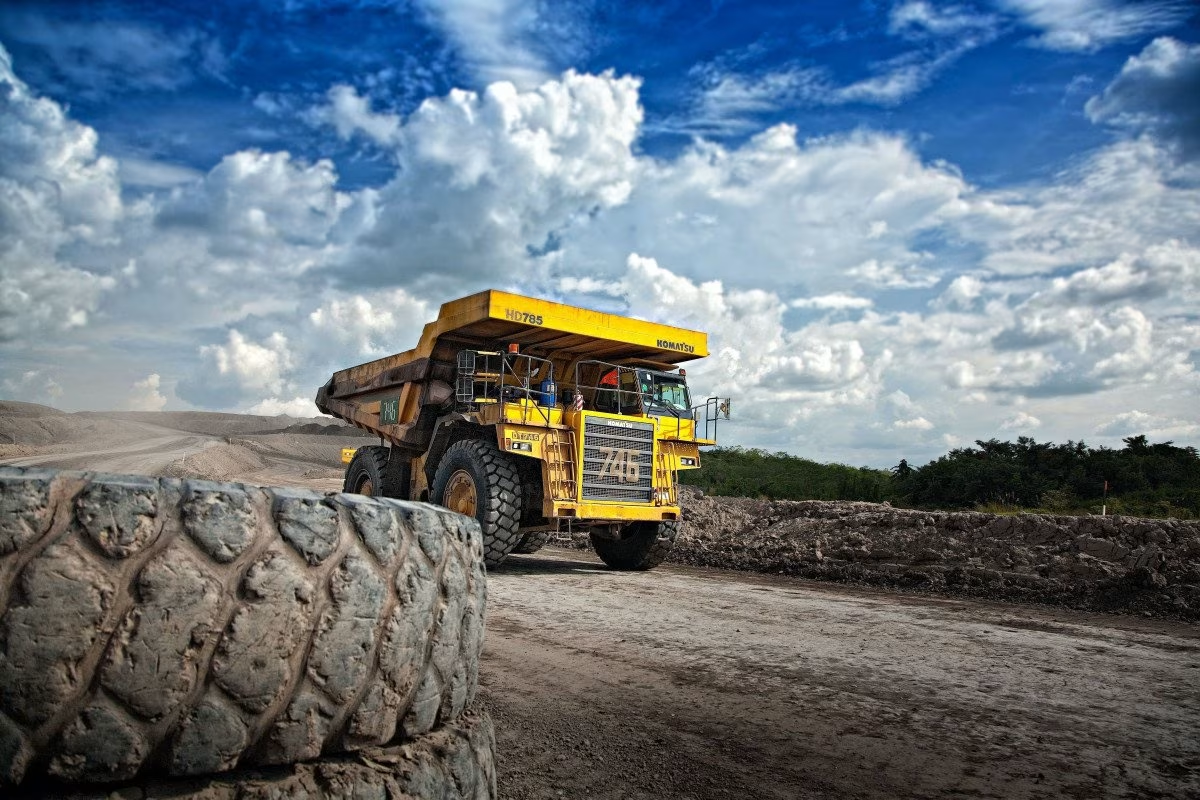
Arkle Resources is moving into a more decisive phase at its Erongo uranium project in Namibia, having converted recent geophysical work into a pipeline of drill targets across a large land package. For investors, the latest update matters because it shifts the story from broad exploration potential towards specific, testable uranium targets, with drilling now imminent on the most advanced prospect.
The company has identified two distinct styles of uranium mineralisation across its licences: palaeochannel-hosted uranium and hard rock uranium associated with uraniferous leucogranites. Both are well recognised in Namibia, and both are now present within Arkle’s portfolio. That geological duality gives the company more than one route to discovery, while the scale of the licence package offers scope beyond the initial drill campaign.
With around 4,000 metres of drilling planned, a 1,500-metre reverse circulation programme set to begin on the eastern palaeochannel target on licence 8995, and trenching work being prepared on a large leucogranite target, the next few months are likely to define the pace and direction of the wider Erongo story.
Table of Contents
- Why Namibia and Erongo matter for uranium exploration
- The geophysics programme that underpins the current targets
- Two uranium target styles, one project area
- The first drill test: eastern palaeochannel on licence 8995
- Trenching and sampling the hard rock uranium target
- A broader pipeline beyond the lead targets
- What could change the investment case over the next few months
- How to assess the programme realistically
- Outlook
- FAQ
Why Namibia and Erongo matter for uranium exploration
Namibia is one of the world’s most established uranium jurisdictions, and the Erongo region in particular hosts several important uranium deposits and operating mines. That matters because geology is rarely assessed in isolation. Neighbouring deposits can help confirm whether a company’s exploration model is sensible, whether target styles are proven locally, and whether mineralised systems are capable of extending across licence boundaries.
Arkle’s ground sits in an area where both key uranium styles seen elsewhere in Namibia are represented:
- Secondary uranium in palaeochannels, where uranium has been leached from hard rock by oxidised groundwater and later precipitated in ancient river channels under reducing conditions.
- Primary hard rock uranium associated with uraniferous leucogranites, where mineralisation is hosted directly within granitic rocks.
That backdrop is strategically important. It means the exploration thesis is not based on an unfamiliar or speculative deposit model. Instead, Arkle is testing target types already known to host uranium mineralisation in this part of Namibia.
The geophysics programme that underpins the current targets
The latest target generation has been built on a substantial first-phase geophysics programme. Arkle began with an airborne radiometric and magnetic survey covering roughly 12,000 to 13,000 line kilometres at relatively tight spacing. This kind of survey is often central to uranium exploration because radiometrics can highlight areas with elevated uranium signatures, while magnetics help map structures and lithologies that may control mineralisation.
The company has also completed a horizontal loop electromagnetic survey across three lines, focused mainly on what it believed to be an eastern palaeochannel on licence 8995. That work appears to have confirmed the palaeochannel interpretation, which is significant because palaeochannel uranium targets can be subtle under cover and often need multiple datasets to define them confidently.
On top of the airborne and electromagnetic work, Arkle has undertaken additional mapping over areas previously sampled, bringing together geophysics, surface geology and earlier field results. The resulting interpretation has involved internal geologists as well as specialist geophysicists and consultants. For an early-stage exploration company, that is an important detail. The quality of the interpretation can be just as critical as the quality of the raw data.
The practical outcome is straightforward: Arkle now has multiple uranium targets, including one that management considers sufficiently mature to drill immediately.
Two uranium target styles, one project area
Palaeochannel-hosted uranium
Palaeochannel uranium deposits are formed in ancient drainage systems. Over time, uranium is mobilised by groundwater from source rocks, then redeposited in channel sediments where chemical conditions allow it to precipitate. These deposits can be attractive because they may be relatively shallow, laterally extensive and amenable to systematic drilling.
At Erongo, Arkle has identified:
- A key eastern palaeochannel target on the southern licence, 8995
- Additional palaeochannel targets on the northern licences, 8290 and 8298
- A possible palaeochannel in the central-west area of licence 8995
Some of these targets remain conceptual and require more work, particularly additional electromagnetic surveying to refine basement profiles under cover. But the eastern palaeochannel on 8995 has advanced furthest and is now the clear priority for drilling.
There is also historical drilling near licence boundaries that may help refine the geological model. Arkle is carrying out downhole gamma-ray spectrometry on those older holes to better understand the palaeochannel system and guide current drill planning.
Uraniferous leucogranite targets
The second exploration style at Erongo is hard rock uranium in uraniferous leucogranites, often shortened to ULGs. These are granitic bodies capable of hosting primary uranium mineralisation. While palaeochannel deposits are secondary accumulations, leucogranite targets potentially offer a different scale and geometry of mineralised system.
Arkle has identified a notably large ULG target on the southern licence, measuring about one kilometre in length and 700 metres in width at surface. That makes it a meaningful exploration objective in its own right.
One of the more eye-catching details is that a previous sampling programme returned a sample grading 3,000 parts per million uranium from this broader target area. A single sample does not define a deposit, but it does support the rationale for follow-up work and suggests that uranium is indeed present within the system.
Management also believes there are multiple analogous targets elsewhere in the licence package, especially on the northern licences. If the southern ULG target proves to be mineralised at scale, the read-across to the rest of the portfolio could become highly significant.
The first drill test: eastern palaeochannel on licence 8995
The immediate catalyst is a 1,500-metre reverse circulation drilling programme aimed at the eastern palaeochannel on licence 8995. The campaign is expected to begin as soon as contractor availability allows, with June referenced as the likely timing.
From an investor’s perspective, this is the first real pass at determining whether the geophysics and surface work translate into subsurface uranium mineralisation. Management’s definition of success is clear and practical:
- Uranium intersected in multiple holes
- A meaningful thickness of palaeochannel fill
- Evidence that mineralisation extends through the channel system rather than occurring only as isolated pockets
- Potential uranium in the underlying basement rock as well as in the sedimentary fill
That final point is worth noting. Historical drilling in some palaeochannel systems has shown that mineralisation can extend into basement rocks below the channel fill. As a result, Arkle intends to drill slightly into the basement rather than stopping strictly at the base of the channel.
The holes are not expected to be deep. Management indicated that most may be drilled to a maximum of around 20 metres. In practical terms, that means 1,500 metres should provide a useful number of holes and give the company a reasonable first-pass test of geometry, continuity and uranium tenor.
The target is already supported by several indicators:
- A clear radiometric footprint
- Favourable uranium-thorium ratios
- Surface sampling that has confirmed uranium presence
- Hyperspectral and ASTER imagery suggesting continuation of the geological trend associated with nearby mineralisation
Arkle also believes the eastern palaeochannel may not be a single simple feature. Instead, there could be sub-channels within two broader channel zones, potentially creating a more complex but also more prospective architecture. Drilling will be needed to determine whether that interpretation holds.
Trenching and sampling the hard rock uranium target
While drilling on the palaeochannel takes priority, Arkle is also advancing the ULG target on the southern licence. The next step here is not immediate drilling, but trenching, mapping and systematic sampling.
In this context, trenching does not mean deep excavation into fresh rock. Instead, the plan is to remove shallow surface cover, in some places perhaps only around 30 centimetres thick, to expose the bedrock properly. That should allow geologists to map the leucogranite more accurately along strike and understand how uranium mineralisation is distributed.
The company’s objective is to determine whether uranium occurs consistently across the exposed extent of the target. If sampling supports continuity and confirms the geological model, Arkle would then design a dedicated drill programme.
That second-phase drilling could be more substantial than the palaeochannel work. Management suggested holes of up to 200 metres depth may be required, reflecting the possibility that the target consists either of stacked leucogranite units or one broader homogeneous body. The difference matters because it affects both the geometry and potentially the resource scale.
If drilling were to confirm mineralisation throughout a large leucogranite body, it could open the door to a materially larger hard rock uranium opportunity than the shallow palaeochannel target alone.
A broader pipeline beyond the lead targets
One of the stronger features of the Erongo project is that Arkle is not reliant on a single target. The licence package covers more than 500 square kilometres, and management has repeatedly emphasised that work will continue in parallel across the portfolio rather than narrowing the programme to just one or two prospects.
This matters because exploration value is often created in layers:
- Generate new targets through geophysics and mapping
- Prioritise the most advanced targets for drilling
- Keep earlier-stage targets moving up the curve behind them
Arkle appears to be following that model. As drilling proceeds on the eastern palaeochannel and trenching advances on the ULG target, field teams are also expected to continue mapping and sampling across the northern licences. Additional horizontal loop electromagnetic work is planned to help define palaeochannels near the boundary with Elevate Uranium’s ground, where the Koppies resource at Marenica provides a useful regional analogue.
That parallel approach is sensible from a capital allocation standpoint. Mapping, sampling and target refinement are relatively low-cost compared with drilling, so the company can continue building its inventory without materially changing the overall risk profile of the programme.
What could change the investment case over the next few months
The central question for investors is no longer whether Arkle can generate targets. It has done that. The next question is whether those targets carry uranium in sufficient thickness, continuity and grade to justify follow-up drilling and, eventually, a resource pathway.
Several near-term developments will be particularly important:
- Final refinement of drill hole locations using downhole gamma-ray spectrometry data from historical holes
- Commencement of RC drilling on the eastern palaeochannel target
- Assay results from the first drill campaign
- Trenching and mapping results from the southern ULG target
- Sampling results that support or challenge the hard rock uranium model
- Potential expansion of drilling if the first campaign is successful
Management has indicated that successful results could accelerate the company’s development timeline materially. A maiden mineral resource estimate had previously been framed around 2027, but strong early drilling could potentially bring that forward into 2026.
That is an ambitious statement, but it gives a useful sense of the stakes. If the initial drilling confirms a mineralised palaeochannel system with enough scale and consistency, the company could quickly move into more extensive drilling focused on infill and extensions. In junior exploration, timelines compress when geological confidence rises.
“With good results, there is an ability to really transform the company and rerate it.”
That captures the broader significance of the current campaign. Exploration stories can remain conceptual for long periods. Once a company starts drilling well-defined targets in a proven uranium district, the market begins to reassess both geological risk and strategic value.
How to assess the programme realistically
There is clear upside in Arkle’s current positioning, but investors should also keep expectations grounded. Early-stage uranium exploration remains inherently uncertain. Good geophysics, promising surface samples and favourable regional analogues improve the odds, but they do not guarantee discovery.
Several factors will determine whether the programme delivers on its promise:
- Geological continuity: isolated uranium intersections are less meaningful than broad, repeated mineralisation across the target.
- Channel architecture: palaeochannel deposits depend heavily on sediment thickness, permeability and redox boundaries.
- Assay turnaround times: even successful drilling can lose momentum if lab results are delayed.
- Contractor scheduling: the company has noted that drill timing is subject to availability.
- Follow-up capital discipline: success often creates pressure to accelerate, so sequencing and prioritisation will remain important.
Even so, the project now appears to be entering the phase where data can begin to replace speculation. That is often when junior resource stories become easier to evaluate on their merits.
Outlook
Arkle Resources has reached a more consequential stage at Erongo. The company has used airborne radiometrics, magnetics, electromagnetic surveying, mapping and sampling to identify multiple uranium targets across a large Namibian land package. Crucially, those targets span both of the main uranium deposit styles recognised in the region.
The immediate focus is the eastern palaeochannel on licence 8995, where shallow RC drilling should provide an early test of whether the geophysical model translates into mineralised channel fill and potentially uranium-bearing basement. In parallel, trenching and sampling on a large uraniferous leucogranite target could establish the basis for a second, deeper drilling campaign.
For investors, the significance lies in the combination of imminent drilling, multiple shots on goal and a potential acceleration in development timing if results are positive. This is no longer just a regional exploration concept. It is becoming a sequence of specific geological tests with the capacity to reshape how the market values the project.
If the first pass drilling delivers uranium in multiple holes and the hard rock target continues to strengthen through trenching and sampling, Erongo could move quickly from promising exploration ground to a more advanced uranium growth story.
FAQ
What has Arkle Resources identified at the Erongo uranium project?
Arkle has identified two main uranium target styles at Erongo in Namibia: palaeochannel-hosted uranium and hard rock uranium associated with uraniferous leucogranites. It has also generated multiple individual targets across its licence package, with one palaeochannel target on licence 8995 now drill ready.
What is the first drilling programme planned at Erongo?
The first programme is a 1,500-metre reverse circulation drilling campaign targeting the eastern palaeochannel on licence 8995. The holes are expected to be relatively shallow, with most likely drilled to around 20 metres depth.
Why is the eastern palaeochannel target important?
It is the most advanced target in the portfolio and has been supported by airborne radiometric and magnetic data, electromagnetic surveying, surface sampling and satellite-based imagery. It also lies in a geological setting analogous to nearby Namibian uranium deposits hosted in palaeochannel systems.
What are uraniferous leucogranite targets?
These are hard rock targets where uranium is hosted within granitic rocks rather than secondary channel sediments. At Erongo, Arkle has outlined a large leucogranite target on the southern licence and plans to expose, map and sample the fresh rock before deciding on deeper drilling.
How much drilling is planned in total?
Arkle has indicated that around 4,000 metres of drilling are planned overall, with the first 1,500 metres focused on the eastern palaeochannel target and further drilling expected to follow on other targets depending on results.
Could successful results accelerate a resource timeline?
Yes. Management has indicated that if the initial drilling is successful, the timeline for a maiden mineral resource estimate could potentially be brought forward from 2027 to 2026.
Post Disclaimer
The following content has been published by Stockmark.IT. All information utilised in the creation of this communication has been gathered from publicly available sources that we consider reliable. Nevertheless, we cannot guarantee the accuracy or completeness of this communication.
This communication is intended solely for informational purposes and should not be construed as an offer, recommendation, solicitation, inducement, or invitation by or on behalf of the Company or any affiliates to engage in any investment activities. The opinions and views expressed by the authors are their own and do not necessarily reflect those of the Company, its affiliates, or any other third party.
The services and products mentioned in this communication may not be suitable for all recipients, by continuing to read this website and its content you agree to the terms of this disclaimer.

Previous Post
Next Post

