
Now Reading: The Imperative Shift in Europe’s Defence Strategy Amidst Rising Tensions
-
01
The Imperative Shift in Europe’s Defence Strategy Amidst Rising Tensions
The Imperative Shift in Europe’s Defence Strategy Amidst Rising Tensions
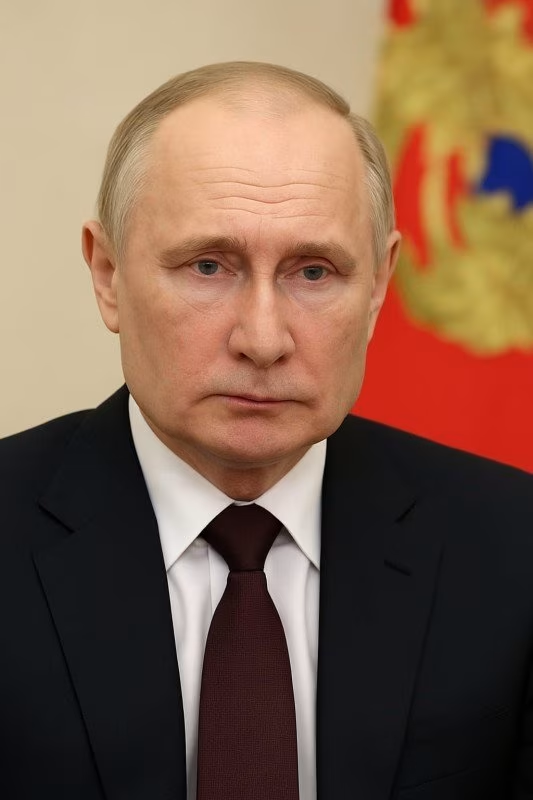
As geopolitical tensions escalate across Eastern Europe, a renewed focus on defence strategies has become paramount for European nations. The ongoing conflict involving Ukraine is not merely a distant concern for the continent; it serves as a stark reminder of the vulnerabilities that many nations face in today’s volatile geopolitical landscape. The recent discussions surrounding the formation of alternative defensive plans, particularly within the framework of NATO, highlight a significant pivot in European defence policy.
In recent weeks, high-ranking officials and defence analysts have underscored the need for a robust and adaptable response to potential threats, particularly those emanating from Russia. The dialogue has suggested a reassessment of the existing military structures and arrangements within NATO, urging member states to strategically prepare for various contingencies that could arise in an increasingly unpredictable environment.
One of the focal points in these discussions is the emerging notion of a “NATO Plan B.” While the alliance has long relied on collective defence principles as articulated in Article 5, the recognition that such measures may not suffice in the event of unconventional warfare or hybrid conflicts has prompted a call for innovative approaches. European leaders have begun to articulate a vision that prioritises flexibility, rapid deployment capabilities, and advanced technological integration to counteract asymmetric threats.
Poland has emerged as a notable case study in this context. The nation, which shares a border with Ukraine, has experienced an economic revitalisation that has reinvigorated its military expenditures. Poland’s strategy aims to strengthen its defence capabilities while simultaneously fostering collaboration with NATO allies. The Polish government is keenly aware that its geographical position renders it vulnerable to aggression and, as such, serves as a linchpin in broader European defensive postures.
However, Poland’s economic success, often referred to as an “economic miracle,” is faced with the spectre of potential instability if the regional security environment deteriorates further. Analysts warn that while current economic indicators are promising, continuous investment in defence must remain a top priority to sustain this growth. The integration of military preparedness with economic resilience is increasingly viewed not only as a defensive necessity but as a cornerstone of national stability.
This perspective is echoed in the broader narrative of European defence, where the implications of Russian aggressiveness are felt beyond immediate borders. The Kremlin’s actions have amplified the urgency for NATO to revisit its strategic objectives. There are calls for a departure from reactive strategies and an embrace of proactive measures that delineate clear defensive lines. This shift necessitates unity among NATO members, as disparate levels of commitment could jeopardise collective security.
Contributions from political heavyweights in the UK have also highlighted the pressing need for a reassessment of spending and strategic focus. British officials have debated the feasibility of rethinking longstanding policies such as the triple lock on pensions, suggesting that funds could be better diverted to bolster defence capabilities. Such discussions signal a growing recognition that national security cannot be assured without adequate financial commitment, especially in times of heightened risk.
The impact of these discussions is currently reverberating through UK politics. As emerging leaders muse over fiscal policies and the allocation of resources, the overarching theme remains clear: defence spending must reflect the realities of the contemporary geopolitical landscape. The prevailing sentiment among analysts is that incremental adjustments will no longer suffice. A comprehensive approach that integrates diplomatic, military, and economic strategies is essential for ensuring resilience against external threats.
As the NATO alliance prepares for potential confrontations in the Baltics, the importance of demonstrating unity and resolve has never been greater. Defence strategists have warned that indecisiveness or disunity could embolden adversaries, particularly in light of the Kremlin’s overt hostility towards Western interests. The imperative to bolster defensive postures is further underscored by the prevailing uncertainty regarding the Kremlin’s intentions and its capacity to sustain military operations in Ukraine.
Moreover, the evolving narrative around alliances underscores the significance of a collective approach. Recent actors within the defence sphere advocate for enhanced military cooperation among NATO members to establish a cohesive response mechanism. The discussions traverse beyond merely defensive postures; the emphasis is also on developing a shared intelligence network that could facilitate preemptive measures against potential aggressors.
Within this framework, the role of public discourse cannot be overlooked. The media’s portrayal of defence strategies, coupled with governmental messaging, plays a crucial role in shaping public opinion and political pressure. The discourse surrounding defence not only informs public understanding but also influences policy decisions at the highest levels of government. Thus, a well-informed citizenry becomes an essential ally in the broader mission of safeguarding national and regional security.
Yet, as European nations brace for a recalibrated defence strategy, the challenge remains to balance immediate military needs with broader socio-economic imperatives. Governments must navigate the delicate terrain of ensuring a robust defence without compromising the welfare of their citizens. Investment in defence must also translate into tangible benefits at home, fostering economic growth while reinforcing national security.
In conclusion, the urgency of revising defence strategies in response to burgeoning threats from adversarial nations cannot be overstated. As European nations grapple with the realities of today’s security landscape, the need for an adaptable and proactive approach has become increasingly clear. The collaborative efforts within NATO, alongside increased military investments in nations like Poland, are pivotal in cultivating a formidable response to challenges that lie ahead. The discussions around alternative defence frameworks signal a transition towards a more resilient and unified European security architecture. As such, the onus is on both leaders and citizens to engage in the discourse that will shape the future of Europe’s defence policy amid a turbulent geopolitical milieu.
Post Disclaimer
The following content has been published by Stockmark.IT. All information utilised in the creation of this communication has been gathered from publicly available sources that we consider reliable. Nevertheless, we cannot guarantee the accuracy or completeness of this communication.
This communication is intended solely for informational purposes and should not be construed as an offer, recommendation, solicitation, inducement, or invitation by or on behalf of the Company or any affiliates to engage in any investment activities. The opinions and views expressed by the authors are their own and do not necessarily reflect those of the Company, its affiliates, or any other third party.
The services and products mentioned in this communication may not be suitable for all recipients, by continuing to read this website and its content you agree to the terms of this disclaimer.
Related Posts


Previous Post
Next Post

