Now Reading: The Uncertain Horizon: Challenges Facing Andy Burnham’s Potential Premiership
-
01
The Uncertain Horizon: Challenges Facing Andy Burnham’s Potential Premiership
The Uncertain Horizon: Challenges Facing Andy Burnham’s Potential Premiership
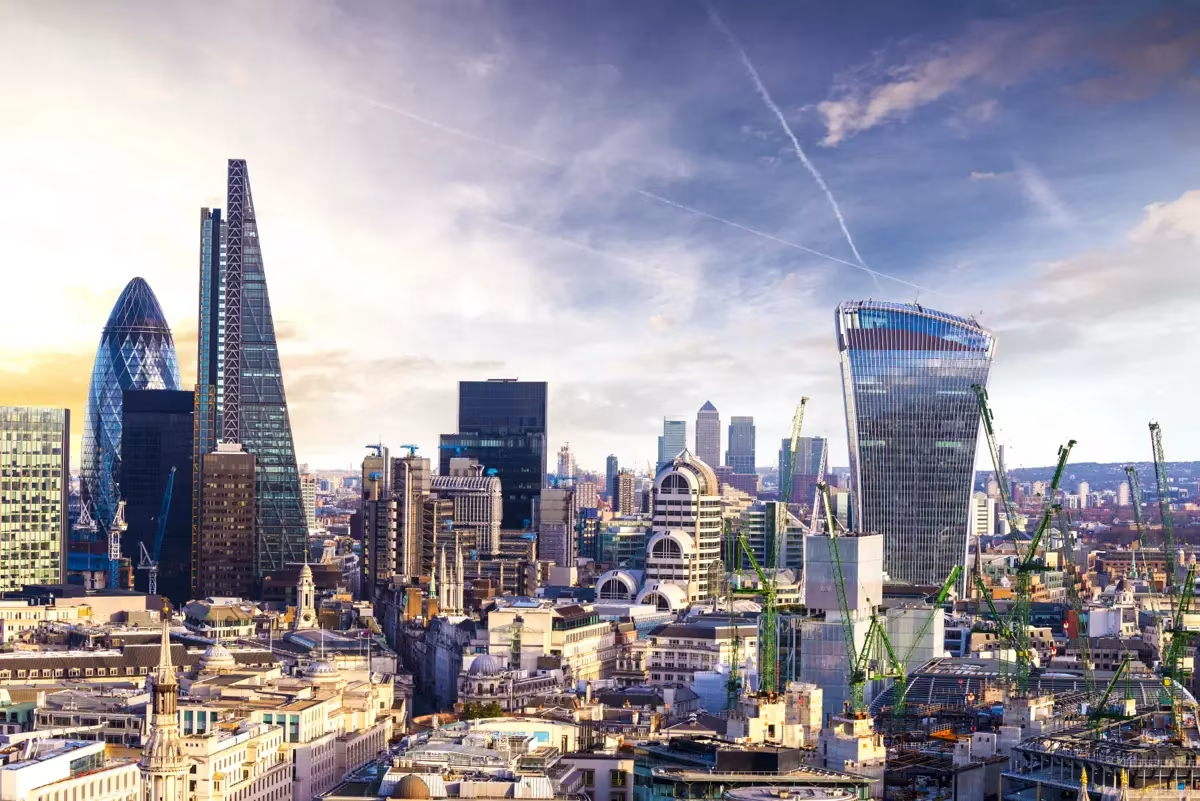
The resignation of Sir Keir Starmer from 10 Downing Street marks yet another pivotal moment in British politics, ushering in speculation around the future direction of the Labour Party under the banner of “Manchesterism” led by Andy Burnham. As Burnham positions himself as the likely successor, a myriad of economic challenges confront him and his potential chancellor—Ed Miliband and Wes Streeting being the front-runners. These challenges, familiar yet daunting, threaten to define their tenure long before policies are crafted or promises made.
At the heart of these concerns is a stubbornly low growth rate that has beleaguered the UK economy, particularly in the years since the 2008 global financial crisis. The average annual growth rate fell from approximately 3 per cent between 1998 and 2008 to just over 1 per cent in the subsequent decade. This decline is attributed chiefly to a marked reduction in productivity, a malaise not unique to Britain but widespread across wealthy nations. The spectre of stagnant growth looms large, stripping successive governments of the tools to address other pressing issues effectively.
Starmer and his Chancellor Rachel Reeves attempted to unlock the economy through a two-pronged strategy: first, to mitigate the political instability wrought by Brexit, and second, to inject £100 billion into public investment. The impact of this investment remains to be seen, but the early verdict is increasingly pessimistic. As the political climate continues to shift, the outcomes of these initiatives remain uncertain, compounded by the financial burdens tied to significant tax increases such as the £25 billion rise in employers’ national insurance contributions.
As Burnham prepares for his potential premiership, his commitment to public investment as a vehicle for growth will be scrutinised. Under his ‘Manchesterism’ philosophy, the aim is not merely to stimulate economic activity but to foster a deeper sense of community by placing essential services back into public control. To this end, his first moves as prime minister will likely hinge on how effectively he can negotiate the complex intersection of economic policy, public expectation, and the fiscal realities left behind by his predecessor.
The issue of inflation adds another layer of complexity for any incoming chancellor. The UK is experiencing its highest inflation rates in decades, exacerbated by a series of global shocks including the pandemic which disrupted supply chains, the war in Ukraine that severely affected energy prices, and ongoing geopolitical tensions in the Middle East. Such economic vulnerabilities were amplified by taxation policies implemented during Starmer’s administration, leading many to question their efficacy in an already inflationary environment. The increase in national insurance contributions was particularly controversial, being accused of sidelining the very objectives they were designed to support.
Since Labour took power in mid-2024, unemployment has risen to 4.9 per cent from 4.2 per cent, translating into approximately 300,000 more jobless individuals. This rise in unemployment was particularly pronounced following Reeves’s controversial fiscal measures. Payrolled employment has decreased by over 200,000, corresponding with a drop in job vacancies of approximately 121,000, amidst murmurs of business discontent regarding tax regulations and minimum wage policies. Perhaps most alarming is the rise in youth unemployment, now eclipsing 16 per cent, reaching a decade-high level. The challenge for Burnham will be how to stimulate job creation without sacrificing the precarious economic gains Labour has secured—namely, a sustained increase in wages that outpaced inflation over the past several months.
Maintaining a delicate balance between addressing the cost of living crises while ensuring employment opportunities is necessary, though inherently complicated. As Burnham surveys the landscape, he must navigate the treacherous waters of public sentiment, which prioritises the cost of living as the utmost concern; it was consistently ranked among the top issues in polls since Starmer assumed office. Burnham’s vision for ‘Manchesterism’ aims to directly alleviate these pressures by instating broader public control over essential services, which he believes can directly impact living costs. However, this ambitious vision brings with it monumental financial considerations that need reckoning.
In the context of stretched public finances, questions loom: how will Burnham finance his ambitious policies? The debt level, consequently, is a pressing concern. The latest economic reports reveal that the UK boasts a debt-to-GDP ratio of 95.1 per cent—levels unseen since the 1960s. With government borrowing reaching £23.3 billion in May alone, exceeding forecasts by £5.6 billion, the mounting cost of debt servicing emerges as a heavy burden upon the economy, projected to surpass £100 billion annually until 2030. The financial prudence required to ensure sustainable growth while adhering to Labour’s manifesto pledges remains a colossal challenge for the new government.
The current political terrain reveals deep-seated concerns among constituents—not merely about unemployment or economic growth but regarding the stability and direction of the government itself. As Burnham contemplates assembling his cabinet and shaping his economic agenda, he must reflect on the lessons learned from Starmer’s administration, which was marked by economic volatility and public discontent. The apparent disconnect between wage growth and the lived experience of the populace presents an intricate puzzle, which would require not just economic acumen but also a concerted effort to rebuild trust in leadership.
Burnham’s potential premiership, therefore, is not merely a test of economic policy; it is a referendum on the viability of progressive politics in modern Britain. He is charged not only with reviving economic growth but also with recalibrating the relationship between the state and its citizens in the wake of rising discontent. As he embarks on this journey, the choices he makes will resonate far beyond the immediate challenges of unemployment, inflation, and public funding; they will shape the very identity of the Labour Party and its ability to govern in an era marked by uncertainty. Truly, this is a moment laden with both possibility and peril.
Post Disclaimer
The following content has been published by Stockmark.IT. All information utilised in the creation of this communication has been gathered from publicly available sources that we consider reliable. Nevertheless, we cannot guarantee the accuracy or completeness of this communication.
This communication is intended solely for informational purposes and should not be construed as an offer, recommendation, solicitation, inducement, or invitation by or on behalf of the Company or any affiliates to engage in any investment activities. The opinions and views expressed by the authors are their own and do not necessarily reflect those of the Company, its affiliates, or any other third party.
The services and products mentioned in this communication may not be suitable for all recipients, by continuing to read this website and its content you agree to the terms of this disclaimer.
Related Posts


Previous Post
Next Post