Now Reading: Elon Musk puts a weekly ceiling on Tesla’s appetite for external AI
-
01
Elon Musk puts a weekly ceiling on Tesla’s appetite for external AI
Elon Musk puts a weekly ceiling on Tesla’s appetite for external AI
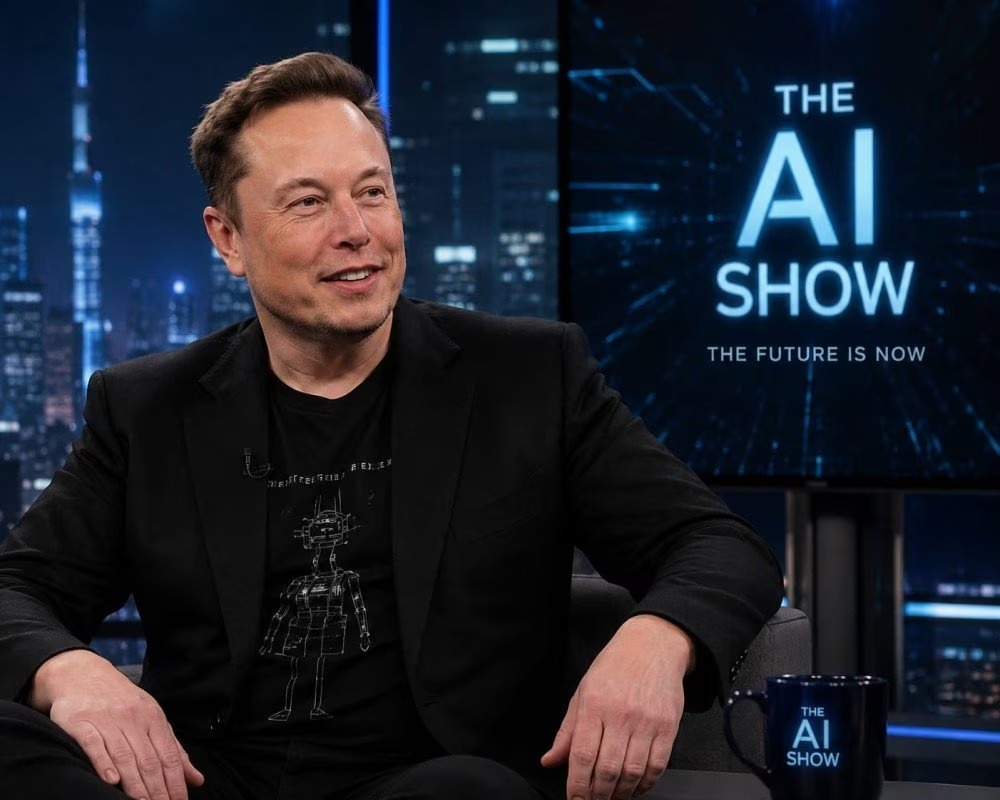
Tesla employees have been told to curb their use of external artificial intelligence tools, after Elon Musk introduced a weekly limit of $200 (about £150) on spending with third-party AI services. The instruction, reported by The Information, lands at an awkward moment for corporate America, where executives are simultaneously demanding the productivity gains promised by machine intelligence and quietly wincing at the invoices required to obtain them.
The cap applies to staff experimenting with, or relying upon, paid AI products outside the company. It does not, notably, apply to Grok, the chatbot developed by xAI, Musk’s own AI venture. In one gesture, Tesla is attempting to impose the disciplines of a procurement department on a technology that has spread through workplaces with the speed of a browser tab: fast enough to transform habits, slow enough to defy accounting.
Only months ago, Musk was evangelising about the economic potential of AI inside Tesla, predicting “nutty high” increases in productivity per worker. The phrase fitted the prevailing mood in boardrooms. For much of the past year, the story line has been one of acceleration: more tools, more licences, more training, more experimentation, and a belief that the cost would be justified by the gains. Yet the arithmetic of advanced AI is stubborn. Unlike many older software systems, where an upfront subscription carries most of the cost, the most capable models charge according to usage. The more employees query, generate, code, rewrite and analyse, the more the meter runs.
In practice, that metered model exposes a tension between organisational enthusiasm and individual behaviour. When a company urges staff to “use AI everywhere”, it is hard to police what “everywhere” becomes. Some uses are strategic, shaving days off a coding sprint or accelerating a research brief. Others are trivial, a kind of digital fidget spinner deployed to summarise emails, format internal documents, or produce first drafts of messages that might have been written without assistance. The bill, however, does not distinguish between a task that changes a product road map and a task that merely helps someone appear busy.
This is the uncomfortable backdrop to Tesla’s new limit. A company famed for its appetite for risk is now trying to instil the mundane virtues of budgeting and prioritisation. The cap suggests that, within Tesla, AI spending has become sufficiently widespread, and perhaps sufficiently diffuse, that finance teams can no longer treat it as experimental. It has become an operational line item, susceptible to the same scrutiny as travel expenses or cloud computing.
Tesla is not alone. Uber, which had previously encouraged its workforce to embrace AI tools, has moved to introduce a monthly limit of $1,500. Meta, Walmart and Coinbase have also indicated they intend to place restrictions on staff usage, as the early phase of exuberant adoption gives way to something closer to cost control. The pattern is telling. It suggests the first wave of AI deployment inside large companies has produced a familiar result: pockets of genuine improvement, a great deal of noise, and a steady accumulation of expenses that no single manager feels personally accountable for.
There is a deeper irony here. AI has been sold as a way to reduce waste, to remove friction, to make organisations leaner. Yet in its current commercial form, it can also create a new species of corporate sprawl: a sprawling array of tools, each with its own pricing tiers, each promising marginal gains, all multiplying quietly in the background. What begins as an innovation initiative ends as an unmanaged subscription estate.
Musk’s decision to exempt Grok from Tesla’s limit is therefore more than a footnote. It reframes the policy as a competitive tactic as well as a budgeting measure. By placing a ceiling on rivals while leaving his own system unmetered, Musk can encourage employees to default to Grok, whether or not it is the best tool for the job. The stated aim may be financial prudence. The likely effect is a reshaping of internal demand towards the products he controls.
This matters because Grok has, by many accounts, struggled to match the leading systems produced by OpenAI, Anthropic and Google. In coding, where many companies have found immediate practical benefits, tools associated with ChatGPT and Claude are often regarded as more capable. Musk himself has acknowledged the gap, recently saying Grok needs to be rebuilt from the ground up. If Tesla staff are nudged towards Grok through policy rather than performance, the company risks paying in another currency: time. A cheaper tool that slows engineers can be more expensive than a pricier tool that accelerates output.
That is the central question behind every corporate AI spending crackdown. Is the company trimming fat, or is it quietly constraining capability? A blanket limit is easy to communicate and straightforward to enforce, but it also assumes that usage can be standardised. The reality of modern knowledge work is uneven. A designer experimenting with prompts does not consume AI in the same way a software engineer does; a lawyer reviewing documents does not use AI like a marketer testing copy variations. A rigid cap may reduce waste, but it can also penalise legitimate intensive use.
It is possible Tesla intends the limit as a forcing function rather than a fixed doctrine. In many organisations, a strict early policy is later replaced by a more nuanced framework: approved tools, centralised procurement, logging and audit controls, and clearer guidance about what tasks justify spend. Musk’s move, however, carries a distinct ideological signature. He is not simply rationing a resource. He is drawing a line between AI inside his ecosystem and AI outside it.
The broader context makes that line more intriguing. Musk’s companies have not been shy about investing aggressively in AI. SpaceX, another firm within his orbit, has reportedly acquired the AI coding start-up Cursor for $60 billion, a figure that, if accurate, would rank among the most staggering bets on developer productivity ever made. SpaceX also has its own AI system, Composer, which Musk has promoted for Tesla staff. Taken together, these moves point towards a strategy of vertical integration: constrain external spending while building internal alternatives and buying the talent required to make them credible.
Such consolidation is not unique to Musk. The largest technology firms are pursuing similar dynamics, bundling AI into existing platforms and attempting to lock customers into their stacks. Yet Musk’s version is unusually explicit. He is not merely offering an integrated solution. He is, in effect, setting the thermostat for what employees can spend on competitors, while leaving the doors open to the tools he owns.
The corporate world is watching these shifts closely because they intersect with a larger economic narrative. Over the past year, the boom in AI infrastructure spending has been treated as a pillar of market optimism. Chipmakers, cloud providers and AI labs have argued, implicitly and sometimes directly, that demand will scale relentlessly as every sector builds AI into its processes. If major employers begin tightening budgets, it raises the prospect that the first frenzy of adoption has reached a plateau, at least temporarily.
Musk has publicly dismissed the idea that a pullback will amount to a lasting reversal. Responding on X to talk of a tech market crash, he suggested that while “momentary dips” are inevitable, the macro trend remains overwhelmingly up, propelled by AI and robotics. In the abstract, the argument is plausible. AI does promise productivity gains, and robotics could reshape manufacturing and logistics. Yet the near-term economics are messier. Realising those gains requires sustained investment, careful integration, and cultural change. It also requires discipline in deciding where AI truly adds value and where it merely adds output.
For Tesla, that discipline carries particular urgency. The company is not pursuing AI as an office convenience. Its ambitions are rooted in autonomy and machines: the development of fully autonomous driving and the humanoid Optimus robot, both of which depend on advanced AI systems and enormous volumes of training data. These are projects where marginal improvements can have existential consequences, either unlocking new revenue streams or reinforcing scepticism about timelines and feasibility.
Musk said this week that Tesla has begun producing Optimus bots at its facility in Texas, signalling a shift from prototypes towards manufacturing reality. It is a statement designed to reassure investors that the robotics vision is not merely theatrical. At the same time, Tesla is navigating fierce competition in the electric vehicle market, particularly from cheaper Chinese manufacturers. In that environment, AI is not just a research frontier; it is part of Tesla’s defence against commoditisation.
The company has also reported a 25 per cent increase in quarterly sales, helped by a recovery in Europe after a period in which boycotts, linked to Musk’s public support for Donald Trump, weighed on demand. That bounce offers a reminder that Tesla’s fortunes are shaped not only by engineering and supply chains but by political and cultural currents. Musk’s personal brand, once a halo, has become a variable that markets must price in.
Against this backdrop, the decision to cap spending on external AI tools reads less like a mundane cost-cutting memo and more like a signal of how Tesla intends to manage its next phase. The company wants the benefits of AI, but on terms it can control: financially, operationally, and ideologically. It is an attempt to prevent a thousand uncoordinated experiments from turning into a permanent budget leak, while also nudging employees towards internal systems that can be monitored, improved and, crucially, owned.
There is, however, a risk embedded in that approach. Innovation inside complex organisations often comes from the edges: from small teams testing new tools, from engineers adopting best-in-class systems, from informal practices that later become standard. If budgets force those teams to settle for whatever is cheapest or most politically favoured, the company may save money while losing momentum. The history of enterprise software is littered with examples of organisations standardising too early and discovering too late that they have optimised for procurement rather than performance.
In the end, Tesla’s $200 weekly limit is a small number with a large meaning. It speaks to the end of AI’s honeymoon phase in corporate life, where experimentation was treated as virtue in itself. Now comes the harder stage: governance, measurement and accountability. The question for Tesla, and for the growing list of companies following suit, is whether these caps become a bridge to smarter adoption, or a brake applied just as the technology begins to earn its keep.
Post Disclaimer
The following content has been published by Stockmark.IT. All information utilised in the creation of this communication has been gathered from publicly available sources that we consider reliable. Nevertheless, we cannot guarantee the accuracy or completeness of this communication.
This communication is intended solely for informational purposes and should not be construed as an offer, recommendation, solicitation, inducement, or invitation by or on behalf of the Company or any affiliates to engage in any investment activities. The opinions and views expressed by the authors are their own and do not necessarily reflect those of the Company, its affiliates, or any other third party.
The services and products mentioned in this communication may not be suitable for all recipients, by continuing to read this website and its content you agree to the terms of this disclaimer.
Related Posts


Previous Post
Next Post