
Now Reading: Half a million Russians go bankrupt as Putin courts a banking crisis
-
01
Half a million Russians go bankrupt as Putin courts a banking crisis
Half a million Russians go bankrupt as Putin courts a banking crisis
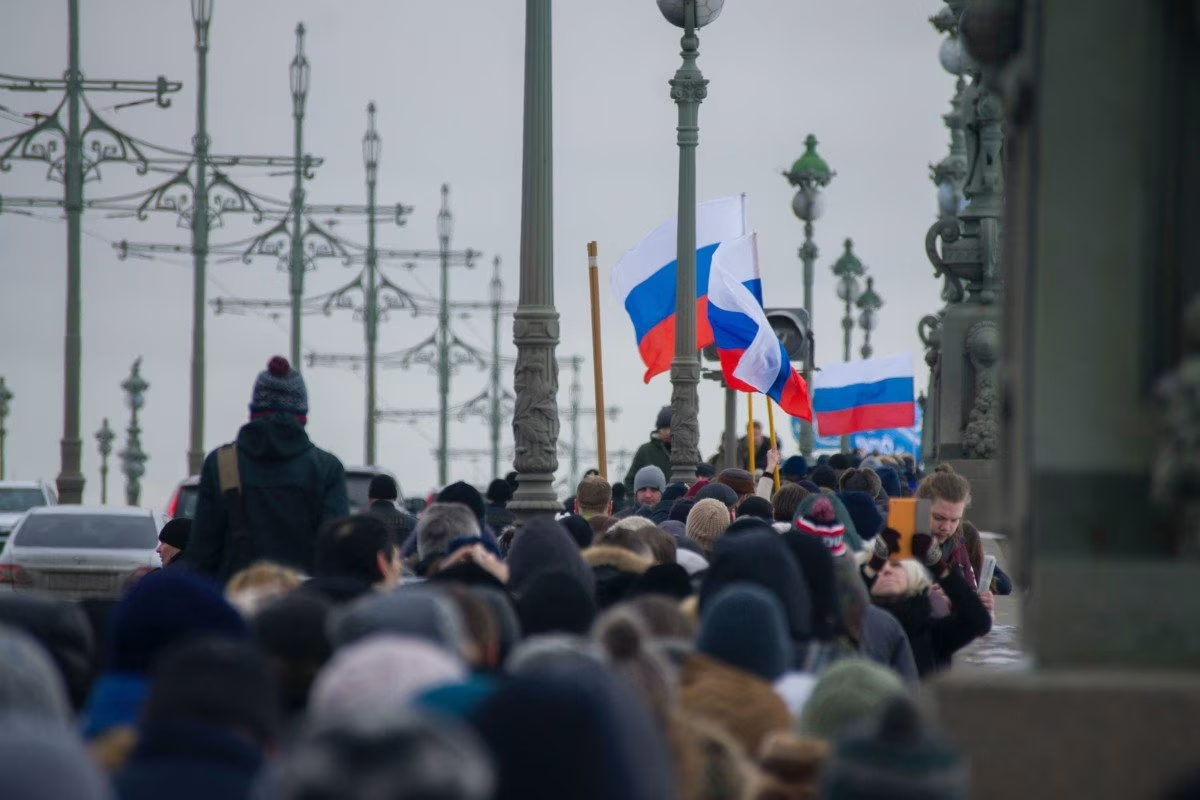
Half a million Russian households declared bankruptcy last year, a sharp and unsettling measure of the strain now running through the country’s wartime economy. The figure, up nearly a third on the previous year, is not merely a social statistic. It is increasingly read by European officials and analysts as an early warning signal: the Kremlin’s effort to sustain growth, fund the war in Ukraine and project resilience has relied on a credit boom that is beginning to curdle into something more dangerous.
The warning comes from an intelligence briefing prepared for European officials ahead of another round of sanctions on Russia. The two-page note, seen by Reuters, carries a blunt title: “Note on the probability of a banking crisis in Russia in 2026”. Its central argument is that an economy propped up by subsidised lending, loosened credit standards and political pressure on banks can look dynamic for a time while quietly accumulating the ingredients of a rupture. A shock, it suggests, might do the rest.
This is not a new fear. Russia has a history of financial stress turning suddenly systemic, when confidence evaporates and the state is forced to choose between devaluation, controls and rescue. What is new is the particular mixture at work now: large-scale state direction of credit, a household debt overhang, and a corporate sector increasingly entangled with the defence economy, all operating under the long shadow of sanctions. Western restrictions have not collapsed Russia’s economy, as early predictions sometimes implied. Instead they have helped to shape its adaptation into a more insular and administratively steered model, one that appears stable until it is not.
The Kremlin has pursued a familiar playbook for a country at war, though with a distinctly Russian inflection. When private demand is weak and trade is constrained, the state directs finance towards strategic sectors, subsidises borrowing and encourages domestic consumption. Banks are pushed to make loans that serve policy. Some of those loans are explicitly designed to support defence companies. Others have been aimed at homebuyers and households, part of a broader attempt to prevent living standards from collapsing and to keep the public mood steady as the war drags on.
The intelligence note argues that this approach has begun to erode the quality of loan books. Russia’s banks, it says, were urged to forego normal credit checks while issuing subsidised loans. In the short term such programmes can conceal stress, allowing borrowers to refinance, restructure or delay recognition of losses. In the longer term, however, the bill arrives. When a large volume of credit has been extended for political reasons, the true state of bank balance sheets can be difficult to judge, even for regulators.
Officially, the Russian economy is slowing. In May, the economic ministry cut its forecast for growth this year from 1.3 per cent to 0.4 per cent, and it lowered its forecast for 2027 from 2.8 per cent to 1.4 per cent. Those revisions matter less for their precision than for what they imply. In a system where economic optimism is itself a political tool, downgrades often signal that stresses are becoming harder to disguise. Many analysts, already sceptical of official data, believe the situation is worse still, with some arguing that Russia may already be in recession.
Against that backdrop, the report estimates that the share of corporate loans that may never be repaid has climbed to 10 per cent. It adds that some major banks have warned that as many as 15 per cent of their consumer loans are non-performing. Those numbers, if sustained, would be serious for any banking system. For Russia’s, they carry a further complication: the sector is not only commercial but also an arm of state capacity, tasked with financing priorities determined in the Kremlin.
Household borrowing, a key pillar of the recent credit expansion, appears increasingly precarious. The intelligence note says more than 13 million Russians took out at least three simultaneous loans last year, encouraged by state programmes. Multiple concurrent loans can be manageable when wages are rising, inflation is stable and refinancing remains easy. They become perilous when prices are volatile, incomes are squeezed and banks begin to tighten terms. For ordinary Russians, bankruptcy is often the final acknowledgement of a reality that has been building for months: the monthly arithmetic has stopped working.
To interpret Russia’s rising bankruptcies as merely the consequence of personal misfortune is to miss the larger story. The country’s war economy has produced pockets of prosperity and a broadening sense of fragility. Defence spending can keep factories running and pay packets flowing, but it can also distort the distribution of credit and labour. Subsidised mortgage programmes can keep construction sites busy, while inflating property prices and creating vulnerabilities when subsidies are withdrawn. Restructuring and state support can keep bad loans out of sight, while multiplying them in fact.
The intelligence note warns that these interventions can create what it calls the illusion of a dynamic economy that conceals an explosive situation. A shock, such as an ambitious package of sanctions aimed at banks, could trigger the detonation. The point is not that sanctions alone would break Russia’s system. Rather, the note suggests that sanctions could serve as a catalyst in an already combustible environment, accelerating a crisis that the state has been postponing through administrative measures.
Europe is now weighing how far to push its next restrictions. EU officials are hoping to finalise a 21st package of sanctions this month, with a greater focus on Russia’s financial system. Diplomats have discussed targeting another 90 banks, which would bring the total number of blacklisted lenders to 100. If enacted, it would mean hitting more than half of Russia’s internationally connected banks, tightening the channels through which trade is financed and money flows abroad.
Alongside banking, European planners have considered measures against cryptocurrency networks, oil refiners and traders, and drone producers. Such targets reflect the way Russia has adapted: where traditional finance is constrained, alternative routes emerge; where technology imports are restricted, domestic and third-country supply chains are built; where oil revenues are squeezed, new trading structures and intermediaries proliferate. Sanctions, in this sense, are less a single instrument than a long game of pressure and evasion.
Yet sanctions also carry their own risks, including the possibility of unintended consequences in global markets and the difficulty of enforcement. The more complex and sprawling the measures, the greater the burden on European regulators and businesses to ensure compliance. The Russian state, for its part, has become adept at learning from each new package, adjusting procurement methods and financial plumbing. Even so, the banking system remains a critical vulnerability, precisely because it sits at the intersection of domestic credit, international payments and public confidence.
A sign of that sensitivity appeared in Russian commentary itself. Russia’s Centre for Macroeconomic Analysis and Short-term Forecasting, a body aligned with the Kremlin, published a report in February warning that a “banking crisis has now been confirmed”. It based that assertion on a technical definition: that more than a tenth of banks’ loan books were unlikely to be repaid. The language is striking in a political environment where alarms are often muted. It suggests that within Russia’s policy ecosystem, there is recognition that the costs of the credit-driven wartime model are rising.
Other indicators point in the same direction. The Moscow Times reported in May that the number of unprofitable banks surged from 34 in January to 60 by early March, roughly one in five. That was the highest figure since 2022, when Russia faced the initial wave of Western sanctions after the full-scale invasion of Ukraine. A rise in unprofitable banks does not automatically mean collapse, particularly in a system where the central bank and state can intervene. It does, however, signal pressure on margins, rising provisions for losses and a deteriorating ability to lend without further state support.
Perhaps the most telling measure is not on balance sheets but in behaviour. Russian central bank data showed households withdrew a record 381.2 billion roubles from the banking system in May, the biggest May cash withdrawal since records began in 1995. The sum, about £3.7 billion, is not enormous by the standards of large economies, but the pattern matters. In banking, confidence is a form of capital. When ordinary savers begin to prefer cash, it reflects fear of what might happen next: a tightening of controls, a bank failure, or simply a sense that keeping money in the system carries risks that cannot be calculated.
It is tempting, particularly in Western capitals, to treat Russia’s economic predicament as a morality tale in which bad policy choices must end in crisis. Reality is more ambiguous. Russia’s state has proved willing to impose controls that would be politically impossible in many democracies. It has redirected trade, tightened the flow of information, and maintained a degree of macroeconomic management despite enormous military spending. It has also benefited from the fact that the global economy still needs energy, and that not all countries share the West’s sanctions regime.
But endurance is not the same as health. A system can persist while becoming progressively less efficient and more brittle. The intelligence report’s significance lies in its portrait of brittleness: a banking sector carrying politically driven loans, borrowers juggling multiple debts, and a state relying on programmes that may be unsustainable. It is not hard to imagine scenarios that could test such a system. A sharper slowdown in growth, a fall in export earnings, a further squeeze on financing channels, or a shift in public expectations could all force banks and regulators into painful choices.
Much depends on Russia’s central bank, which has navigated crises before and has at times acted with a professionalism that surprises those who assume Moscow’s institutions are merely instruments of politics. Yet even a capable central bank has limits when the underlying problem is structural and the political leadership demands that credit keep flowing. Recognising losses, allowing defaults and closing weak banks can stabilise a system in the long run, but each step brings short-term pain. In wartime, short-term pain carries political consequences, particularly when the state is invested in a narrative of economic normality.
The Kremlin’s preference, therefore, is often to postpone. Restructure loans, extend maturities, direct state support where necessary, and hope that time, inflation and growth will erode the burden. That strategy can work, up to a point. It can also deepen the eventual adjustment, as poor-quality assets remain in place and resources are misallocated. The intelligence report’s warning is essentially about this dynamic: what is concealed by intervention does not disappear, it accumulates.
For Europe, the dilemma is equally clear. If Russia’s financial vulnerabilities are real, tightening sanctions on banks may accelerate strain and reduce Moscow’s capacity to fund its war. If those vulnerabilities are exaggerated, or if the Russian state can contain them through controls, the sanctions may deliver less impact than hoped while imposing additional complexity on European enforcement. Policymakers must also weigh the likelihood that Russia responds by further insulating its system, reducing remaining channels for diplomacy and trade.
The rise in bankruptcies is the human face of these calculations. Behind the figure of 500,000 are households that took loans under conditions the state itself helped to create: subsidised rates, eased checks, encouragement to borrow. Some will have done so to buy homes, some to survive inflation, some to maintain the appearance of normal life. Bankruptcy in Russia has its own legal and social contours, and can be used as a way to reset debts, but it remains a marker of distress. When it rises sharply, it tells a story about the relationship between citizens and the financial system, and about the burdens being shifted downwards as the war economy grinds on.
In central Moscow, improvised memorials for fallen fighters have become part of the landscape, a public reminder of the war’s cost. The financial strain is less visible, but it may prove just as consequential. A banking crisis is not only an economic event; it is a political one, exposing how much of the state’s promise rests on confidence. Russia’s leaders have wagered that they can manage both the battlefield and the balance sheet. The growing evidence of bad debts, unprofitable banks and anxious depositors suggests the second front is becoming harder to hold.
Post Disclaimer
The following content has been published by Stockmark.IT. All information utilised in the creation of this communication has been gathered from publicly available sources that we consider reliable. Nevertheless, we cannot guarantee the accuracy or completeness of this communication.
This communication is intended solely for informational purposes and should not be construed as an offer, recommendation, solicitation, inducement, or invitation by or on behalf of the Company or any affiliates to engage in any investment activities. The opinions and views expressed by the authors are their own and do not necessarily reflect those of the Company, its affiliates, or any other third party.
The services and products mentioned in this communication may not be suitable for all recipients, by continuing to read this website and its content you agree to the terms of this disclaimer.
Related Posts


