
Now Reading: Italian Tomato Firm Mutti Faces Pressure of Rising Prices Amidst Global Supply Chain Disruptions
-
01
Italian Tomato Firm Mutti Faces Pressure of Rising Prices Amidst Global Supply Chain Disruptions
Italian Tomato Firm Mutti Faces Pressure of Rising Prices Amidst Global Supply Chain Disruptions
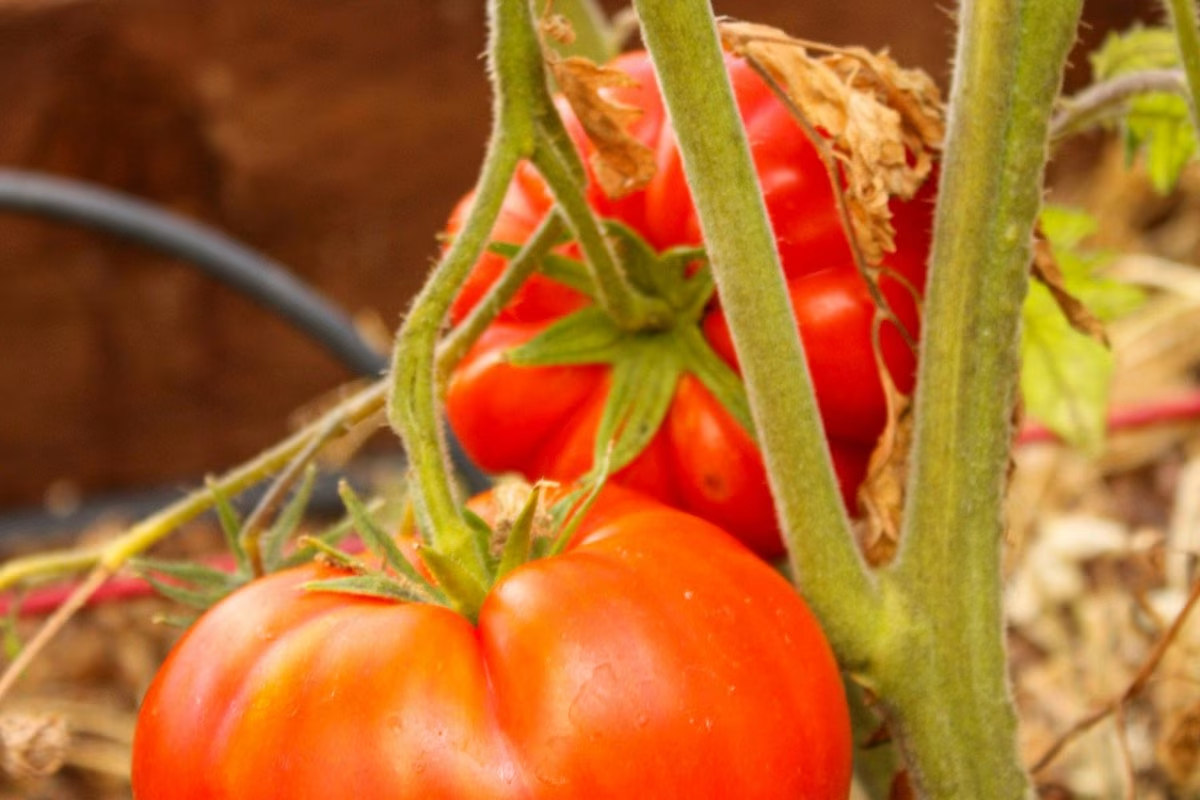
Italy’s rich tradition in agriculture faces yet another challenge as Francesco Mutti, chief executive of the eponymous family-owned tomato processing company, warns of a potential price increase in their products if oil costs remain elevated through the peak harvesting season. Established in 1899 and headquartered in the renowned city of Parma, Mutti has become one of Europe’s foremost producers of various tomato products, such as chopped tomatoes, passata, and purées. With the family business processing over 700,000 tonnes of tomatoes last year and achieving revenues close to €800 million, the stakes are high.
This impending financial strain is attributed to a significant surge in energy costs, which Mutti claims have risen by approximately 50 per cent due to the ongoing geopolitical tensions stemming from the conflict in Iran. This volatility in energy prices demonstrates how interconnected the modern agricultural sector is with global events. As Mutti cautiously refrains from enacting immediate price hikes, he characterises the situation as precarious, indicating that any adjustments would likely be made only after the harrowing summer harvest period ends.
The nuances of the tomato market illustrate a broader problem affecting food producers across the continent. The delicate balance between cost, yield, and pricing strategies is becoming increasingly difficult to maintain amid rising expenses. Indeed, Mutti asserts that the forthcoming summer harvest will be a critical determinant in assessing the company’s pricing policies. Should oil prices rise to $120 a barrel, the repercussions on food production could be severe. Conversely, if prices remain stable, there may be opportunities for mitigation.
The ramifications of this oil price shock extend beyond mere economics; they touch upon the lives of farmers, the livelihoods of those dependent on agriculture, and the choices available to consumers. Notably, a poor harvest due to adverse weather conditions could exacerbate the situation. Mutti recalls the disastrous crop yields of 2024, where more than a third of the expected output was lost to inclement weather. The aftermath highlighted the volatility of agricultural production, relying on delicate natural conditions and market demands alike.
This year, however, initial assessments appear promising, with a good crop forecast contributing to cautious optimism. Nevertheless, the unpredictable nature of agriculture means that conditions can make a dramatic shift at any moment. The relationship between domestic production and energy costs is far from straightforward. Mutti notes that robust yields per hectare could offer some relief and help cushion the blow of soaring energy costs. Yet, if yields underperform, the spiral of rising prices may commence, putting pressure on producers to pay more to procure tomatoes and thereby further inflating market prices.
The consequences for consumers are unmistakable. Tins of Mutti Polpa chopped tomatoes currently sell in the UK for around £1.60 each, positioning the brand competitively against rivals like Napolina. Yet as costs escalate, the effects will be felt not just in the supermarket aisles but also in the broader economy. Food pricing tends to present a slippery slope, particularly given the intricate interplay of supply chain elements including transport, packaging, and even shortages of vital materials like fertilisers. The external shocks from international conflicts underwater this delicate web of economic equilibriums, often leading to a cascade of increases that make essentials harder to come by for less affluent households.
<pMutti’s caution echoes the sentiments expressed by other key players in the food industry. This month, Princes, one of Britain’s leading food suppliers, likened their recent emergency price increases to a reactionary measure amidst unprecedented cost pressures. The current landscape illustrates a juggling act where companies are tasked not only with balancing costs against profitability but also maintaining customer loyalty in the face of rising prices. A carefully crafted menu of strategies is required to navigate these challenges, especially as consumers become increasingly price-sensitive during times of economic uncertainty.
The complexities of this situation are underscored further by ongoing negotiations within the agriculture sector regarding packaging and energy supplies. As the harvest approaches, Mutti anticipates a series of discussions that will ultimately inform how he positions the company in the market. The outcomes of these negotiations will reflect broader trends, with implications beyond just tomatoes, extending to various agricultural products across Europe and beyond. Such negotiations can often produce unintended pressures, ultimately affecting consumer pricing.
Within the agricultural and chemical industries, executives have issued stark warnings regarding fertiliser shortages that threaten to destabilise food production further. As Svein Tore Holsether, chief executive of the global fertiliser giant Yara, has noted, diminishing crop yields due to lower fertiliser usage could usher in a bidding war for essential food products. This complex interplay of agriculture and geopolitics casts a long shadow over European food security, a matter of significant concern for both policymakers and consumers alike.
In this environment of uncertainty, one cannot ignore the looming spectre of climate change, which exacerbates the challenges already faced by the agricultural sector. The unpredictable nature of weather patterns can leave farmers precariously exposed, leading to shifts in production capabilities and, ultimately, market instability. The lessons from prior years—where a single extreme weather event could obliterate yields—should serve as a clarion call for all stakeholders involved in food production and distribution to pay closer attention to climate resilience strategies.
This delicate triad of agricultural production, energy costs, and consumer prices serves as a reminder of the fragility inherent in our interconnected global supply chains. The ongoing crisis propelled by international events underscores the reality that food production is not only an agricultural issue but also one deeply entwined with global politics and economics. As markets wobble, the implications are felt across continents, from fields in Italy to supermarket shelves in the UK.
For Mutti and the broader agricultural community, the forthcoming months will be pivotal. Should the harvest yield favourable results, the company may be able to navigate the treacherous waters of price increases with some measure of success. However, as Mutti articulates, the prevailing uncertainty necessitates a patient and watchful approach, keenly attuned to the dynamics at play within the market and beyond. The stakes are high, not just for producers but also for consumers who find themselves on the receiving end of price repercussions borne of circumstances far removed from their immediate realities.
As the agricultural sector stands at this crossroads, the need for adaptive strategies and forward-thinking governance will become increasingly important in safeguarding food security and economic stability in the face of a turbulent global landscape. With the next harvest season looming, all eyes remain on Italy and the delicate interplay of energies—both literal and metaphorical—that will shape the fate of one of the country’s most cherished products.
Post Disclaimer
The following content has been published by Stockmark.IT. All information utilised in the creation of this communication has been gathered from publicly available sources that we consider reliable. Nevertheless, we cannot guarantee the accuracy or completeness of this communication.
This communication is intended solely for informational purposes and should not be construed as an offer, recommendation, solicitation, inducement, or invitation by or on behalf of the Company or any affiliates to engage in any investment activities. The opinions and views expressed by the authors are their own and do not necessarily reflect those of the Company, its affiliates, or any other third party.
The services and products mentioned in this communication may not be suitable for all recipients, by continuing to read this website and its content you agree to the terms of this disclaimer.
Related Posts


Previous Post
Next Post

