
Now Reading: Pubs scramble as government lifts the shutters for England’s 1am World Cup test
-
01
Pubs scramble as government lifts the shutters for England’s 1am World Cup test
Pubs scramble as government lifts the shutters for England’s 1am World Cup test
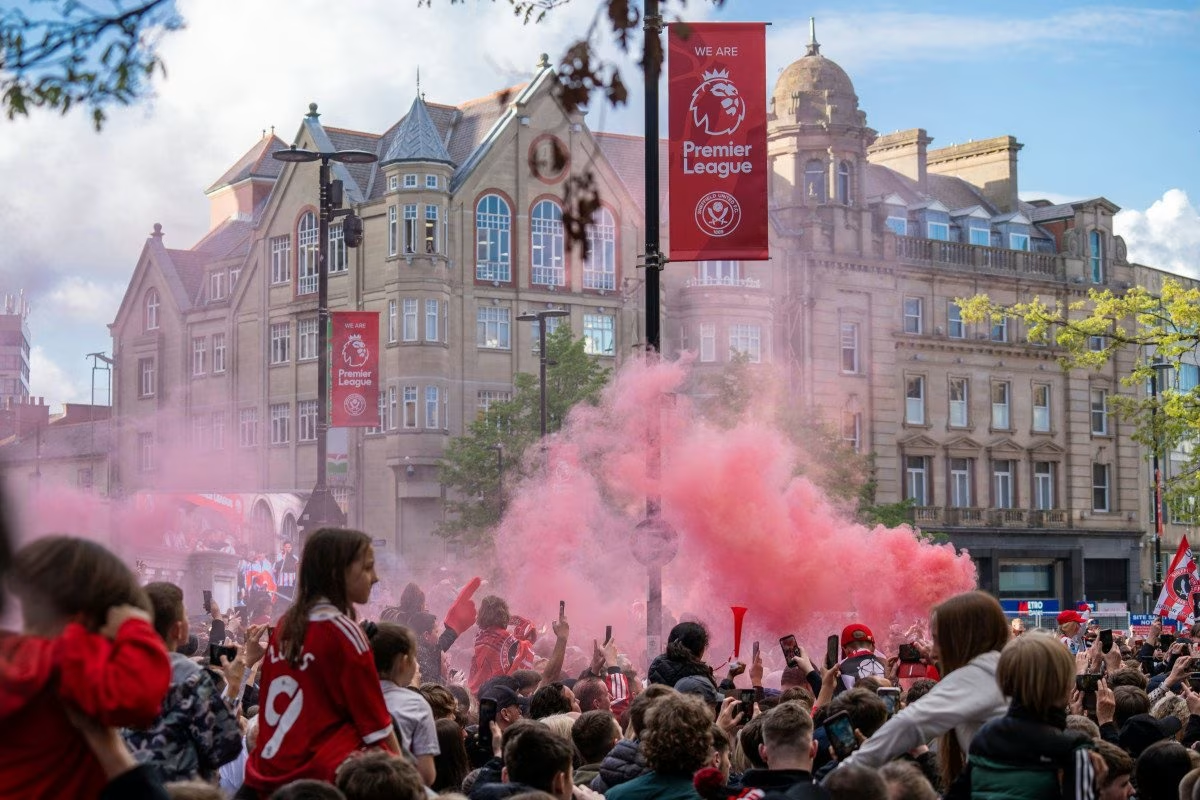
There are few things more British than a pub door unlocked against the sensible advice of bedtime. The nation has built an entire folklore around last orders, closing time and the small, negotiated liberties that allow a room of strangers to become a temporary community. Yet even by those elastic standards, the instruction that pubs may serve deep into Monday morning to show England’s World Cup last 16 match against Mexico has landed with the peculiar jolt of a rule change announced after the planning has already been done.
Ministers confirmed late on Thursday afternoon that licensed premises could stay open until 5am for the game, a fixture scheduled to kick off at 1am on Monday. In theory, it is the sort of concession governments like to make: a gesture of national good humour, a promise that the country can gather for a shared moment without being clipped by routine licensing hours. In practice, its timing has turned a commercial opportunity into a logistical sprint, leaving landlords, pub groups, police and local authorities trying to reshape staffing, security and transport plans for an event that has been on the calendar for weeks.
For publicans, the appeal is obvious. A match at an hour that rules out much of the casual audience can still deliver a concentrated surge of trade, particularly in pubs that have built their modern identity around live sport and communal screens. It is also a rare chance to sell into a time slot that is ordinarily dead. The British Beer and Pub Association estimates that extended hours around the match could translate into as many as an extra one million pints poured. Its chief executive, Emma McClarkin, has been keen to frame the uplift as wider than lager, arguing that a late night football crowd now buys a more varied basket than the stereotype suggests, including low and no alcohol beers, hot drinks, soft drinks and snacks.
Large operators have watched the pattern of the tournament and like what they see. Stonegate, the biggest pub company in the country, said that during England’s comeback win over DR Congo on Wednesday it sold more than 800,000 drinks across its 370 managed pubs and 656 Craft Union venues. That was about 438,000 more than on an average Wednesday, a statistic that speaks to how football nights can still produce old fashioned volume. For the Mexico match, Stonegate has spoken of 10,000 bookings already taken, a figure that suggests punters are willing to schedule their sleep around the national team when the stakes are high enough.
Those headline numbers are what sit behind the cheerful rhetoric about the “unique atmosphere only a pub can provide”, as Andy Spencer, chief executive of Punch Pubs, put it. There is truth to it. England matches in major tournaments have a specific, recognisable sound: the collective intake of breath, the laughter that arrives slightly too early, the ritualised groan at a mis hit shot. It is not simply viewing; it is performance, and the pub remains the stage where strangers can safely act out belonging.
But the economics of opening at 1am are not the economics of a sunny afternoon kick off, and many landlords are weighing whether the sums work. A game that runs into the early hours carries costs that a weekend fixture does not: taxis for staff, overtime, the need for door supervision and, in some places, the uncomfortable arithmetic of how many customers can be expected to arrive and leave quietly when adrenaline is doing its usual work. The uncertainty is compounded by the question of where fans can be hosted. At several venues, the use of beer gardens remains unclear. Even when the weather cooperates, outdoor late night viewing triggers noise concerns and the risk of neighbour complaints that linger long after the final whistle.
Dawn Slater, who runs the Garricks Head, a sports pub in Flixton, Greater Manchester, captures both the confidence and the constraint. She has said her pub has reached full capacity for every England game and she does not expect the hour to change that. “The phone’s not stopped ringing with people looking to book a table,” she reported. The Garricks Head can accommodate 499 fans in total, but Slater believes it is unlikely she will be allowed to use the garden, which could limit the effective number to the 300 she can fit indoors. That is the kind of detail that decides whether an all night opening becomes a windfall or an expensive gesture.
Chris Jowsey, the chief executive of Admiral Taverns, has described receiving a flood of requests from licensees who wanted to take advantage of the chance to stay open longer. For a pub estate, the attraction is not just the bar takings on the night. Big televised events create a reason to build pre bookings, strengthen local loyalty and, in chains that compete hard on sport, persuade customers that a particular venue is their default. There is also an obvious point about a sector that has spent years managing energy bills, staffing shortages and rent pressures: high demand nights still matter, psychologically as well as financially.
Yet it is precisely because these nights matter that the late government decision has frustrated operators who had already followed the old rules. Before the announcement, pubs without the necessary permissions to trade late and show the match had been preparing to apply for temporary event notices. Those notices carry fees and administrative steps and, for some businesses, are not a minor add on but an expense measured in thousands, sometimes tens of thousands of pounds across multiple sites. A blanket extension announced days before the game makes many of those applications redundant, and publicans who acted early are left staring at costs that now buy them nothing.
One industry source has characterised the decision as “very knee jerk”, not because the idea of extended hours is unwelcome but because the practicalities were ignored. The most immediate is security. A large crowd drinking through the night requires properly staffed door control, a point the responsible operators accept as part of the bargain of late trading. The problem is that security staff are a finite resource, particularly at short notice, and prices move accordingly. For a landlord already running on tight margins, a sudden bill for guards can wipe out the extra profit that the extended trading was supposed to deliver.
There is another, more subtle irritant. In a competitive market, being one of the few venues allowed to show the match late can be an advantage. Some publicans had made plans based on that scarcity. The extension means, as one operator put it, that “everyone is open”. The comment has a blunt logic: if punters have more choice, crowds spread out; if crowds spread out, the venue that has paid for extra staff and security may not see the numbers that justify it. The extension, intended as a national gift, becomes in some cases an equaliser that makes the business case harder.
The police have not been immune to the same irritation about timing. The National Police Chiefs’ Council has criticised the late announcement, noting that England’s likely path through the tournament has been understood for some time. The implication is clear. Whether one views extended licensing as celebration or risk, it is not something that benefits from improvisation. Planning for crowd management, staffing and local coordination is not done in an afternoon, especially when the event takes place at an hour when most of the country’s infrastructure is designed to be dormant.
That infrastructure question is most visible in London. The capital’s pubs can fill quickly for England games, but celebrations, and the labour that supports them, depend on getting people home. Late night Tube services are not expected to be running, which means a city that sells itself on round the clock energy will still push fans and staff towards buses, long walks and expensive ride hailing. The BBPA has called for Transport for London to extend public transport, arguing that this is not merely a question of convenience for supporters but of safety and practicality for those who will be working until the early hours. A policy designed to allow pubs to open later looks less coherent when it does not align with how customers and staff will disperse afterwards.
The unusual kick off time also forces a sharper conversation about who this night is really for. Afternoon matches at tournaments can feel like local festivals, with families in gardens, office workers stopping in on the way home, and a broader demographic that produces a softer sort of noise. A 1am start is different. One industry insider has argued that it “is not going to get the family punters out” and will not attract the after work crowd, describing it instead as an event for “diehard England fans”. That is a plausible reading of human behaviour and the working week. It suggests a crowd that is more committed, perhaps more intense, and potentially more willing to drink in a way that is less compatible with Monday morning responsibilities.
Publicans, of course, have experience of managing intensity. Many have spent the past decade turning their venues into semi professional sporting theatres, with table booking systems, wristbands, staggered entry, pre ordered food and the quiet but firm insistence that patrons behave as adults. The modern sports pub is often less chaotic than the folklore suggests. But the pressures of a knockout game, the stress of penalties, and the long hours of waiting for a 1am kick off create a very particular cocktail. Landlords know it can go brilliantly, and that it can go wrong quickly.
There is also a wider political and cultural question hiding inside this hurried administrative change. Governments like to be seen as enabling national moments, but they also like to avoid responsibility for the second order effects. Extending licensing hours is presented as a simple relaxation of red tape. For the venues that have paid for notices, arranged staff rotas, ordered stock, and negotiated with neighbours, it is not simple. It is a shift in the distribution of costs and benefits, where some operators gain a last minute opportunity and others are penalised for having been diligent.
None of this will stop thousands of pubs from trying. The commercial incentive is real, and so is the civic instinct that keeps many landlords doing things that are barely rational on a spreadsheet. A pub that opens at 1am is not merely selling beer. It is selling permission for people to feel that the tournament belongs to them, that football is still something lived in public rather than consumed alone. On nights like these, the pub becomes a kind of informal public service, one that the country praises whenever it fears it is disappearing.
What the scramble reveals, though, is the fragility of that service. The modern pub is a complicated machine with narrow tolerances. Its costs are high, its workforce is stretched, and its relationship with regulation is a daily negotiation. When ministers move quickly, the industry can look agile, even jaunty. But agility is often just stress dressed up as resilience. The same landlords who will smile as England line up for the anthem will also be calculating whether the takings cover the security, the taxis, the extra wages, and the unnoticed losses from permits that nobody needed in the end.
By the time the match begins, the debate about timing will have been drowned out by noise, caffeine and the collective belief that the next ninety minutes might justify the sleep that follows. Some venues will have queues down the pavement; others will discover that the promise of a late night crowd was more romantic than real. Either way, the episode offers a sharp vignette of how Britain now stages its national rituals: with enthusiasm, with improvisation, and with an industry asked to absorb the consequences of decisions made at the last possible moment.
Post Disclaimer
The following content has been published by Stockmark.IT. All information utilised in the creation of this communication has been gathered from publicly available sources that we consider reliable. Nevertheless, we cannot guarantee the accuracy or completeness of this communication.
This communication is intended solely for informational purposes and should not be construed as an offer, recommendation, solicitation, inducement, or invitation by or on behalf of the Company or any affiliates to engage in any investment activities. The opinions and views expressed by the authors are their own and do not necessarily reflect those of the Company, its affiliates, or any other third party.
The services and products mentioned in this communication may not be suitable for all recipients, by continuing to read this website and its content you agree to the terms of this disclaimer.
Related Posts


Previous Post
Next Post

