
Now Reading: Royal Mail’s Christmas cap leaves small firms counting the cost
-
01
Royal Mail’s Christmas cap leaves small firms counting the cost
Royal Mail’s Christmas cap leaves small firms counting the cost
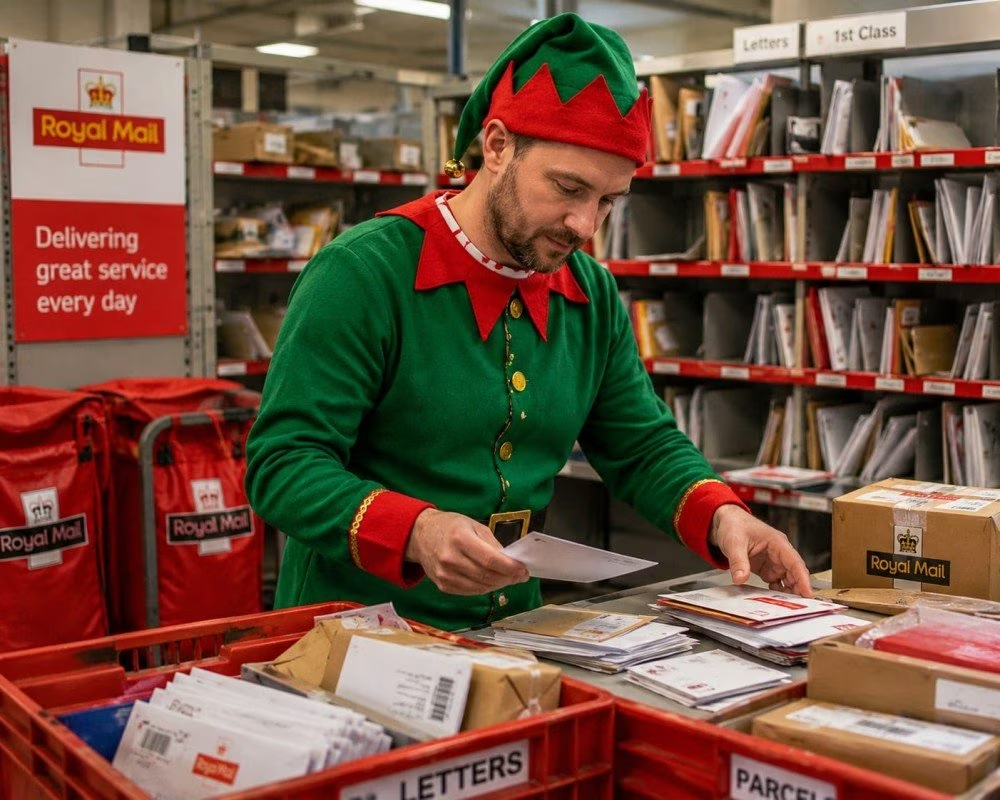
For thousands of British small businesses, the run-up to Christmas is not simply a busy quarter but the period on which the rest of the year quietly depends. Cash flow is secured, debts are paid down, and the margin for error narrows as orders rise. It is precisely at that moment that Royal Mail has chosen to tell many of its business customers that, during November and December, daily collections will be limited to no more than three times their usual contracted capacity. In the language of operations, it is a planning measure. In the language of commerce, it looks rather more like a ceiling placed on ambition.
The distinction matters because the businesses affected are not asking Royal Mail for a convenience but for the core service on which much of modern retail still rests. For many small and medium-sized companies, particularly those selling directly to consumers, parcel collection is the bridge between a sale made online and cash realised in the bank. The inability to send goods promptly is not an administrative nuisance. It can mean cancelled orders, reputational damage and a forced retreat from the very growth that seasonal demand is supposed to deliver. The Federation of Small Businesses has voiced precisely that fear, arguing that Christmas is a make-or-break period for many firms and that a cap on collections introduces needless strain at the most commercially sensitive point in the year.
Royal Mail’s defence is straightforward. The company says that Christmas volumes typically double and that agreed daily collection limits are part of routine peak planning designed to preserve a reliable service across the network. Its case is that capacity cannot be left wholly open-ended without risking wider disruption, and that only a small number of customers are likely to require collections above the three-times threshold. Where they do, Royal Mail says it will discuss arrangements individually. That is a rational position in the abstract. Any national logistics network must balance finite labour, vehicles and processing capacity against highly uneven demand. Yet the force of the criticism lies in the suspicion that this is less a carefully calibrated seasonal adjustment than a public admission of structural weakness.
That suspicion has been building for some time. Royal Mail is not introducing these limits from a position of conspicuous operational authority. It is doing so after years in which service standards have repeatedly fallen short, prompting a succession of penalties from Ofcom. Last year the regulator imposed a £21 million fine after delivery performance on first and second-class mail fell, in its own words, well below the standard customers had paid for. Previous fines in 2023 and 2024 reinforced the same point. The company’s difficulties are therefore not episodic but part of a longer story in which the universal service provider has struggled to reconcile legacy obligations, labour tensions, rising costs and the demanding economics of parcel delivery.
Against that background, a Christmas collection cap can be read in two ways. The first is the charitable interpretation offered by Royal Mail itself: a prudent effort to avoid over-promising during the most pressurised period of the year. The second is rather harsher: that the business, having failed for years to build sufficient resilience into its network, is now attempting to manage risk by transferring it on to the firms least able to absorb it. The truth may lie somewhere between the two, but it is not difficult to see why small companies incline towards the second view. They have already been asked to shoulder more of Royal Mail’s difficulties through higher surcharges and uneven service. Now, just as demand is expected to surge, they are being told there may be a limit to how much success the network can physically accommodate.
The timing makes the measure especially awkward. Only recently Royal Mail raised its fuel and energy surcharge, taking the domestic rate from 11 per cent to 16 per cent and the Parcelforce Worldwide rate from 8 per cent to 13 per cent. The company pointed to external cost pressures, including higher oil and fuel prices linked to instability in the Middle East. That explanation may be credible, but for customers it alters little. From the point of view of a small business owner, the sequence is plain enough: higher costs first, then tighter limits on service. That is a difficult message to absorb from a company which, unlike many private couriers, still occupies a singular place in the country’s commercial and civic infrastructure.
The tension is heightened further by Royal Mail’s parallel efforts to loosen parts of its regulatory settlement. The company has been lobbying for the removal of the cap on annual price increases for second-class stamps, a safeguard introduced after privatisation and tied to inflation. There is, of course, no equivalent restraint on first-class prices, which have risen far more sharply over the past decade. One can understand why a business under financial pressure seeks greater pricing freedom. But the combination of rising charges, reduced service expectations and requests for more regulatory latitude invites an uncomfortable question. If customers are asked to pay more while receiving less certainty, what precisely remains of the old public-service compact on which Royal Mail’s legitimacy still rests?
The human consequences of that question are clearest in the experience of companies such as Natural & Noble, the Wiltshire drinks-kit business founded by Gordon Leatherdale. The company’s direct-to-consumer sales account for around 30 per cent of annual revenue, roughly £750,000, and Christmas is central to that trade. At quieter times of year it may send 20 or 30 orders a day. In the festive rush, particularly from mid-November to mid-December, volumes can rise to 15 or 20 times that level. A cap set at three times usual collection capacity therefore does not represent a manageable administrative tweak but a yawning gap between commercial reality and logistical permission. A business that has invested in marketing, stock and staffing in anticipation of seasonal demand may find itself checked not by customers or competition, but by the carrying limits of its delivery partner.
Leatherdale’s frustration is sharpened by dependence. Like many smaller firms outside major urban fulfilment networks, he relies on Royal Mail to collect from his premises because the alternative is to divert time and labour into taking parcels to a post office or arranging costlier private options. The issue, then, is not simply whether other carriers exist in theory, but whether substitution is practical in the compressed conditions of peak season. Royal Mail remains, for many businesses, the one network whose reach, familiarity and integrated collections make direct-to-consumer trade viable at scale. When that network signals constraint, the market does not instantly provide a painless workaround.
There is also a wider economic irony here. Governments of every stripe have spent years extolling the virtues of entrepreneurial Britain, of nimble exporters, local manufacturers and digitally enabled small firms taking goods directly to households around the country. Yet those firms operate within systems they do not control. They can design websites, buy advertising and predict demand with ever greater precision, but none of that matters if the final handover fails. Logistics is often treated as a neutral background utility until it falters. At Christmas, when volumes spike and customer expectations harden, it becomes visible again as a decisive constraint on growth. Royal Mail’s cap is unsettling because it exposes that dependency so starkly.
To its credit, the company is at least not pretending that investment is unnecessary. It has pledged £500 million over the next five years to improve punctuality and modernise operations. It has already begun implementing changes, including ending second-class Saturday letter deliveries and converting around 6,000 part-time postal roles into full-time positions. These are not trivial steps. They suggest an organisation trying to rebuild a more reliable network after years of drift and dispute. Yet investments announced over five years offer limited comfort to businesses planning stock levels for the next five months. The Christmas trading period is governed by immediate operational reality, not by the promise of future efficiencies.
That is why the company’s insistence that only a small minority of customers will need more than triple their normal collection volume is unlikely to settle the argument. The customers most likely to breach that threshold are precisely those seasonal businesses for whom Christmas demand is radically unlike the rest of the year. In other words, the cap is calibrated to ordinary usage when the whole point of festive trading is that it is not ordinary at all. If a florist, gift retailer or speciality food business experiences a December surge many multiples above its annual baseline, that is not evidence of poor planning on its part. It is the business model. To define capacity in relation to a quiet-period norm may be administratively tidy, but it risks misunderstanding the commercial rhythms of those customers who rely on Royal Mail most intensely.
There is a final reputational hazard for Royal Mail in all this. The company has long sought to present itself as more than just another parcel operator. Its history, its reach and its statutory duties still grant it a distinct place in British life. But that status carries expectations. A national postal service is meant to provide confidence as much as carriage, particularly for smaller firms without bargaining power. If those firms come to believe that Royal Mail can no longer be counted on during the very weeks that matter most, the damage will exceed a single disappointing Christmas season. Trust, once lost in logistics, is expensive to regain.
For now, the cap may still be negotiable in individual cases, and Royal Mail may judge correctly that the number of businesses genuinely affected will be limited. But the anxiety provoked by the decision is itself revealing. It speaks to a relationship that has become more transactional, more brittle and less assured than the company would wish. British small businesses are being asked to enter their busiest season with higher delivery costs and less certainty that success can be physically moved through the network. That is not merely an operational detail. It is a measure of how far one of the country’s oldest commercial institutions is still struggling to match its obligations to the demands of the economy it serves.
Post Disclaimer
The following content has been published by Stockmark.IT. All information utilised in the creation of this communication has been gathered from publicly available sources that we consider reliable. Nevertheless, we cannot guarantee the accuracy or completeness of this communication.
This communication is intended solely for informational purposes and should not be construed as an offer, recommendation, solicitation, inducement, or invitation by or on behalf of the Company or any affiliates to engage in any investment activities. The opinions and views expressed by the authors are their own and do not necessarily reflect those of the Company, its affiliates, or any other third party.
The services and products mentioned in this communication may not be suitable for all recipients, by continuing to read this website and its content you agree to the terms of this disclaimer.
Related Posts


