
Now Reading: Ryanair Profits Decline 34 Percent Amid Middle East Conflict and Rising Fuel Costs
-
01
Ryanair Profits Decline 34 Percent Amid Middle East Conflict and Rising Fuel Costs
Ryanair Profits Decline 34 Percent Amid Middle East Conflict and Rising Fuel Costs
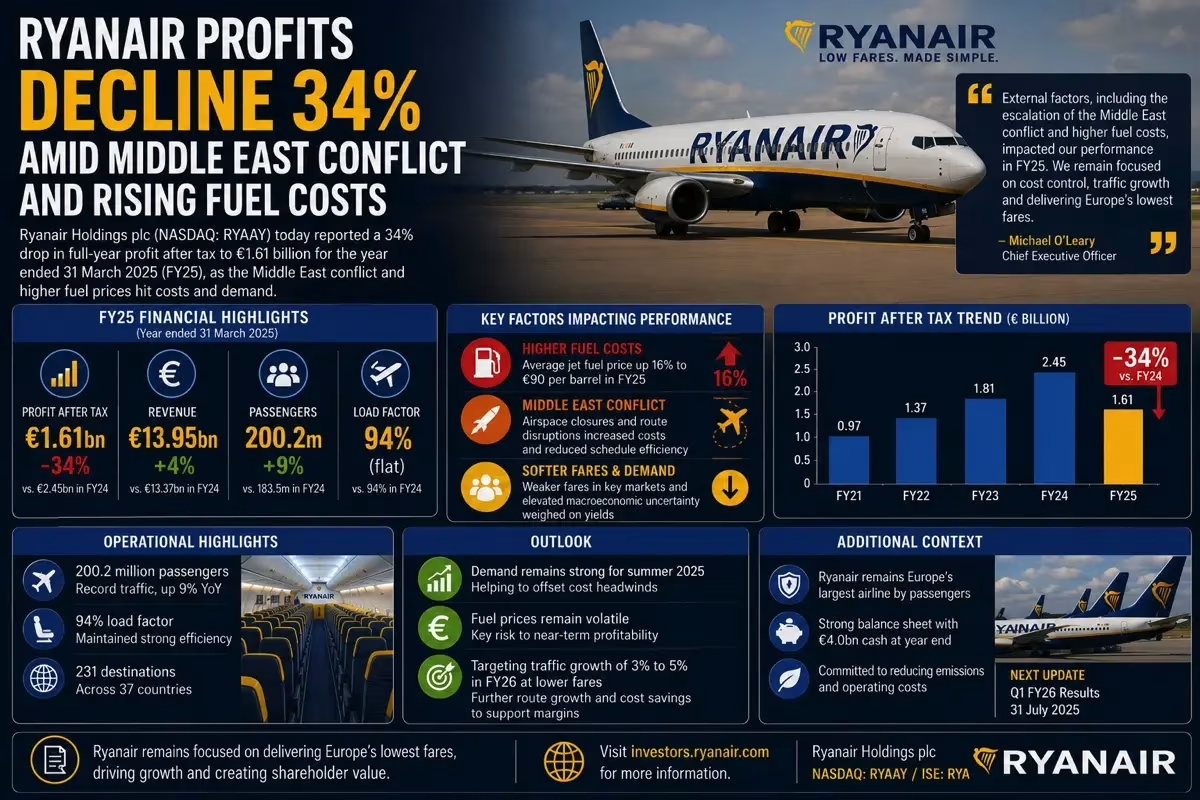
Ryanair has reported a substantial decline in profitability as ongoing conflict in the Middle East has driven jet fuel prices sharply higher whilst simultaneously dampening customer confidence in air travel. The Irish carrier recorded pre-tax profits of €593 million for the quarter ending June, representing a 34 per cent decline compared with the corresponding period last year. Revenue remained broadly flat as the airline was compelled to reduce fares in order to stimulate demand.
The airline has indicated that it anticipates summer fares will remain slightly below last year’s levels, attributing this outlook to persistent consumer hesitancy regarding air travel. Jet fuel costs have increased markedly following military strikes conducted by the United States and Israel against Iran in February. Whilst Ryanair has hedged a significant portion of its future fuel requirements, the cost of unhedged fuel has more than doubled during the period.
Crude oil prices reached $90 per barrel for the first time in a month before retreating slightly, following an escalation of military exchanges between the United States and Iran. Traffic through the Strait of Hormuz, a critical conduit for global oil and gas supplies, has come to a standstill. An interim peace agreement reached last month provided temporary relief to oil and energy prices; however, these gains were quickly reversed as negotiations collapsed and hostilities resumed.
The carrier has cautioned that its full-year results will remain highly sensitive to external factors, including potential escalation of conflicts in the Middle East and Ukraine, as well as volatility in unhedged jet fuel prices. Shane Oliver, head of investment strategy at fund manager AMP, observed that prolonged closure of the strait combined with further military escalation could necessitate oil prices rising to approximately $150 per barrel to restore equilibrium between supply and demand.
Oliver noted that whilst this scenario does not represent the base case expectation, it constitutes a significant risk. Ryanair has forecast that fares for the critical summer trading period between July and September will be modestly lower than the previous year, with passengers increasingly booking closer to their departure dates than historically observed.
Neil Sorahan, the airline’s chief financial officer, indicated that flights on popular Mediterranean routes continue to operate at full capacity. He suggested that consumer appetite for travel remains robust, albeit with bookings occurring later than traditional patterns would indicate. During the April to June quarter, Ryanair’s revenue increased marginally by 1 per cent to €4.4 billion. Passenger numbers rose 6 per cent to 61 million, supported by Easter holiday traffic in April; however, average fares declined 6 per cent as the airline implemented fare reductions to attract travellers concerned about the Iran conflict.
Post Disclaimer
The following content has been published by Stockmark.IT. All information utilised in the creation of this communication has been gathered from publicly available sources that we consider reliable. Nevertheless, we cannot guarantee the accuracy or completeness of this communication.
This communication is intended solely for informational purposes and should not be construed as an offer, recommendation, solicitation, inducement, or invitation by or on behalf of the Company or any affiliates to engage in any investment activities. The opinions and views expressed by the authors are their own and do not necessarily reflect those of the Company, its affiliates, or any other third party.
The services and products mentioned in this communication may not be suitable for all recipients, by continuing to read this website and its content you agree to the terms of this disclaimer.
Related Posts


Previous Post
Next Post

