Now Reading: The Defence Plan’s Missing Billions
-
01
The Defence Plan’s Missing Billions
The Defence Plan’s Missing Billions
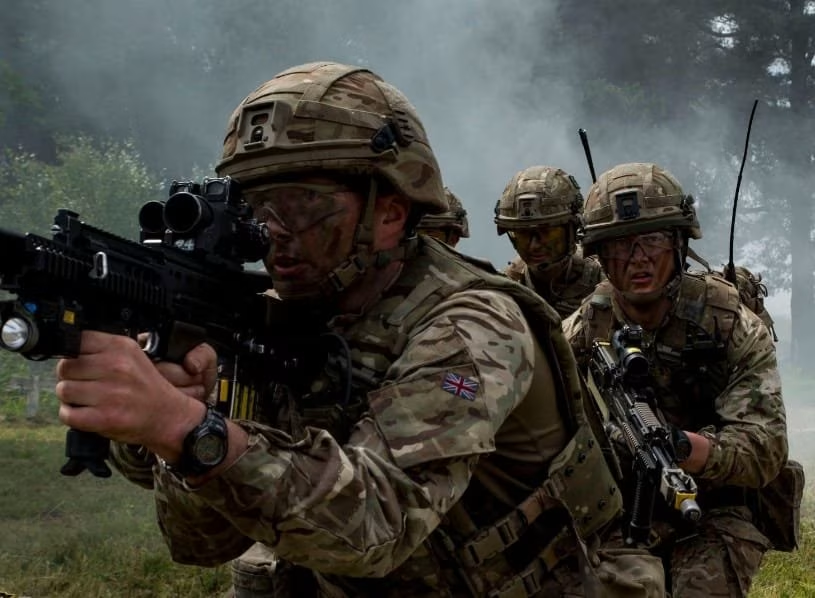
The Government has chosen to sell its new defence settlement in the language of urgency and arithmetic. A single number has done much of the work: £15bn. That is the additional sum ministers say will be spent on defence by 2030, compared with what had previously been pencilled in. It is meant to sound like a break with the stale improvisations of recent years and, more pointedly, like an answer to the Nato pressure that now bears down on every European capital.
Yet the more closely one looks at the Defence Investment Plan unveiled in the Commons, the more that headline figure begins to resemble an impressionistic sketch rather than a funded programme. The plan is framed as a statement of national intent. It is also, in several important respects, an exercise in accounting that appears designed to postpone the hardest choices until somebody else is holding the red box.
Dan Jarvis, making his case to MPs, insisted that “more money matters” while urging Parliament to focus on the “choices” being made about how the money is spent. He then listed the kinds of projects that lend themselves to strong headlines: the platforms, programmes and procurements that can be photographed, toured, or name checked at a defence factory. The politics of this are obvious. Defence spending, unlike many other areas of public expenditure, has physical outputs that look like national power. It is easier to dramatise and, for a government trying to look strategically serious, hard to resist.
But the critical question is not whether ministers can name the beneficiaries of a spending uplift. It is whether the uplift exists in the way the public is being encouraged to assume. Strip away the Commons theatre and the plan contains a stubborn fact: of the promised £15bn, only £10.3bn has funding attached. That leaves almost a third of the figure not so much allocated as wished for, a gap that will have to be bridged by decisions yet to be taken in future budgets.
In another policy area, a shortfall of that scale would be treated as a confession. In defence, it is being offered as a feature of the settlement rather than a flaw: the plan marks out an ambition and assumes the money will follow. But assumptions do not buy munitions, pay shipyard workers, or keep aircraft serviceable. In practice, the plan functions as a political marker on the road to 2030, with an implied promise that the Treasury will find a way to honour it later.
The Chancellor, Rachel Reeves, has attempted to calm the domestic anxiety that invariably accompanies defence announcements by insisting that the additional spending does not come at the expense of “day-to-day spending on frontline services”. That phrase is not incidental. It is a reassurance to voters, and a warning to restive MPs, that no immediate raid is planned on the revenue budgets that fund schools, hospitals, policing and welfare.
Yet even in presenting that reassurance, the Government has conceded that the full bill is not met. The remaining £4.7bn over four years, Reeves has said, will be “confirmed” in a “fair and balanced” way at the 2026 Budget. The language is careful, almost legalistic. “Confirmed” is not “allocated”. “Fair and balanced” is not a funding mechanism. It is a way of describing the unpleasant reality that somewhere in the system there must be either higher taxes, lower spending elsewhere, or borrowing that the Government has not yet chosen to admit to.
The first pinch point comes quickly. The plan seeks to find £1.8bn of the missing money in 2026-27 alone. That is not a distant problem for a future parliament. It is a near term fiscal event that will collide with the political constraints of a government that has promised both seriousness abroad and restraint at home.
Even the funded portion of the plan is not entirely what it seems. A significant share of what is being described as new defence “money” is not new spending, but what Whitehall calls “spending power”. The distinction matters. New spending implies additional cash entering the department’s accounts. Spending power can mean the department has been permitted to re-label, re-time, or re-purpose funds it was already expecting to handle.
The Treasury describes this as “removing burdens on defence” and “unlocking” funds, the sort of language that suggests a vault has been opened and resources released. In reality, parts of this “unlocking” are closer to a rearrangement of the furniture. The plan includes £400m from asset sales and £600m from “reprioritisation” within the Ministry of Defence across four years. Selling assets can be defensible if it is done with a clear view of long term capability rather than short term cash. Reprioritisation can be sensible if it reflects strategy rather than desperation. But neither is the same as a sustained injection of new public money.
There is also a more consequential reshuffle across departmental lines. The Treasury will take on £2.4bn of spending that had previously been charged to the MoD. This is presented as a pragmatic correction, a way of ensuring that some of the state’s “ongoing international objectives” do not distort the core defence budget. Among the examples cited is support for potential peacekeeping operations in Ukraine.
Again, the optics are helpful. By moving items away from the MoD ledger, ministers can claim to be freeing defence money for defence priorities. But the state does not save money by shifting it from one pocket to another. The Institute for Fiscal Studies has made the obvious point: if these newly assumed Treasury responsibilities require spending, that spending still has to be financed, and in the absence of greater headroom it risks squeezing other budgets further. A transfer of liability does not make a liability disappear.
The political temptation to proceed in this way is easy to understand. The country’s finances are tight, public services are under strain, and an electorate that has lived through years of stagnant living standards has little appetite for grand strategic projects if they come with a visible domestic price tag. Defence is, in that sense, an awkward category. It is a form of insurance that becomes more expensive precisely when it is most obviously required.
That is why the debate over defence spending as a share of GDP has become so charged. When the shadow defence secretary, James Cartlidge, observed in the Commons that Jarvis’s bonus funding did not shift the percentage, he was drawing attention to a problem that ministers would rather blur. If defence spending remains around 2.7 per cent of GDP before and after the announcement, then the claim to have transformed Britain’s defence posture begins to look less dramatic. It becomes, instead, a matter of presentation.
Defence spending targets expressed as a percentage of GDP have always carried a whiff of convenience. They allow governments to speak in moralised numbers rather than in the operational language of readiness, stockpiles, recruitment, maintenance and industrial capacity. They also encourage a form of political alchemy, since GDP itself is a moving denominator. A growing economy makes it easier to raise cash in absolute terms through rising tax receipts. It also makes the target more expensive, because 3.5 per cent of a larger economy is more money than 3.5 per cent of a smaller one.
For Britain, the Government’s reluctance to admit how hard it will be to reach Nato’s emerging benchmark of 3.5 per cent of GDP by 2035 is not merely a matter of political timidity. It is an implicit acknowledgement that the scale of the adjustment is beyond what could be achieved by trimming a fraction from civilian capital budgets and calling it a day. The sums involved are too large, and the state’s existing commitments too entrenched.
On current trajectories, the UK is expected to remain at 2.7 per cent of GDP by the time of the next general election, likely in early 2029. That leaves the next government, whatever its political colour, with a familiar inheritance: a defence requirement framed as unavoidable, and a funding question that has been deliberately deferred.
There is a further complication. The target itself is not solely a measure of tanks, ships and aircraft. Nato’s definition of what counts as defence expenditure has expanded in ways that suit member states attempting to square strategic ambition with fiscal discomfort. In theory, the alliance’s broader goal is 5 per cent of GDP, a figure championed by Donald Trump and treated in European capitals as both a threat and a negotiating position. In practice, the definition of compliance is increasingly elastic, allowing governments to reach for categories that sit adjacent to defence rather than within it.
Up to 1.5 per cent of GDP, under Nato’s newer framing, can be spent on defence and security related investments such as infrastructure and industrial capacity. This is the loophole that allows a project like Italy’s proposed bridge to Sicily to be presented as Nato compliant: a piece of national infrastructure reimagined as a strategic asset.
Even within the core 3.5 per cent, the boundaries are wide. War pensions, on which Britain spends more than £650m a year, can be counted. So can intelligence services. In last year’s spending review, the combined budget for MI5, MI6 and related agencies was set at £4.5bn for 2025-26, rising to £5.4bn by 2028-29. These are real national security costs. They are also politically convenient inclusions when a government is attempting to show progress towards a defence ratio without writing cheques for more brigades or bigger stockpiles.
This is the context in which Sir Keir Starmer has been able to claim that Britain is tracking towards a Nato defence spending ratio of 4.2 per cent of GDP. The number is not conjured from thin air, but it is built on a definition of “defence” that stretches across the modern security state. It relies, in effect, on counting not only what the military does, but what the nation does in preparation for conflict: industrial readiness, infrastructure, intelligence, and the lingering costs of past wars.
One can argue, with some justification, that modern conflict demands precisely this breadth of spending. Ukraine has demonstrated that resilience is not merely a matter of frontline kit; it is the capacity to manufacture, repair, transport, train, and sustain. Western governments have spent decades treating defence as a procurement problem rather than an industrial ecosystem. If Nato now encourages members to rebuild that ecosystem, it may be an overdue correction.
But it also creates a political risk. The broader the definition, the easier it is for governments to meet targets on paper while the armed forces struggle in practice. A bridge can be strategic, but it does not substitute for ammunition production. Intelligence budgets are vital, but they do not train infantry battalions or keep frigates at sea. War pensions honour past sacrifice, yet they cannot by themselves deter a future aggressor.
The Defence Investment Plan therefore lands in a familiar British territory: a country that wants to be taken seriously as a military power, a Treasury that cannot easily fund the ambition, and a political class that reaches for cleverness when it cannot yet summon candour. There is an argument that this is the only way to proceed, that governments must move in increments and use every accounting flexibility available to keep pace with worsening geopolitics.
Still, one should not mistake flexibility for strength. If almost a third of the plan’s headline figure is unfunded, then the announcement is not a settlement so much as a down payment, and even that down payment is partly financed through reclassification. Ministers may yet find the missing billions, either by raising revenue, cutting elsewhere, or borrowing more than they have so far been willing to admit. They may also discover that the international environment moves faster than domestic budgets can accommodate.
For now, the plan gives the Government a story to tell: that it has increased defence spending, protected frontline services, and charted a route towards Nato expectations. The difficulty is that stories eventually meet balance sheets. At that point, the country will learn whether the most impressive capability in Britain’s defence arsenal remains, as ever, not a weapons system but an accounting manoeuvre.
Post Disclaimer
The following content has been published by Stockmark.IT. All information utilised in the creation of this communication has been gathered from publicly available sources that we consider reliable. Nevertheless, we cannot guarantee the accuracy or completeness of this communication.
This communication is intended solely for informational purposes and should not be construed as an offer, recommendation, solicitation, inducement, or invitation by or on behalf of the Company or any affiliates to engage in any investment activities. The opinions and views expressed by the authors are their own and do not necessarily reflect those of the Company, its affiliates, or any other third party.
The services and products mentioned in this communication may not be suitable for all recipients, by continuing to read this website and its content you agree to the terms of this disclaimer.
Related Posts


Previous Post
Next Post