
Now Reading: Legal Feud Erupts as Gymshark Co-Founder Accuses Aybl Partners of Abusive Dismissal
-
01
Legal Feud Erupts as Gymshark Co-Founder Accuses Aybl Partners of Abusive Dismissal
Legal Feud Erupts as Gymshark Co-Founder Accuses Aybl Partners of Abusive Dismissal
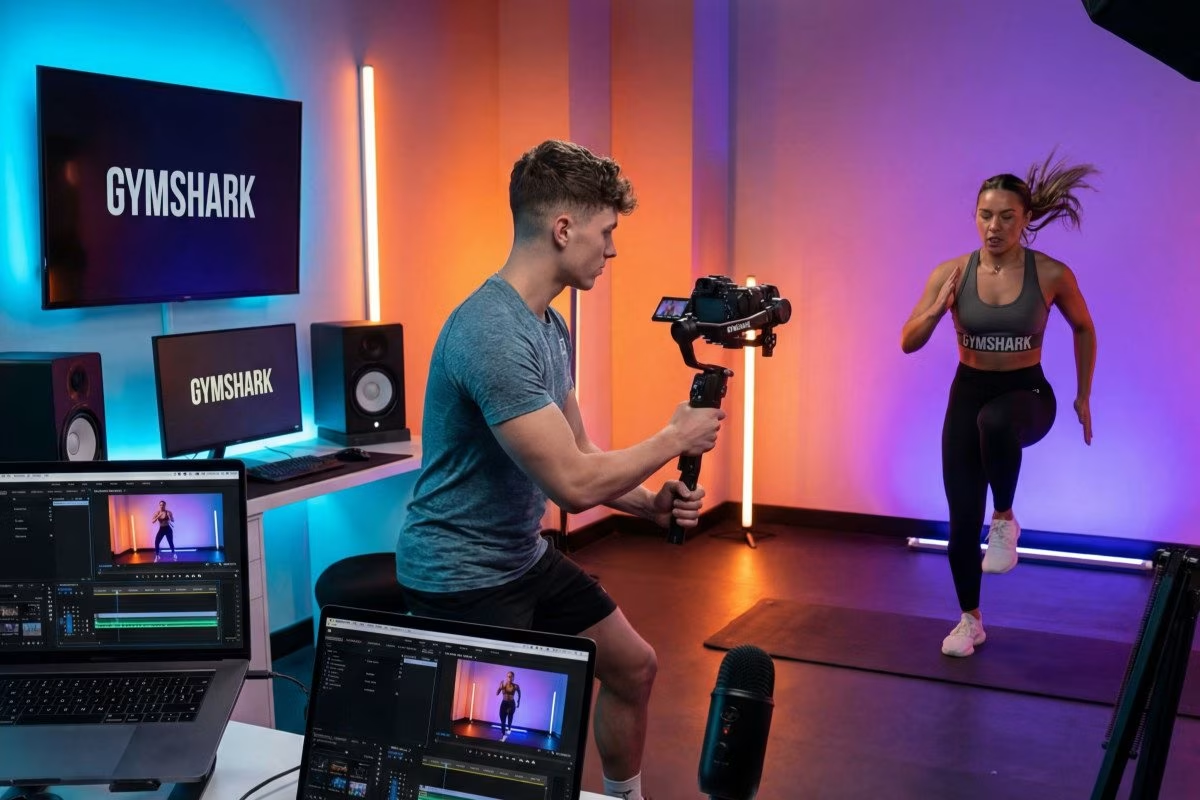
In a tumultuous turn of events within the competitive world of sportswear, Lewis Morgan, co-founder of the renowned fitness brand Gymshark, has launched legal proceedings against his former school friends and business partners, Reiss and Kristian Edgerton. The high-stakes dispute centres around his abrupt removal from Aybl, a burgeoning sportswear start-up founded by the trio in 2021. Morgan’s allegations paint a picture of a bitter fallout marked by accusations of shareholder manipulation and the undermining of personal relationships that began in their school days in Bromsgrove, Worcestershire.
Five years after the formation of Aybl, a rival to Gymshark, Morgan claims that he was unjustly forced out of the company, which he alleges occurred under “abusive circumstances.” The 33-year-old entrepreneur’s lawsuit, lodged in the High Court, asserts that he was removed following his refusal to relinquish a portion of his shares in a proposed initial public offering (IPO). Central to the legal contention are claims that Morgan was labeled a “bad leaver,” a calculated move allegedly aimed at devaluing his stake and undermining his position within the company.
The dispute began to escalate in earnest last August when Morgan resisted pressure from the Edgerton brothers to part with 10 per cent of his shares. This request was positioned as crucial to meeting a “sweet spot” of 30 per cent for a potential flotation of Aybl. The relationship between Morgan and the Edgertons reportedly soured further after Morgan relocated to Dubai with his family. This relocation quickly became ammunition in a conflict where the Edgertons accused him of prioritising financial interests over friendship.
In court documents, Morgan has recounted an incident where Reiss accused him of fugging off to Dubai and disregarding his responsibilities to Aybl. The brothers framed the situation as a form of conflict of interest, arguing that Morgan’s involvement in another company, Ownkind—centred on energy drinks and supplements—posed a direct competition to Aybl’s brand identity. The Edgertons assert that Morgan’s actions constituted a breach of both his duties as a board member and a shareholder agreement, leading to a suspension from access to Aybl’s data.
As tensions reached a breaking point this January, the Edgertons attempted to buy out Morgan’s stake in Aybl, valuing the company at £81.3 million with Morgan’s shares pegged at £15.6 million. Morgan dismissed the offer, contending that it substantially undervalued his stake and reflected a desire to expropriate his interest at the lowest possible price. The negotiations which followed revealed a marked deterioration in trust and camaraderie that had defined their earlier collaboration.
The backdrop of this dispute underscores a stark irony; the trio had once shared the same academic foundations at South Bromsgrove High, where their paths crossed and destinies intertwined. Morgan and Reiss, alongside Kristian Edgerton, shared formative experiences that led them to venture into the increasingly competitive landscape of sports fashion. Both Morgan and Ben Francis co-founded Gymshark in 2012, and with their initial success, they garnered a collective wealth which at one point made them prominent figures in The Sunday Times Young Rich List.
The legal confrontation has unfolded amidst a backdrop of larger questions regarding corporate governance, shareholding rights, and the ethical obligations that come with leadership in new enterprises. Following Morgan’s formal dismissal, a crucial board meeting took place, wherein the Edgertons and Chief Financial Officer Sir Robert Pound voted in favour of Morgan’s removal from both his director post and employment. Detailed claims from Morgan highlight that he was granted a mere 85 minutes’ notice prior to this pivotal meeting, an allegation that raises concerns about proper procedure and etiquette in business practices.
In a concerted effort to solidify their positions, the Edgertons have publicly defended their actions, asserting that Morgan’s exit was essential for protecting the integrity of Aybl as a business. Positioned as a regrettable necessity, their statement conveyed a commitment to act in the best interests of the company amidst what they term unfounded claims by Morgan. The juxtaposition of their perspectives—from long-time friends to adversaries in a courtroom—fascinates both the business community and the media, where the broader implications of failed partnerships often resonate deeply.
For his part, Morgan has categorically denied any misconduct related to his involvement with Ownkind, arguing that the allegations are unfounded and an attempt to diminish his rights as a shareholder and director. In legal statements, he has expressed a determination to seek declaratory relief, aiming to restore his position within Aybl, while reserving the right to claim damages should he be forced to sell his shares under contested market conditions.
This saga is emblematic of the challenges facing entrepreneurial ventures where friendships intersect with business interests. The idealism of founding a start-up often encounters the harsh realities of financial pressures, strategic disagreements, and the sheer unpredictability of the market. As this case unfolds in the High Court, it casts a spotlight on the intricate relationships that fuel the creation of brands like Aybl and Gymshark and reveals the potentially corrosive effects that capital and ambition can exert on personal connections.
While the outcome of this legal battle remains uncertain, it is likely to reverberate throughout the burgeoning sportswear industry, a sector that continues to expand rapidly, drawing in both emerging players and established giants. As the trial approaches, industry observers will watch closely to see not only the verdict on Lewis Morgan’s claims but also the broader implications for shareholder rights and the ethical practices that underpin new business ventures.
In the wake of these developments, the question arises: how will friendships endure when enmeshed in the complexities of business? For Morgan, Reiss, and Kristian, the answer may ultimately define not just their professional futures but also the personal bonds that brought them to this point. The intertwining of their lives has raised profound questions about loyalty, trust, and the cost of ambition in today’s entrepreneurial landscape, a narrative that, as it unfolds, is guaranteed to captivate audiences far beyond the confines of the courtroom.
Post Disclaimer
The following content has been published by Stockmark.IT. All information utilised in the creation of this communication has been gathered from publicly available sources that we consider reliable. Nevertheless, we cannot guarantee the accuracy or completeness of this communication.
This communication is intended solely for informational purposes and should not be construed as an offer, recommendation, solicitation, inducement, or invitation by or on behalf of the Company or any affiliates to engage in any investment activities. The opinions and views expressed by the authors are their own and do not necessarily reflect those of the Company, its affiliates, or any other third party.
The services and products mentioned in this communication may not be suitable for all recipients, by continuing to read this website and its content you agree to the terms of this disclaimer.
Related Posts


Previous Post
Next Post

