Now Reading: Taco Bell Withdraws Lettuce from US Outlets Following Cyclospora Parasite Outbreak
-
01
Taco Bell Withdraws Lettuce from US Outlets Following Cyclospora Parasite Outbreak
Taco Bell Withdraws Lettuce from US Outlets Following Cyclospora Parasite Outbreak
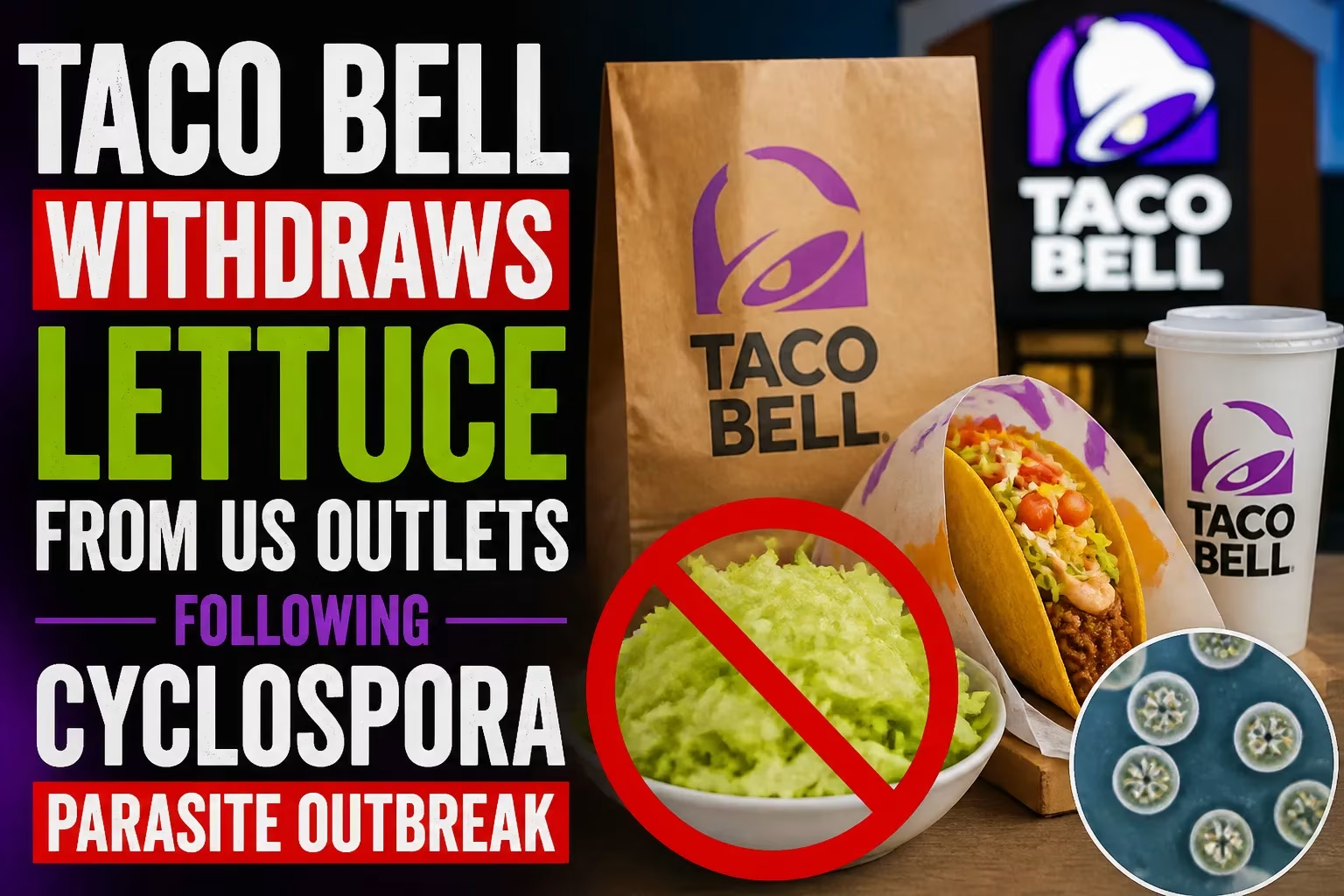
American fast-food operator Taco Bell has commenced the removal of lettuce from its menu across several states following regulatory investigations linking the product to an outbreak of cyclosporiasis, a parasitic infection causing severe gastrointestinal distress.
The chain confirmed to the BBC that the decision was implemented out of an abundance of caution after consultations with public health authorities. The outbreak has affected consumers across five states with documented exposure to Taco Bell establishments.
According to the Centers for Disease Control and Prevention, approximately 1,645 individuals have contracted cyclosporiasis, a parasitic infection transmitted through contaminated food or water supplies. The outbreak was initially detected on 13 May, with Michigan reporting the highest concentration of cases at more than 3,300 infections.
Whilst no fatalities have been recorded, the Food and Drug Administration reported that 94 individuals have required hospitalisation due to the severity of their infections. The FDA has issued a specific advisory warning consumers against consuming shredded iceberg lettuce from Mexican sources served at Taco Bell locations in Indiana, Kentucky, Michigan, Ohio and West Virginia.
Taco Bell stated that lettuce from an unspecified supplier would be removed indefinitely and substituted with alternative products. The company emphasised its view that public health constitutes a shared responsibility amongst restaurant operators, suppliers and regulatory authorities, despite the absence of an official advisory mandate.
US media outlets have identified the supplier in question as Taylor Farms, which operates facilities in Mexico. The FDA’s traceability investigation pointed to Mexican lettuce suppliers as the source of the contamination. Taylor Farms subsequently confirmed to the BBC that it was voluntarily withdrawing all iceberg lettuce sourced from central Mexico from the American market. The supplier acknowledged that FDA tracking procedures had identified one of its independent farms as the potential origin of the outbreak.
Cyclosporiasis presents diagnostic challenges due to its extended incubation period, with symptoms typically manifesting approximately two weeks following exposure. Clinical indicators include prolonged watery diarrhoea lasting several days, rapid weight loss and appetite suppression.
Steven Manderach, executive director of the Association of Food and Drug Officials, highlighted the substantial difficulties inherent in tracing parasitic contamination. He characterised the detection process as analogous to identifying a microscopic portion of a needle in a haystack, noting that recent reductions in federal health agency resources may have further complicated investigative efforts.
The incident underscores ongoing vulnerabilities within food supply chains and the complexities associated with cross-border agricultural product sourcing. The outbreak has raised questions regarding inspection protocols and the adequacy of current traceability systems for imported produce.
Post Disclaimer
The following content has been published by Stockmark.IT. All information utilised in the creation of this communication has been gathered from publicly available sources that we consider reliable. Nevertheless, we cannot guarantee the accuracy or completeness of this communication.
This communication is intended solely for informational purposes and should not be construed as an offer, recommendation, solicitation, inducement, or invitation by or on behalf of the Company or any affiliates to engage in any investment activities. The opinions and views expressed by the authors are their own and do not necessarily reflect those of the Company, its affiliates, or any other third party.
The services and products mentioned in this communication may not be suitable for all recipients, by continuing to read this website and its content you agree to the terms of this disclaimer.
Related Posts



Previous Post
Next Post