
Now Reading: Coda Minerals Kicks Off Major Work Programmes at Elizabeth Creek Copper Project
-
01
Coda Minerals Kicks Off Major Work Programmes at Elizabeth Creek Copper Project
Coda Minerals Kicks Off Major Work Programmes at Elizabeth Creek Copper Project
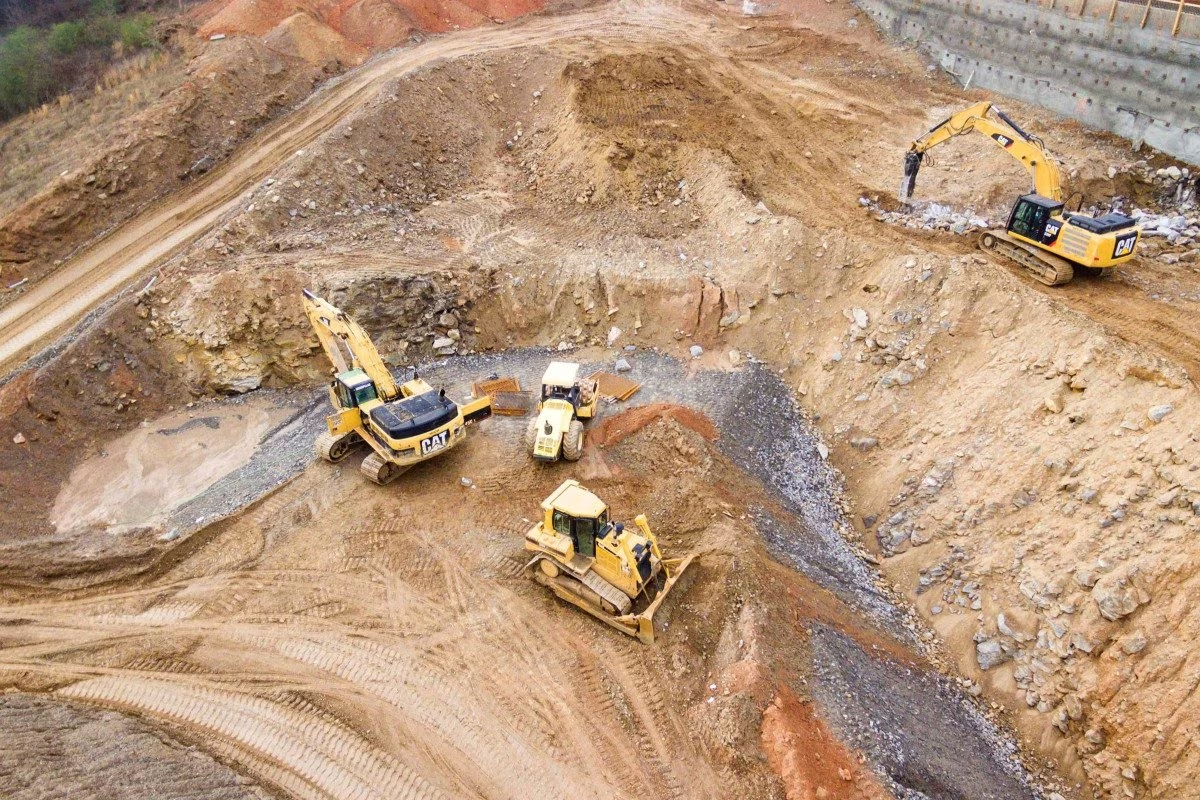
Coda Minerals has moved into a pivotal phase at its Elizabeth Creek copper project in South Australia, with a series of on-site and technical workstreams now under way as the company advances towards a pre-feasibility study, or PFS.
For investors, this matters because Elizabeth Creek is no longer being framed simply as an exploration story. The company is now focused on the more demanding task of project development: tightening resource confidence, progressing mine planning, testing metallurgy, establishing water supply options and building the data set required for future approvals.
That transition is often where mining projects begin to separate into two groups: those with enough scale, quality and management discipline to move towards development, and those that remain speculative. Coda’s message is that Elizabeth Creek belongs firmly in the former category.
Table of Contents
- Why Elizabeth Creek stands out
- From exploration story to development pathway
- Why the PFS is such a critical catalyst
- The new work programmes under way
- A possible exploration upside within the development programme
- The de-risking argument behind the Coda investment case
- What news flow could arrive before the PFS
- How investors should assess this stage of the project
- Outlook
- FAQ
Why Elizabeth Creek stands out
Elizabeth Creek is located around six hours north of Adelaide and sits in one of Australia’s most established mining jurisdictions. Its position is particularly notable because it lies adjacent to BHP’s Carrapateena mine and south of BHP’s Oak Dam West project.
Location is not a trivial detail in mining. A project’s address can affect everything from infrastructure access and labour availability to permitting confidence and strategic relevance. In Elizabeth Creek’s case, proximity to major BHP operations reinforces the view that this is a serious copper district rather than a remote greenfields concept.
Coda is targeting a commodity mix that also aligns well with long-term market themes. The project is centred on copper and silver, with accessory cobalt. Copper remains the dominant investment case, particularly given the market’s increasing focus on electrification, grid expansion and long-term supply constraints.
The company has already completed a scoping study and argues that the economics outlined at that stage were conservative relative to current market conditions. Management highlighted that the study used a copper price assumption of roughly 10,500, materially below the stronger spot pricing seen more recently. While price strength can fluctuate, the gap between study assumptions and prevailing market prices is one reason the project continues to attract attention.
From exploration story to development pathway
Coda’s current investment case is built less around headline-grabbing drill intercepts and more around systematic de-risking. That distinction is important.
In the early exploration phase, companies often generate market interest through frequent drilling updates and discovery news flow. Once a resource has been defined, however, the work becomes more technical and, in some respects, less glamorous. Yet it is this stage that often creates the most durable value.
Elizabeth Creek has already moved beyond the earliest stages of resource definition. Coda says the project sits in the higher-confidence indicated category and that a mineral resource estimate update is expected shortly. Recent drilling, including a substantial campaign completed over several months, is feeding into the next phase of engineering and technical studies.
The company has now established the project steering structures, budget framework and execution plan needed to push the PFS forward. For investors, the practical significance is clear: Coda is trying to convert a promising copper deposit into a bankable development proposition.
Why the PFS is such a critical catalyst
Among mining studies, the PFS often carries particular weight. A scoping study can demonstrate conceptual potential, but a PFS is generally the point at which a project begins to take real shape.
At this stage, assumptions are tested with greater rigour. Mine design becomes more detailed. Processing routes are evaluated more deeply. Infrastructure requirements, operating costs, capital costs and development sequencing all receive more disciplined treatment.
That is why management described the PFS as the stage where a company starts to have a “real project”. It is also the period when the company has significant ability to influence long-term outcomes at a relatively manageable cost. Choices made here can affect economics, permitting timelines, financing options and eventual mine design.
Coda is targeting delivery of the PFS towards the end of 2026, while acknowledging that some slippage into the first quarter of 2027 is possible. That timetable underlines both the scale of the work and the need for realism. In mining, overly aggressive schedules can create more problems than they solve.
For shareholders, the key point is that the final PFS release is unlikely to be the only important milestone. Much of the information underpinning it is expected to emerge progressively over the coming months in the form of technical updates, resource work and field activity.
The new work programmes under way
The latest operational push comprises several major workstreams. While these may not have the immediacy of a discovery hole, they are central to proving that Elizabeth Creek can support a viable mining operation.
1. Water drilling
Water is the most important immediate field programme. Every mine needs a reliable water supply, and securing that supply is not only an operational issue but also an approvals issue.
Coda described Elizabeth Creek as a medium-scale project with relatively modest water requirements, and management believes there is ample water in the broader area. Even so, confidence must be built through drilling and testing.
The current programme is designed to establish production bores and monitoring bores and to improve understanding of the project’s water balance. This is not routine box-ticking. Water drilling starts generating the data needed for future regulatory submissions, and management noted that two years of water data are required before final mining approvals can be secured.
In other words, this work does more than identify a water source. It starts the regulatory clock.
The drilling itself is also more technically involved than some might assume. Hydrogeological drilling requires the right expertise, the right positioning and detailed interpretation. If results are not as expected, further exploration or adjustment may be needed. Coda’s position is that the selected targets are appropriate, but the company is approaching the work with measured confidence rather than certainty.
2. Environmental and ecology surveys
Environmental fieldwork is another important strand of the PFS programme. Ecology surveys form part of the baseline data package that underpins future approvals and environmental planning.
Although such work can seem less exciting than drilling or metallurgical breakthroughs, it is essential for any project seeking to move towards development. A mining company that waits too long to build environmental baseline data can create delays later in the permitting process. Coda appears intent on avoiding that trap.
3. LiDAR and surface mapping
The company is also progressing detailed surface mapping through LiDAR and aerial survey work. This type of high-resolution surface data helps refine project design, site layout and engineering assumptions.
At the PFS stage, the cumulative effect of better topographic and surface information can be meaningful. It supports more accurate planning for infrastructure placement, access routes and broader development footprints.
4. Metallurgical work
One of the major technical areas to watch is the company’s chloride leaching metallurgical programme. Metallurgy can have a profound effect on project economics because recovery rates, processing complexity and reagent requirements all feed directly into revenue and cost assumptions.
Coda signalled that this met work is a “big ticket” item as Elizabeth Creek advances through the PFS. Investors should pay close attention to these results because metallurgy often becomes one of the defining differentiators between an attractive development story and a difficult one.
5. Mine planning and resource updates
The project is also moving forward on mine plan work and a revised mineral resource estimate. Management indicated that a JORC resource update is expected in the near term, reflecting recent drilling and improved geological confidence.
This is another key de-risking step. A stronger, more refined resource base can support improved mine schedules, better reserve conversion potential and more confidence in the assumptions that feed into the PFS.
A possible exploration upside within the development programme
Although Coda is now firmly in development mode, there is still some exploration upside embedded in the current fieldwork.
One of the planned water holes is expected to test an area that may host additional mineralisation. Management was careful not to overstate the opportunity, noting that it would not transform the project on its own. Even so, it could provide a useful addition in an area already associated with some of the stronger grades in the underground deposit.
That is a helpful reminder that advanced projects do not stop evolving geologically once they enter study phases. Incremental additions near existing resources can still improve mine design and overall value, particularly if they occur in accessible or higher-grade zones.
The de-risking argument behind the Coda investment case
Perhaps the clearest theme running through Coda’s current positioning is that the market may still be valuing the company like a high-risk junior explorer, even though the business is now progressing through a more advanced and structured de-risking pathway.
This is a familiar pattern in the junior mining sector. Companies can remain trapped in speculative valuations until they begin to demonstrate, through studies and technical execution, that key project risks are being reduced one by one.
For Elizabeth Creek, those risk areas include:
- Resource confidence through updated geological modelling and estimation
- Metallurgical confidence via chloride leaching test work
- Mine design confidence through formal planning and engineering studies
- Water security through hydrogeological drilling and monitoring
- Permitting readiness through environmental baseline studies and approvals-related datasets
Coda argues that this is a well-trodden route. Management pointed to several peers that have followed a similar development pathway, including New World Resources, Rex, Danakali and KGL, the latter recently securing a major silver streaming deal as it advanced towards production. The implication is that Elizabeth Creek is not following an untested playbook. Rather, it is moving through a familiar sequence of milestones that investors in the resources sector know well.
“Got a real project in a real place” was how chief executive Chris Stevens summarised the company’s position, underscoring the practical, execution-focused tone of the current phase.
What news flow could arrive before the PFS
Although the PFS is the headline end point, investors should not expect silence between now and its release. Coda outlined a fairly active pipeline of interim updates.
The likely areas of news flow include:
- Commencement and progress of water drilling
- Results from the exploration component attached to one of the water holes
- A near-term mineral resource estimate update
- Advances in mine plan work
- Progressive results from chloride leaching metallurgical studies
- Further field and approvals-related workstreams linked to the PFS
That sequence matters because markets often reward visible progress when it reduces uncertainty. Even if none of these updates individually carries the impact of a final study, together they can help shift sentiment from speculation to execution.
How investors should assess this stage of the project
For investors assessing Coda Minerals today, the central question is not simply whether copper prices remain strong. It is whether Elizabeth Creek can continue to advance in a disciplined way through the technical, environmental and regulatory hurdles that stand between resource definition and eventual mine development.
On that front, several aspects of the story are noteworthy:
- Jurisdiction and location are favourable, with the project situated in a recognised South Australian mining province.
- Commodity exposure is aligned with long-term structural demand themes, particularly in copper.
- Scoping study economics were based on pricing assumptions below more recent spot levels.
- The current work programme is focused on practical de-risking rather than promotional activity.
- News flow is expected to remain active as individual components of the PFS are advanced.
At the same time, mining development remains inherently risky. Water work must deliver usable outcomes. Metallurgy must prove robust. Resource updates need to support mine planning. Timelines can slip, and studies can identify new technical challenges. None of that is unusual, but it is part of the reality investors need to keep in mind.
Still, the broader narrative is clear. Coda is trying to move Elizabeth Creek from an interesting copper project to a more fully defined development asset. The current phase may look less dramatic than an exploration campaign, but it is arguably more important.
Outlook
Coda Minerals has entered a period where delivery matters more than ambition. The company has laid out a coherent programme covering water, resource work, metallurgy, environmental studies and mine planning, all aimed at delivering a PFS that could become the major catalyst in the project’s life cycle.
If management executes effectively, Elizabeth Creek should emerge from this phase with materially lower technical and development risk, a stronger data set for approvals and a clearer picture of long-term value.
For a company that believes it is still being valued like a high-risk junior, that progression could prove significant. The next six to nine months are likely to be less about headline excitement and more about whether Coda can do the detailed work required to justify a re-rating.
FAQ
What is the Elizabeth Creek project?
Elizabeth Creek is Coda Minerals’ copper project in South Australia. It is located roughly six hours north of Adelaide, close to BHP’s Carrapateena mine and Oak Dam West project. The project is focused on copper and silver, with accessory cobalt.
Why is the PFS important for Coda Minerals?
The pre-feasibility study is often the point where a mining project becomes significantly more defined. It applies more rigorous technical and economic analysis than a scoping study and can provide a clearer basis for valuation, mine planning, permitting strategy and future financing discussions.
When is the Elizabeth Creek PFS expected?
Coda is aiming to deliver the PFS towards the end of 2026, with some possibility of timing moving into the first quarter of 2027.
What are the main work programmes currently under way?
The key programmes include water drilling, ecology surveys, LiDAR and aerial mapping, mine planning, a mineral resource estimate update and chloride leaching metallurgical test work.
Why is water drilling such a major milestone?
Water is essential for mine operations, but it is also critical for the approvals process. Coda said that two years of water data are needed before full final mining approvals can be secured, so this drilling starts building a dataset that supports both project design and regulatory progress.
What news could investors expect before the PFS is released?
Likely milestones include updates on water drilling, a mineral resource estimate update, mine planning progress, metallurgical test work and other PFS-related field and technical activities. These should provide a steady flow of de-risking milestones ahead of the final study.
Post Disclaimer
The following content has been published by Stockmark.IT. All information utilised in the creation of this communication has been gathered from publicly available sources that we consider reliable. Nevertheless, we cannot guarantee the accuracy or completeness of this communication.
This communication is intended solely for informational purposes and should not be construed as an offer, recommendation, solicitation, inducement, or invitation by or on behalf of the Company or any affiliates to engage in any investment activities. The opinions and views expressed by the authors are their own and do not necessarily reflect those of the Company, its affiliates, or any other third party.
The services and products mentioned in this communication may not be suitable for all recipients, by continuing to read this website and its content you agree to the terms of this disclaimer.

Previous Post
Next Post

